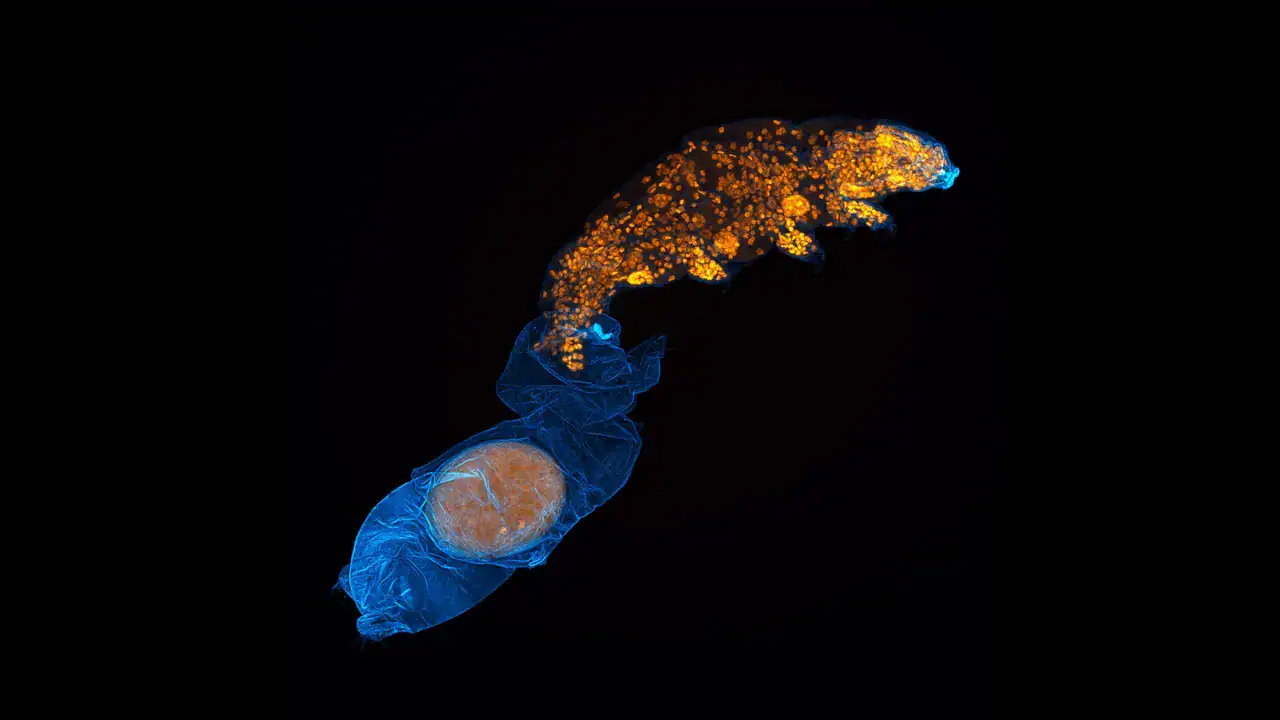
Hypsibius exemplaris was captured shedding its outer shell while laying an egg on the discarded skin. Credit: Dr. Gonzalo Quiroga Artigas/Nikon Small World A striking microscopic photograph captures a tardigrade in the middle of its molt, slipping off its old skin while simultaneously filling it with a fresh egg. Captured by biologist Gonzalo Quiroga-Artigas, the image placed 12th in the Nikon Small World 2026 competition. However, the biology on display is far more compelling than the praise. This microscopic mother is reusing her discarded and outgrown outer shell as a protective nursery. In fact, while this species of tardigrade leaves its egg-filled skin behind, a handful of related tardigrades take the strategy a step further: They drag their makeshift nurseries with them as they walk. To appreciate how strange this breeding strategy is, it helps to take a close look at the microscopic animal carrying it out. Built to survive H. exemplaris staggering with visible algae in its digestive tract. Fun fact: In 2007, dehydrated tardigrades became the first animals known to survive direct exposure to the vacuum and cosmic radiation of open space during a 10-day European Space Agency mission, reviving on Earth after a simple drop of water. Credit: Wikimedia Commons Tardigrades, often called water bears or moss piglets, are eight-legged microanimals famous for surviving conditions that would instantly kill almost anything else. Less than half a millimeter long, they can withstand boiling heat, sub-zero temperatures, the crushing pressures of the deep sea, and even the vacuum of space by entering a dehydrated state of suspended animation. Like arthropods, they are enclosed in a rigid outer layer called the cuticle that they must periodically shed to grow. In species such as the photographed H. exemplaris, reproduction is directly synchronized with this molt. As the mother emerges from her old cuticle, she deposits smooth-shelled eggs directly into the empty shell, called the exuvium. According to a 2021 study on H. exemplaris, females can leave between one and a dozen eggs inside the discarded skin. The embryos develop safely inside until they hatch and exit through the same opening their mother used to escape. Turning dead skin into an egg case provides delicate embryos with a vital physical barrier against predators and environmental changes. Researchers also suspect that the casing helps prevent the eggs from drying out or washing away, although those benefits have not yet been demonstrated experimentally. ×Thank you! One more thing… Please check your inbox and confirm your subscription. “Therefore, the exuvium may provide an additional layer of physical protection for developing embryos,” Quiroga-Artigas told LiveScience. The mother does not need a father Second image of a tardigrade by Dr. Quiroga-Artigas shown from below. Credit: Dr. Gonzalo Quiroga Artigas/Nikon Small World There’s another twist to the already amazing reproductive biology of tardigrades: the animal in the photo didn’t need a mate to produce that egg. H. exemplaris reproduces through parthenogenesis, in which females produce offspring from unfertilized eggs. A single female can start a new generation on her own, without the need for males. In fact, every documented specimen studied since the formal description of the species consists exclusively of parthenogenetic females. No male has ever been documented for the species. But an egg typically contains only half of the genetic material needed to form a new animal. The other half comes from sperm in most animals. So how does a tardigrade cope without it? A 2026 study published in the journal Genetics revealed that H. exemplaris takes a shortcut during egg formation, allowing its eggs to retain a full set of chromosomes. The process also helps preserve the genetic diversity already present in the mother, even without mating. However, not all tardigrades have given up sex. A 2021 review describes some remarkably elaborate courtship rituals between sexually reproducing species. In Isohypsibius dastychi, mating can last up to an hour, with males releasing sperm repeatedly while females molt. In another species, scientists have even observed nine males gathered around a single female. Some tardigrades use discarded skin during mating, while others lay their eggs directly into the environment. Some mothers bring their nurseries with them. Then comes perhaps the strangest variation of all. According to a 2024 evolutionary review by Roberto Guidetti of the University of Modena and Reggio Emilia, females of several groups of freshwater tardigrades, including Pseudobiotus, Isohypsibius, and Borealibius, keep sloughed, egg-filled skin attached to their bodies. She hooks the opening of the shed skin onto her hind legs, leaving her six front legs free to walk on as she drags the egg-filled carcass behind her. Scheme of tardigrade sexual reproduction in species such as Pseudobiotus, Isohypsibius and Borealibius. Credit: ZME Science. Guidetti considers this an unusual form of parental care among tardigrades. Carrying the eggs can allow the mother to keep them in conditions favorable enough for their own survival. Scientists still don’t know precisely when it releases the package for its young to emerge. The H. exemplaris photographed is not one of these egg-bearing mothers. But its extraordinary image offers a glimpse of the same evolutionary ingenuity. For some water bears, an old skin is not a waste. It is the first home that their descendants will know. Dr. Quiroga-Artigas also earned an Honorable Mention in Nikon’s Small World in Motion competition for a video that captures another surprisingly intimate moment. In the images, a tardigrade with eggs makes contact with another individual, which quickly defecates.