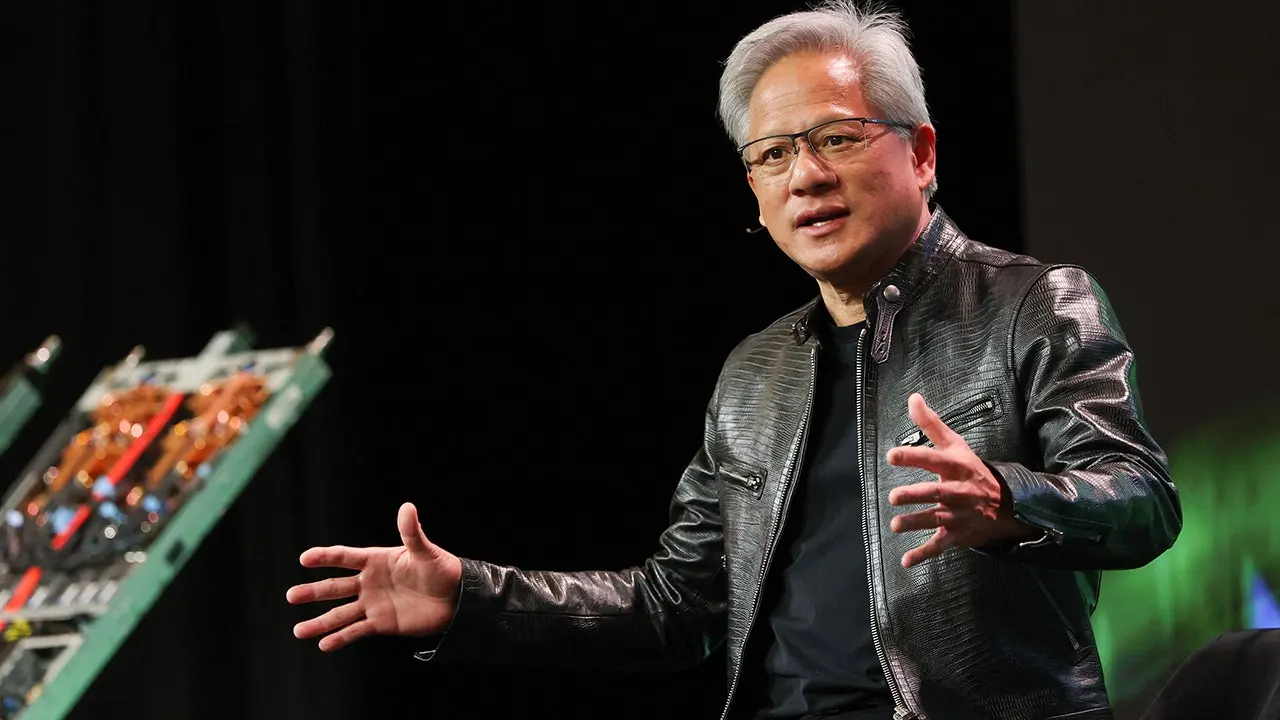
NEWYou can now listen to Fox News articles! The US AI industry is about to discover how much its funding depended on Jensen Huang’s word. Huang has said he would be willing to return to Nvidia. On Tuesday, board Chairman Harvey Jones said the board has no intention of reinstating him as CEO. For independent companies raising money now, the question is whether Nvidia will still commit early enough to attract other investors to its rounds. According to PitchBook, the rounds Nvidia joined represented 27.2% of the value of global venture deals as of mid-November. That includes each investor’s contribution, and a handful of very large rounds drove much of the total. Nvidia separately reported $99 billion in capital expenditures as of July 26. That was the value of his holdings at that time. We don’t know how much Nvidia invested in independent open-model developers or how often it led its rounds. Nvidia CEO Jensen Huang speaks at the Dreamforce 2026 summit in San Francisco, California, on September 15, 2026. Reflection AI shows what Nvidia could do when it decided to lead. Huang reportedly committed Nvidia to half of Reflection’s initial $1 billion goal and urged other investors to join. The round grew to $2 billion, with Nvidia contributing around $800 million. It was an unusually large deal. The sequence is important: Huang committed Nvidia’s money first and then brought in other investors. Nvidia was willing to sell chips to Reflection, and that type of financing deserves scrutiny. It also shows why a lead investor’s decision can shape a round. Nvidia still has the means to invest. On Tuesday it reported $115.8 billion in quarterly revenue, up 103% from a year earlier. Its board of directors has said it expects operations, customer commitments and product roadmap to continue without interruption. Interim CEO Colette Kress said the company is looking at future investments, commitments and guarantees. It also said Nvidia had made no changes to the financing terms of its existing agreements with specialized cloud providers. I hope Nvidia is more selective when it comes to taking new risks. The question for founders and co-investors is which deals it will continue to lead and how quickly it will decide. JENSEN HUANG’S NVIDIA DEBACLE REVEALS AMERICA’S REAL PROBLEM: NO SPECIALIZED BUILDERS As an AI founder and investor, I see how quickly a delay can become a problem for a smaller company. Microsoft, Meta and Google can finance much of their own expansion. An independent lab may have paying customers and still need to raise money to train its next model. A specialized cloud provider has to finance the chips before it can sell the computing time. If the main investor waits, others can wait too. The company still has to decide whether it can afford to reserve computing capacity or keep the people it hired to do the job. GPU racks with a closed-loop liquid cooling system are seen inside an operational Microsoft data center in Indonesia on February 4, 2026. (Yasuyoshi Chiba/AFP via Getty Images) China is already competing for the customers those companies could serve. The Lowy Institute counted nearly 1.8 billion downloads from Chinese models on Hugging Face in the third quarter, compared to 500 million from American models. Huawei shows its customers how to run Alibaba’s Qwen on its Ascend chips. As more developers use Qwen, Huawei will have the opportunity to sell them the systems that run it. Beijing’s AI action plan promotes both open source cooperation and overseas computing infrastructure. That combination could become the next chapter of China’s Digital Silk Road. BEYOND KILLER ROBOTS: CHINA’S REAL AI THREAT TO THE US IS ALREADY HERE, EXPERTS WARN Governments that want to run AI on their own infrastructure should have a competitive US option in models and hardware. That means Nvidia and AMD, custom accelerators from Broadcom, and systems from specialists like Cerebras and d-Matrix. Once a government buys the equipment, adapts its software, and trains its engineers, switching suppliers is costly. Americans may disagree over which chips Nvidia should be allowed to sell to China. Weakening Nvidia or the American companies that build on its technology would give Beijing an advantage while other countries make those decisions. Nvidia should continue supporting independent AI companies. Kress and Jones should inform founders and co-investors who can approve pending deals, when decisions will be made, and whether Nvidia intends to provide follow-on financing. Institutional investors, sovereign wealth funds and independent venture firms should start organizing their own rounds. Elon Musk, who welcomed the idea of hiring Huang, could rally investors for one such partnership. It would need firm capital commitments and freedom to make investment decisions independently of xAI and its other companies. If we make a model’s weights public, Beijing will be able to obtain them too. Our allies also need American models that they can run on their own infrastructure, with their own data, and under their own rules. If we leave that market to China, we will make it easier for Beijing to sell the systems those countries will depend on for years. Before taxpayers guarantee funding for an open model project, an independent review should establish what American security interest it serves and whether the benefits of releasing the weights justify the risks. CHINA COULD EXPLOIT US TECHNOLOGY TO THREATEN US FORCES, CONGRESSIVE WATCH LEADERS WARN They believe private investors should decide which companies are worth their money. I would make a small exception when a documented funding shortfall threatens a viable project vital to national security. The Treasury should call on private investors this week to find out which projects are at risk and how much private capital it is willing to move. It would set an initial goal of $100 billion in combined public and private commitments. Congress should act urgently to authorize a temporary federal credit guarantee under bipartisan oversight, tapping the Pentagon’s Office of Strategic Capital. Congress should separately limit taxpayer exposure and set an expiration date. An independent committee should apply published criteria, require challenges in case of conflicts, and approve guarantees only when private investors hold their own capital at risk. CLICK HERE TO DOWNLOAD THE FOX NEWS APP If Nvidia and private investors fill the gaps, the guarantees may not be used. It could take months to know what deals will go ahead. A lab can lose equipment that took years to assemble in weeks. Nvidia can give founders answers now, and Treasury can rally investors while there are still deals to be made. Disclosure: The author has an indirect investment in Reflection AI through her participation as a limited partner in a fund managed by 1789 Capital. Noosheen Hashemi is a Silicon Valley entrepreneur, former Oracle executive, and founder and CEO of January AI, which uses artificial intelligence to transform the way people understand and manage their health.