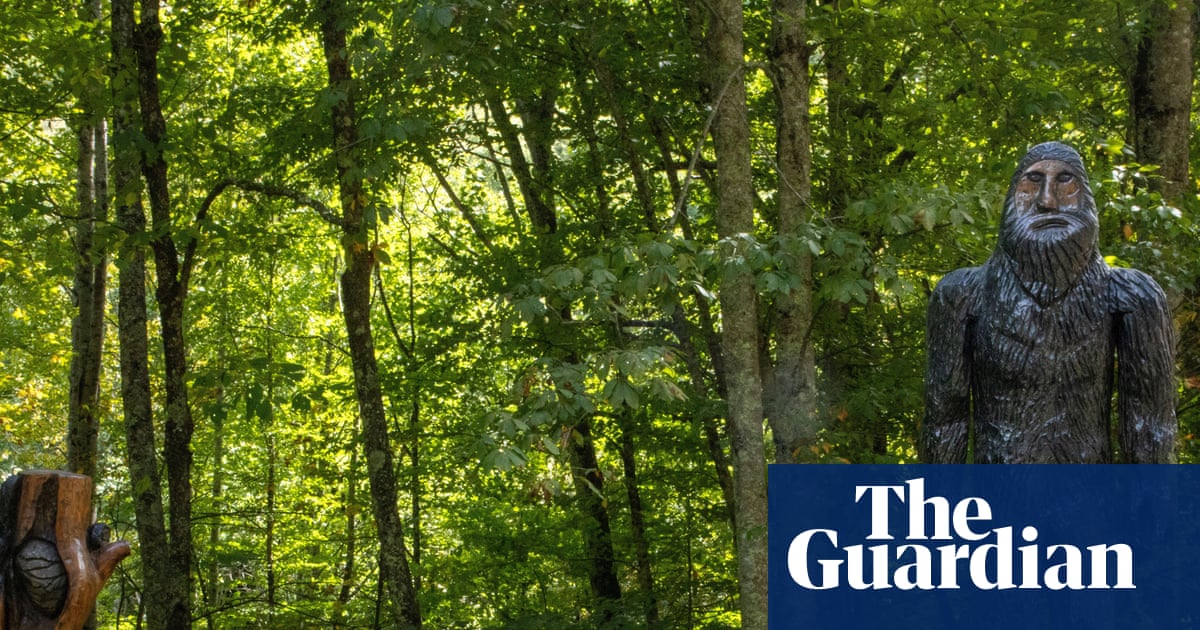
Bigfoot has quietly reappeared. Well, not Sasquatch directly, but new files on the cryptid. In a public file, the US Forest Service recently added reports of suspicious encounters with Bigfoot – or his remains in Montana and Oregon. A recently published report from 1982 showed how a wildlife biologist investigated peculiar tracks in northeastern Oregon. Additional documents also included a 2003 Montana newspaper story about a sighting of Bigfoot footprints and a testimony about the history of a creek area. in Montana, where people saw what they thought was “a very large bear, except that bears don’t walk on their hind legs only for short distances.” The recent release of the files by the U.S. Forest Service comes months after residents in rural Ontario, Canada, reported encounters with massive figures matching Bigfoot’s description. Collectively, they add to a long history of suspicious Bigfoot sightings or marks of the bipedal ape whose existence has not been confirmed by science. The Bigfoot Mapping Project contains more than 16,000 reports on the cryptid, a term that refers to an animal or creature whose existence has not been proven. Josh Redstone, a philosophy professor at Carleton University, previously told The Guardian that Bigfoot is a prime example of how fascinating the unverified can be to humans. “For people who believe in Sasquatch, there is excitement around the possibility of discovering something new,” Redstone said. In the 1982 report, biologist Rodney Johnson investigated tracks at three locations in the Umatilla National Forest in northeastern Oregon. To determine their origin, Johnson (or a fellow researcher) made plaster casts of two of the footprints. Johnson gave eight reasons why he did not believe the tracks belonged to Sasquatch, including: “The pitch of the tracks did not change with the slope.” “The footprints at both sites were not all the way to the ‘bottom’ of the mud. The little toes lack a defined ‘pad’ on the tips, as would be expected.” Still, Johnson did not completely rule out the Bigfoot theory. “If the prints were fake, someone went to a lot of trouble and detail,” Johnson wrote. “The ‘footprint’ marks on the foot would have to be very difficult to duplicate. They look very natural. I would almost suspect that a cast made from a real foot would have had to be used to make the ‘fake’ feet. However, if this were the case, the other wrinkles on the foot should have shown.” In a subsequent Forest Service report, the investigator stated that the tracks “were a very clever attempt to perpetrate a hoax.” “Confident that this memo will be sufficient to close this ‘Bigfoot’ case,” the report said. That case could have been closed, but there were others. In novel-like 1980 testimony, Leo Kinney in Montana wrote: “Now, to tell some of the stories he and three others went into the woods to recover a moose carcass, he wrote. But he said that instead they saw “another type of creature that walked on its hind legs and that, although [sic] There were no actual sightings, footprints, a strong odor, and a growl were observed.” After determining that the creature had supposedly grabbed the moose and dragged it, “we held a conference and decided that we were not particularly eager to reach whatever it was and although [sic] We didn’t confess it at the time, in later conversations we discovered that we all had a very uncomfortable feeling and could feel chills running down our spines.” The journalist who produced the Clark Fork Valley Press story in 2003 wrote that a group in Montana found hundreds of “strange footprints.” “I didn’t believe it until I saw the footprints,” one woman said. Residents in rural Ontario reported in June seeing two creatures rummaging through trash. “One big, one not so big,” one story stated, “Cinnamon was prominent on the smaller one.” Everyone who believes they have seen a Bigfoot trail submits a report to the Bigfoot Mapping Project.