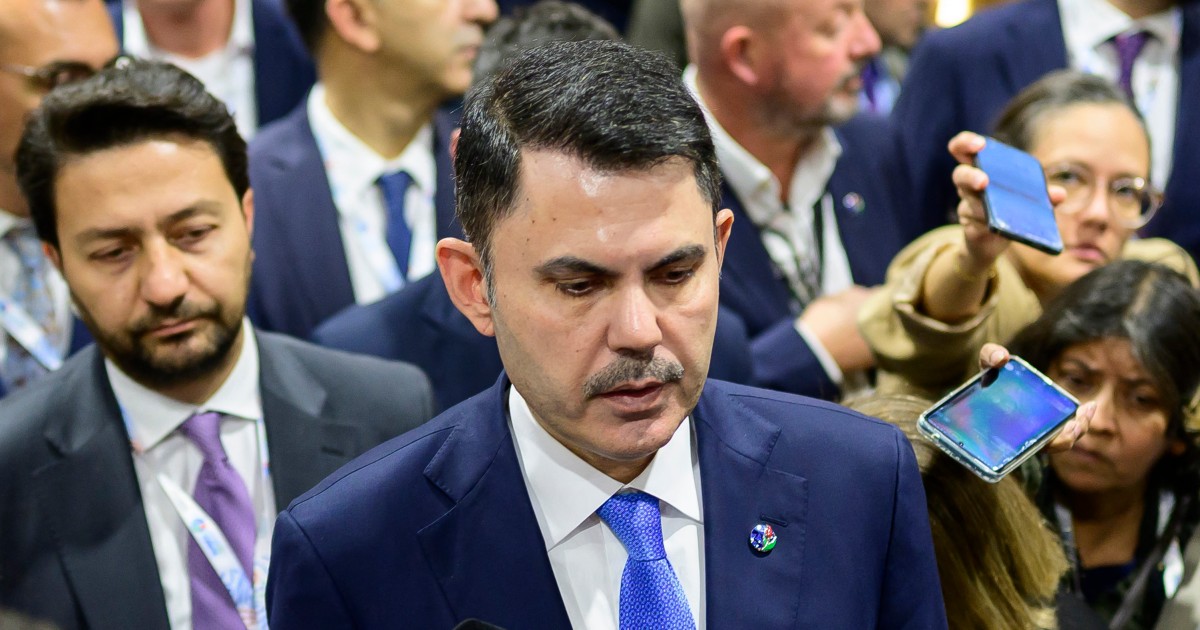
International climate talks in Turkey collapsed on Sunday after the European Union and other nations rejected a draft agreement that had removed all references to fossil fuels. Negotiations in the Mediterranean resort city of Antalya collapsed two days after the United Nations COP31 conference ended, after delegates from 196 countries and the European Union struggled to agree new pledges for climate action and how to deliver on previous ones. COP31 President Murat Kurum said on Sunday there would be no new draft climate agreement after a fourth draft was rejected. “There is nothing to do. We did everything we could,” said Kurum, who is the environment minister of Türkiye, the host nation. “We will not carry out any work on a new text in an environment where there is no consensus.” He later added that he wanted a “much stronger outcome” from the summit. Chris Bowen, COP31 negotiations chair, told reporters there were “insurmountable red lines” in the discussions. “The situation that came to this COP was the most complicated and tense geopolitical environment in living memory,” the Australian minister said. “Things that were manageable in the past, in previous COPs like the last two, where people wanted certain words mentioned but didn’t understand them, this time became a red line,” Bowen added. The latest draft of the agreement, published on Sunday, set out proposed measures for countries to accelerate climate action, but the 12-page document drew immediate criticism for failing to mention a shift away from fossil fuels, a key demand of the EU and other nations. Irish minister Darragh O’Brien, representing the EU in Antalya, said the bloc “firmly opposes” the deal, which he called “greenwashing.” “These decisions are nowhere near the level of ambition needed to address climate change,” O’Brien said. “It is inconceivable that we have a climate pact that does not mention fossil fuels.” Panama also rejected the deal, saying it did not go far enough, as did the Marshall Islands, a lowland Pacific nation facing an existential threat from rising sea levels. Kate Hughes, spokesperson for the UK delegation, called the draft text the “lowest common denominator.” All countries had to agree on the text for it to be approved. The talks were the longest in COP history, overcoming the delay in the COP25 negotiations in Madrid. The summit began on November 9. A week later a first draft was circulated that mentioned “fossil fuels” or “fossil fuels” six times. But a second draft, published on Thursday, removed all references, to the anger of many countries. The conference officially ended on Friday without an agreement. Members have continued talks in an attempt to find a resolution, but a fourth draft released Sunday still does not mention fossil fuels. Countries including Saudi Arabia, Russia and India have refused to include any reference to the words in the text, amid concerns that phasing out fossil fuels, critical to their economies, could pose a financial risk. The United States, one of the largest emitters of greenhouse gases, is officially absent from the conference, having withdrawn from a series of international climate commitments under President Donald Trump. by “recalling the UAE Consensus in its entirety”, a reference to COP28 in the UAE, where countries first agreed to a “transition away” from fossil fuels in energy systems. Panama’s Environment Minister Juan Carlos Navarro said the world was “being held hostage by the oil mafia.” “We love oilmen,” he said at a news conference Wednesday. “We can’t live without them, and they are so smart that they have convinced us that they are doing this for our own good.” Power Shift Africa’s Mohamed Adow called COP31 “the worst in history.” “The collapse of climate talks at COP31 in Antalya should be a wake-up call to the world,” he wrote in a statement. “Rich nations and polluting governments can no longer come empty-handed and wait for a carefully worded declaration to set them free.” United Nations Secretary-General António Guterres said he was “deeply disappointed that COP31 ended without consensus on an overall outcome.” “But this setback does not change the facts,” he posted on X. “There may be no consensus in the negotiating room. There is no ambiguity in science.” As warming exceeds 1.5 C, the impacts of climate change, including extreme heat and other weather events, are expected to increase significantly. As talks break down, Kurum could choose to call a follow-up meeting or delay decisions until next year’s conference, hosted in Ethiopia. Talks last failed at COP6 in The Hague, Netherlands, in 2000.