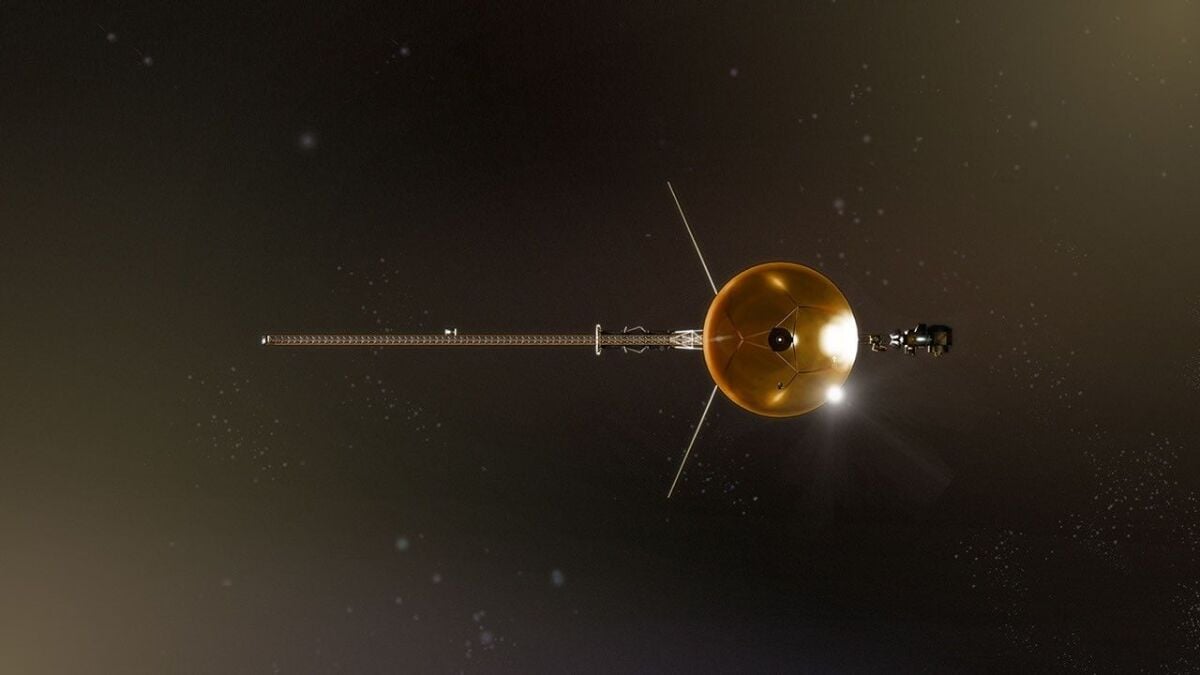
While Voyager 1 passed the one light-day distance milestone, the 49-year-old probe hadn’t actually sent back any scientific or engineering data for days. The problem began on November 14 and has not abated. Voyager 1 still sends a steady radio signal to Earth, telling engineers that the spacecraft is alive and its antenna is still pointed at Earth. But the signal contains no information about the state of the probe or what its instruments are measuring, and engineers still don’t know why. Voyager 1 crossed the milestone at 5:16 a.m. ET on Nov. 18, about 16.1 billion miles away, according to NASA. No other man-made object has come this far. Because the probe’s radio signal takes a full day to cross space, the team didn’t receive news until 5:16 a.m. ET on Nov. 19, when a ground antenna near Madrid picked it up. NASA celebrated the achievement Thursday with an hour-long celebration at its Jet Propulsion Laboratory in Southern California that may have overshadowed the problem. Panelists shared memories of the mission, the agency played a video of fans around the world, and astronaut Jessica Watkins aboard the International Space Station provided a recorded tribute. The presenter covered the data interruption in two sentences before moving on to questions. Officials delved into the current condition of the spacecraft only after a reporter asked how it was doing. “We have an anomaly that is not something that has not been seen before,” said Suzanne Dodd, Voyager project manager. “We have a very strong carrier signal. We currently have no frame synchronization, so we are not currently getting scientific or engineering data.” SEE ALSO: A strange Voyager 1 mystery persists as it moves beyond a light day. The carrier signal is the basic radio wave that a spacecraft sends out, the same type of wave that a radio station uses to broadcast music. Voyager 1 typically uploads its data to that wave in packed blocks, called frames. Antennas on Earth have to find where each block begins before anyone can read it, and that step is called frame synchronization. In other words, right now the engineers may know that the station is on the air, but all they get is dead air. All is not lost. The signal at least shows that the computer keeping Voyager 1 pointed at Earth is doing its job, and that the probe’s antenna and transmitter are still working. The problem most likely lies with another onboard computer, the one that collects readings from instruments and other systems and packages them for the trip home. But, clearly, solving it will not be quick. Each command sent by engineers takes two days to produce a response, the reality of reaching the light-day milestone. NASA warned that finding the cause could take weeks or longer. Mashable Light Speed team says they’ve seen something like this before. In 2023, Voyager 1 also sent a carrier signal without data. Engineers traced that problem to one of their onboard computers, and NASA said the experience is guiding their troubleshooting efforts. Engineers are also checking whether the outage is connected to an episode in October, when the mission lost all contact with Voyager 1 for about 48 hours before the spacecraft reconnected on its own. If the team feared the outage could be permanent, it didn’t show at Thursday’s event. The panelists spent most of the hour smiling and reminiscing. When the problem arose, they treated it as routine. “Anomalies have become normal for us,” said Kareem Badaruddin, Voyager’s mission director, who later added: “An engineer with a problem is like a dog with a bone. That’s why we are very busy and very energetic to solve these problems.” Voyager 1, which launched in 1977, is now more than 16.1 billion miles from Earth. Credit: Infographic by Elif Acar/Anadolu/Getty Images Want more science and technology news delivered straight to your inbox? Sign up for Mashable’s Top Stories newsletter today. Age makes everything more difficult. The original commands were sent on punch cards, Badaruddin said, and the team now has to make modern computers communicate with that 1970s hardware. Power also continues to decline. Both Voyager 1 and its twin, Voyager 2, run generators that convert heat from decaying plutonium into electricity, with each probe losing about four watts a year. To save energy, engineers have turned off instruments over the years. Voyager 1 now uses just two: a magnetometer, which measures magnetic fields, and a plasma wave instrument, which picks up waves in the thin, electrically charged gas of interstellar space. This summer, engineers attempted a risky move and managed to shut down three devices on Voyager 1 while replacing them with lower-powered alternatives that still prevent the fuel from freezing. The team hopes the savings will keep the probe’s instruments operational until at least the 50th anniversary of the launch next summer. Engineers in a clean room mount the Golden Record on the Voyager 1 spacecraft before its launch in 1977. Credit: Corbis Historical/Getty Images Dodd compared the spacecraft to an aging human being who takes longer to recover. “All of us seniors have our aches and pains, and you know sometimes it takes longer to stretch your muscles and remember things,” Dodd said. “I’m sure it won’t be long before he’ll send us data.” Voyager 2 remains in good condition with three instruments working. NASA has said it expects to lose both spacecraft eventually due to problems that engineers cannot fix. But until then, the team will continue to look for solutions like this summer’s energy change. “We pulled a rabbit out of a hat,” Badaruddin said. “If we can find more rabbits, we will continue doing this.”