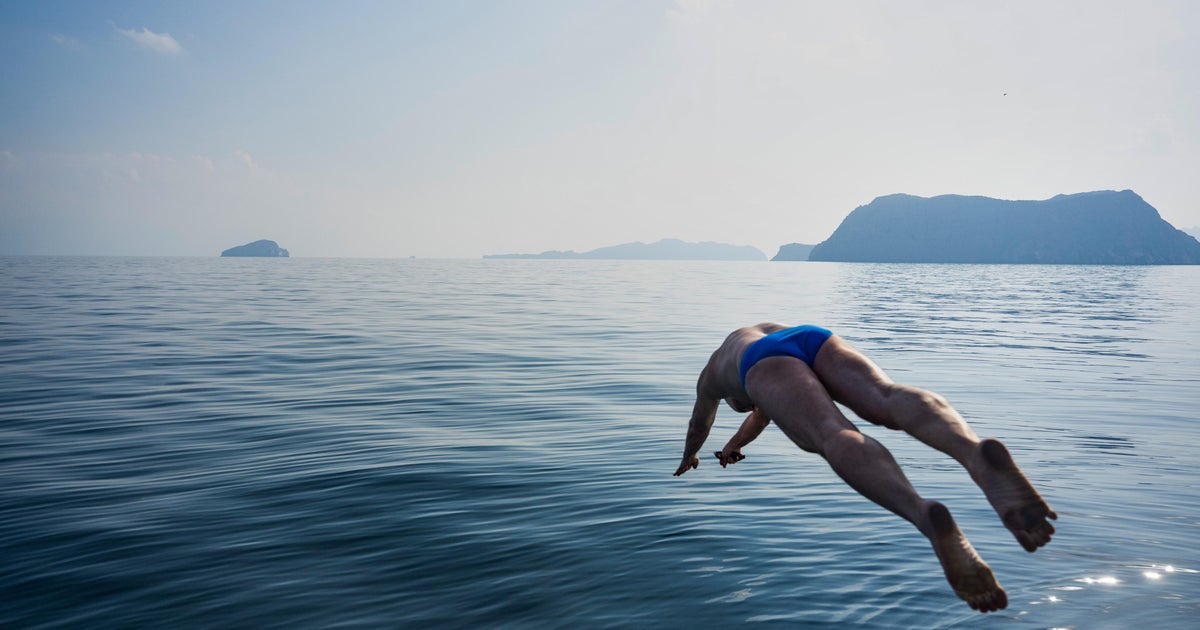
British endurance swimmer Lewis Pugh has swum at the North Pole and Antarctica to draw attention to environmental causes. But battling freezing waters and extreme conditions hasn’t prepared him for his latest challenge: swimming through the Strait of Hormuz while oil tankers are attacked and exploded nearby. Pugh, who is a United Nations Patron of the Oceans, spent three days this week swimming in parts of the dangerous waterway to highlight how the war with Iran threatens the area’s habitat and wildlife. In this photo provided by the Lewis Pugh Foundation, British endurance swimmer and UNEP Oceans Patron, Lewis Pugh dives into the Strait of Hormuz, off the Musandam Peninsula, Oman, Wednesday, Nov. 18, 2026. Lewis Pugh Foundation via AP Wearing only a swimsuit, goggles and a cap with the UN logo, the athlete set off from the Musandam Peninsula, at the southern tip of the narrow, and ended up surrounding Cape Hormuz, completing around 15 kilometers in total. Pugh is believed to be the first person to swim a long distance there since the war began. The swimmer said that minutes after entering the water on Monday, he heard two loud explosions that shook the sea. “I looked up and I could see that an oil tanker about four kilometers away had been hit,” he told The Associated Press after returning to London. “The explosion was so loud, two bangs and then fighter jets coming in. And at that moment I realized we had to get out of here right now.” Pugh, 56, managed to finish his feat after more stops and starts, including passing another ship that sent fireballs into the sky after being attacked. “Most people, when they think of the Strait of Hormuz, think of a sea route,” he said. “But it’s also one of the most beautiful places I’ve ever been… it’s one of the treasures of the natural world.” “With all these sunken ships, this area is seriously threatened,” he added. “This area will take years, decades to recover.” In this photo provided by the Lewis Pugh Foundation, British endurance swimmer and UNEP Oceans Trustee, Lewis Pugh dives into the Strait of Hormuz, off the Musandam Peninsula, Oman, Wednesday, Nov. 18, 2026. Lewis Pugh Foundation via AP Iran has in recent weeks increased attacks on vessels it claims were traveling on unauthorized routes in the strait, as it seeks to assert its control in the crucial waterway. river, through which a fifth of all the oil traded passed before the United States and Israel launched the war on February 28. Several oil tankers also collided with sea mines placed by Tehran, in some cases exploding and bursting into flames, including one carrying more than 2 million barrels of oil last month. Pugh warned that oil leaks from dozens of tankers damaged since February could create lasting problems for the region’s animals, as well as its coastlines, coral reefs and mangrove forests. He described seeing large numbers of dolphins following his boat as he sailed, as well as turtles and ospreys. He also marveled at the hundreds of turtles he saw while swimming off the coast of Oman before the war. “When the oil gets there, when the chemical pollution gets there, it becomes very, very difficult to clean up that kind of mess,” he said. “It lasts generations.” Pugh has plenty of experience dealing with extreme temperatures and predators, including great white sharks. But swimming in a conflict zone presented entirely new dangers. Lewis Pugh gestures as he looks at a map of the Strait of Hormuz before swimming in Plymouth Sound, off the coast of Devon, England, Wednesday, Nov. 11, 2026. Alastair Grant/AP Photo To stay safe, the challenge was done in sections over three days, totaling about six and a half hours of swimming. The athlete recalled seeing a gas tanker being hit as he returned to port on the second day. “I’ll never forget going through that gas ship, the smell of the chemicals and then the flames, it was literally like fireballs going up into the sky. All around the ship, the water was on fire,” Pugh said. “And to think about the impact that a victim like this has on nature, it was very, very serious.” Pugh has spent much of the last 40 years swimming in places from Antarctica to the Red Sea and the English Channel to urge more action to protect marine environments from climate change, pollution and biodiversity loss. He was the first athlete to swim across the North Pole and complete a long-distance crossing of all the world’s oceans. In 2023, he swam the 315 miles of the Hudson River to highlight the importance of clean rivers. His foundation says the challenges have helped secure official agreements to protect more than 1.35 million square miles of vulnerable ocean. Some have dubbed Pugh’s combination of epic swimming and political outreach “Speedo diplomacy.” “Sport opens doors, it creates dialogue, it allows people to start thinking about these important issues,” Pugh said. “My message is very simple,” he added. “We have to stop the war. We have to open the strait and we have to clean up the pollution.” Go deeper with The Free Press on: