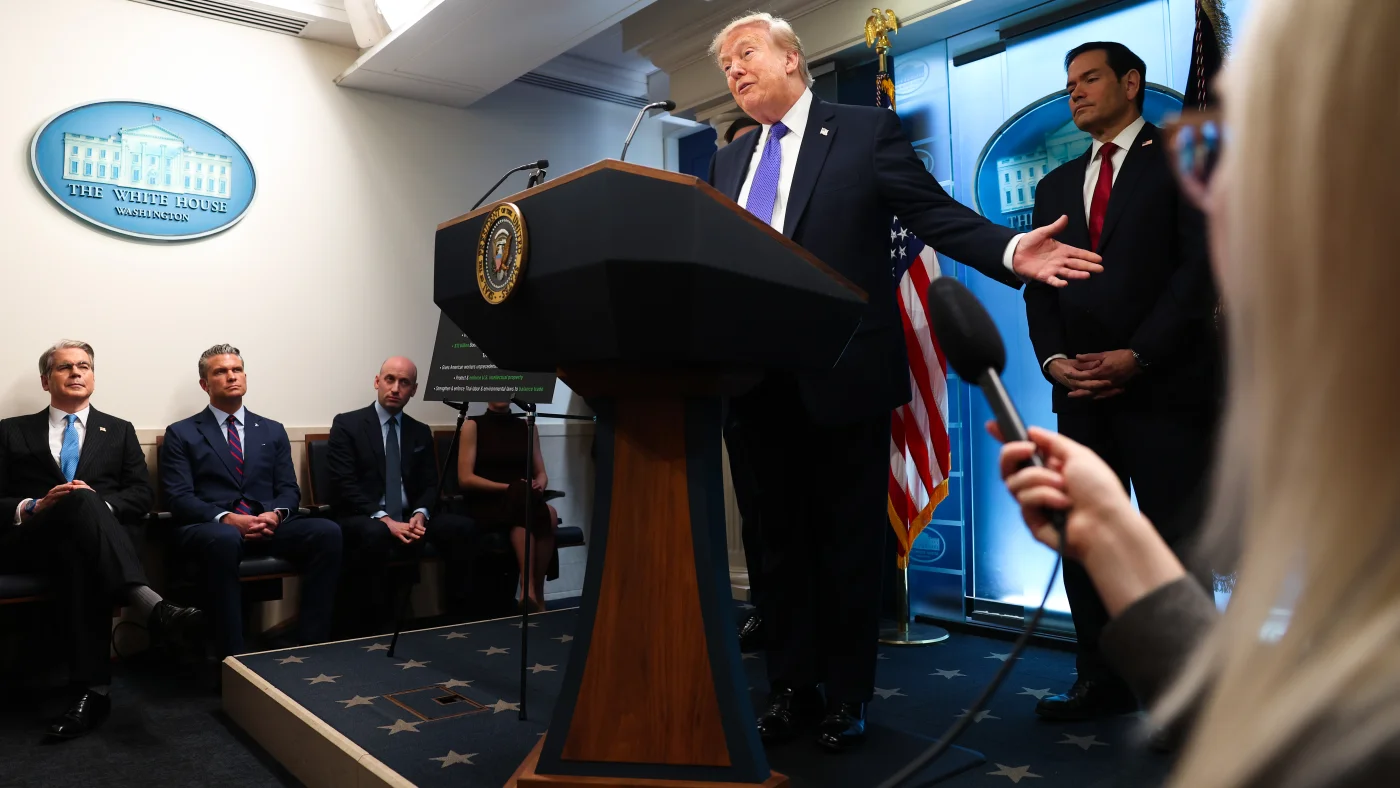
President Trump speaks as Secretary of State Marco Rubio listens during a press conference at the White House on Friday. Trump addresses the media after returning from a visit to China where he held trilateral talks with Russian President Vladimir Putin and Chinese President Xi Jinping. Kevin Dietsch/Getty Images hide caption toggle caption i Kevin Dietsch/Getty Images President Trump touted his recent trip to Asia, where he met with Chinese President Xi Jinping and Russian President Vladimir Putin during a White House news conference on Friday, saying the United States came to the stage from a position of strength. “The United States began this journey from a position of unparalleled economic and diplomatic strength,” he said, although the historic summit between the three countries yielded few tangible results. But Trump offered little about the actual results of the meetings, beyond a joint statement about unity on some issues, such as continuing to discuss reducing nuclear risks. Trump, flanked by Vice President Vance and Secretary of State Marco Rubio, delivered a wide-ranging opening speech that veered from an account of his trip and who he met to asides on Iran, the U.S. Federal Reserve, his pursuit of a Nobel Peace Prize and the domestic manufacturing industry. Trump also said he and Chinese President Xi were agreeing to “put up barriers” amid the race to develop artificial intelligence, a notable acknowledgment of the risks involved. Trump, who said Xi also likes his term “super intelligence” rather than artificial, said: “The problem is that it may be too super. So President Xi and I agree that we’re going to do some joint barriers, the two of us.” Trump added that he would continue to push for the construction of data centers in the US. “Make them pay your community, but take advantage. Don’t shut them down. And there’s always someone else in this country. But if it’s not this country, there’s someone else outside. And we’re not going to allow our companies to build data centers outside of our country. We’re not going to let that happen,” Trump said. Trump said he only wants “older chips” sold from the United States to China in the wake of the Nvidia scandal. “We only want older chips, and we don’t care if none leave, just the older ones. You have to understand that China also makes chips, and if we are not going to sell them, they will make them themselves,” he said. Vance and Rubio spoke before the president took questions; The vice president said he missed the president and Rubio, who was on the trip with Trump, also recounted highlights from abroad. Historic meetings in Asia Trump did not formally answer questions while in China at the end of his trip, although he is normally expected to do so on presidential trips abroad. Putin held a press conference before leaving the country. Before the news conference, Trump said he will discuss historic meetings in China as well as trade agreements reached during the first part of the trip to the Philippines, where he arrived to conclude a summit with South Asian leaders. Trump, Xi and Putin, who command the world’s largest nuclear arsenals, met at a lakeside resort in Shenzhen, China, where they sat around a large round wooden table to discuss nuclear proliferation, Iran and global relations. While the power displays were prominent, the talks offered few signs that Xi or Putin were willing to make significant concessions to Trump. “The trip allowed the president to bask in the glow of great-power friendship after a really strong election result here at home,” Suzanne Maloney, vice president and director of the foreign policy program at the Brookings Institution, said of Trump. “I wanted the optics of this direct engagement with Presidents Xi and Putin to be a kind of validation of his own position as a historical figure. And I think the photo shoot provided that.”