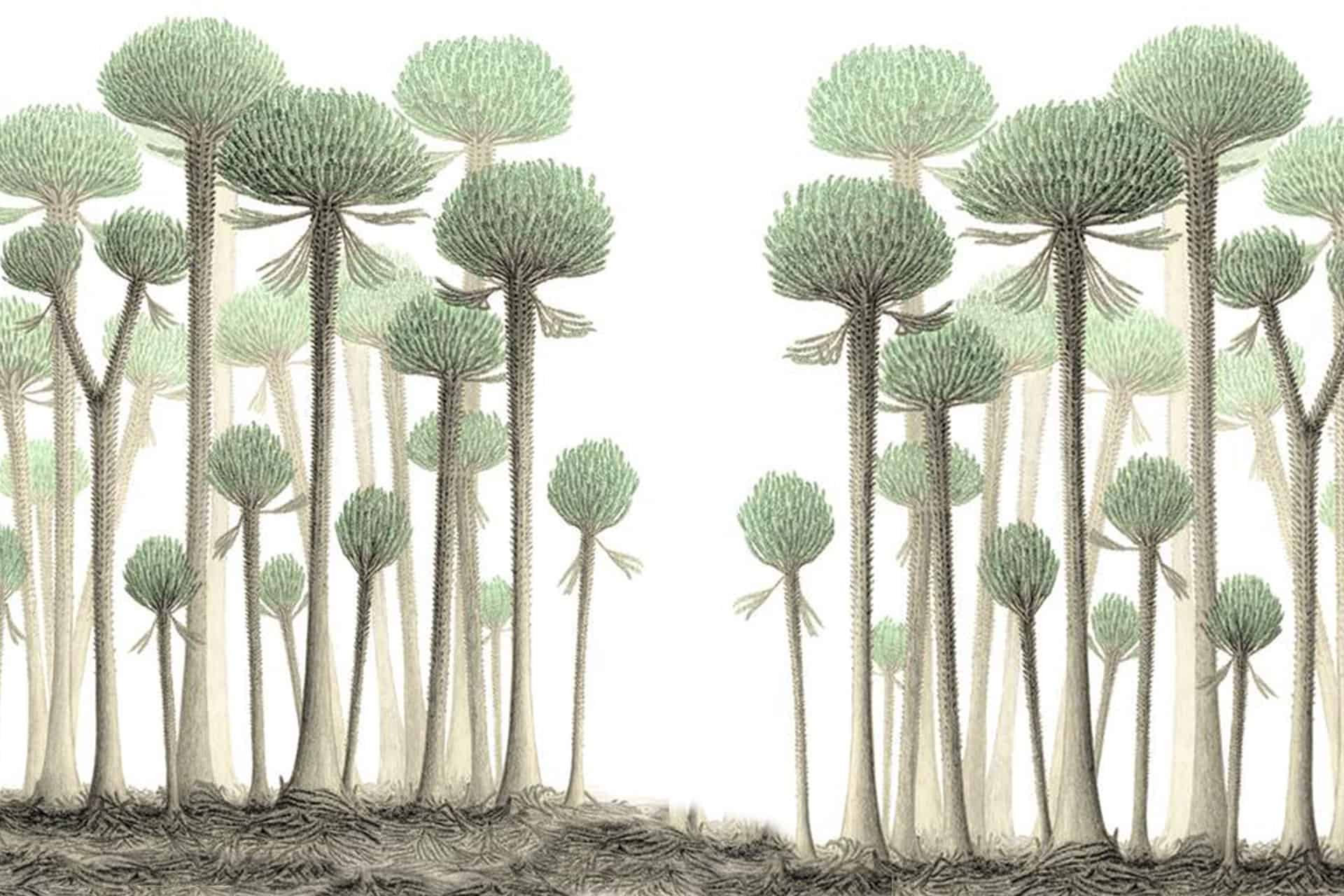
Calamophyton trees. Image credits: Peter Giesen/Chris Berry. There were no leaves to rustle, no birds to sing, no grass to walk on. Instead, the landscape was filled with strange palm-like trees. They were only a few meters tall, with thin trunks and crowns made of hundreds of tiny twigs. As they grew, they constantly dropped their lower branches, covering the ground with debris. This strange forest grew 390 million years ago. It is older than the rings of Saturn. And surprisingly, scientists found his remains hidden in the cliffs of southwestern England. “It was quite a strange forest, not like any forest you would see today,” said Neil Davies, a sedimentary geologist at the University of Cambridge who led the research. A strange forest without leaves or shade Researchers stumbled upon this ancient forest a couple of years ago while examining the Hangman Sandstone Formation along the Devon and Somerset coast in southern England. They discovered an entire fossilized forest floor preserved in sandstone: upright tree trunks where they originally grew, flattened trunks, traces of roots, and ripple marks left by ancient water. Christopher Berry, a paleobotanist at Cardiff University and co-author of the study, recognized the trees immediately after seeing photographs of the fossils. He had spent three decades studying similar plants around the world. “It was surprising to see them so close to home. But the most revealing insight comes from seeing, for the first time, these trees in the positions where they grew,” Berry says. The trees belong to an extinct group called Calamophyton, distant relatives of modern ferns and horsetails that became extinct more than 300 million years ago. They looked a bit like scraggly palm trees. At only two or four meters tall, they were tiny compared to most modern trees. His anatomy was equally peculiar. Instead of a thick solid wood trunk, they had a hollow center surrounded by strands of supporting wood. Its branches also had no recognizable leaves. They were covered in hundreds of twig-like structures. ×Thank you! One more thing… Please check your inbox and confirm your subscription. As the trees grew, they repeatedly shed their lower branches. With no grass and little undergrowth, the forest floor would have been full of dead plant material. Speculative illustration of what the forest may have looked like. It wasn’t particularly impressive by modern standards. But at the time, it represented an important evolutionary innovation: the trees grew together in stands, creating an environment quite different from the low-growing vegetation that had existed before. How the first forests began to change rivers Plants had already lived on land for tens of millions of years. So why is this 390 million year old site so important? Because there is a huge difference between plants that simply survive on the land and forests that fundamentally change the behavior of the land. Before widespread forests, vegetation was generally smaller and less capable of fixing large tracts of sediment. Rivers could easily move loose sand and mud across their floodplains, especially during floods. But the trees introduced something new: substantial living obstacles, rooted in the soil, that could slow the movement of water and help keep sediment in place. The first trees shaped rivers in unprecedented ways. Illustration: ZME Science. During the Middle Devonian, the region that now forms southwestern England lay south of the equator, near areas that would eventually become Belgium and Germany. It was part of a largely semi-arid landscape crisscrossed by canals transporting water and sediment from higher ground. Researchers found particularly revealing evidence at a site called Porlock Weir. There, fossils preserve remains of trees that grew next to a small, ancient river bed. The canal was approximately 15 meters wide and up to 75 centimeters deep. It’s small, but the researchers found that around the bases of the trees, the rock retains distinctive scour marks, formed when flowing water swirled around the trunks and eroded the surrounding sediment. By stabilizing river banks and trapping mud, these early trees forced water into deeper, more sinuous channels, creating the modern river systems we know today. “The evidence contained in these fossils preserves a key stage in the development of the Earth, when rivers began to operate in a fundamentally different way to how they did before, becoming the great erosive force they are today,” Davies added. The English discovery displaces New York’s famous fossil forests in the Catskill Mountains as the oldest known forest. The 390-million-year-old English forest narrowly surpasses (in geological terms) the 386-million-year-old Cairo quarry forest and the nearby Gilboa site. Interestingly, the study’s author, Christopher Berry, was also involved in the discovery of the Cairo Forest. However, despite the relatively small age difference, the forests tell very different stories. The English site was dominated by relatively short, primitive cladoxylopsid trees. New York’s younger forests were already home to more complex plant communities. In Cairo, researchers identified at least two main types of trees, including the primitive cladoxylopsids and the Archeopteris, a much more modern-looking tree with true leaves, substantial wood, and extensive, branching roots. They also found evidence suggesting a possible third type of tree. Those deep root systems would eventually help transform soils and landscapes even more profoundly. The difference suggests that forests diversified dramatically over a geologically short interval, although the fossil record remains too incomplete to determine exactly how quickly the transition occurred. “This suggests that about 390 million years ago there was a sudden takeoff in forest-type environments,” Davies told LiveScience. The study is published in the Journal of the Geological Society.