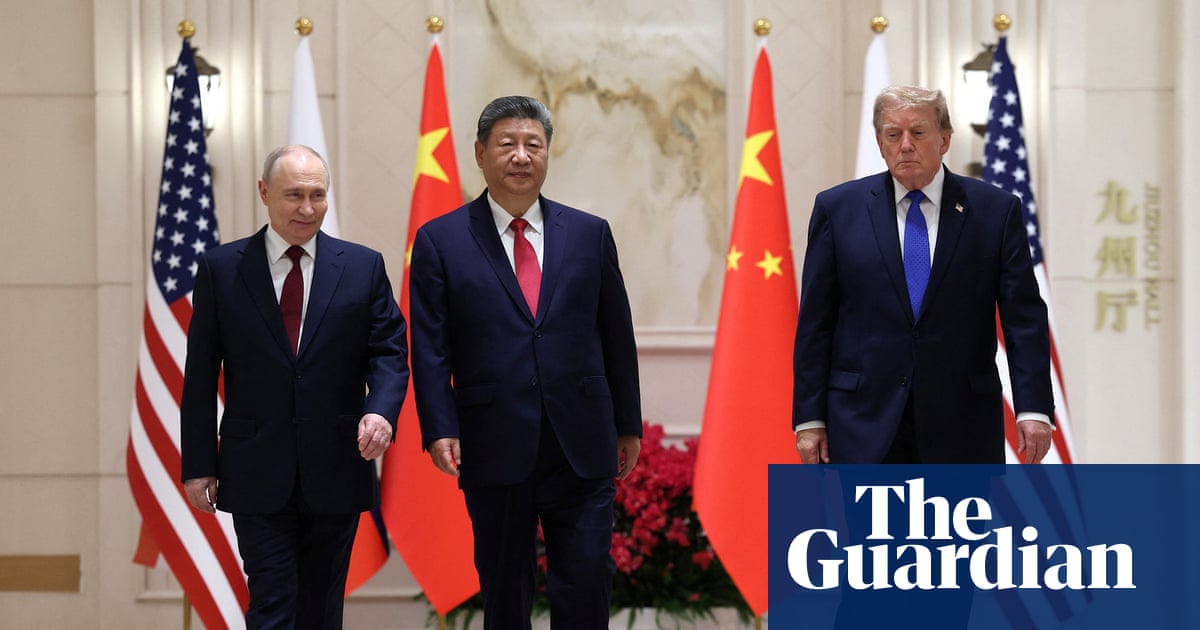
He managed with a little help from his friends. Rebuked by millions of voters in a still-resilient democracy, Donald Trump traveled to Asia this week and found solace in the company of autocrats who still fawn over him. The US president, reduced to outgoing status at home by a humiliating midterm election defeat, returned to the global stage in a meeting with two strongmen in Shenzhen, China, that critics described as a new low for America’s claim to moral authority. “Who is he?” Trump asked rhetorically, pointing as he walked toward Russian leader Vladimir Putin. “He is my friend.” On the other hand, he told Chinese President Xi Jinping: “You are my friend and we have a very special relationship.” Trump, Xi and Putin met at the Kylin Villa in Shenzhen, China, for the first trilateral summit between the leaders of the United States, China and Russia, the world’s three largest nuclear powers. The official product of their 70-minute closed-door meeting was a four-point document titled “Declaration Toward Peace” that made no mention of the wars in Iran or Ukraine. But the defining image was that of the trio sitting around a huge circular wooden table. In its hollow center was an immaculate arrangement of pink flowers, an ancient Chinese motif meant to evoke harmony. To American critics, however, the optics sent a different signal. Steve Schmidt, former adviser to President George W. Bush and Senator John McCain, said: “The image of the grotesque Grand Round Table with a war criminal dictator, a stable dictator, and an irrational, delusional would-be dictator is an image of profound shame and weakness for the United States, and a betrayal of America’s allies around the world.” Donald Trump walks with Xi Jinping as he arrives at Shenzhen Bao’an International Airport in Shenzhen, southern China, on Wednesday. Photograph: Mark Schiefelbein/AP Beijing understood how to satisfy Trump’s ego. When Air Force One landed in Shenzhen for the Asia-Pacific Economic Cooperation (Apec) summit, Xi made the unusual move of personally greeting Trump on the tarmac. An honor guard stood at attention, the crowd waved miniature American and Chinese flags, schoolchildren waved pom-poms, and Xi embraced Trump. For him, victory was not measured in the negotiation of concessions but in the lavish banquet and the seat reserved for him at the main table. “That’s a big victory for us,” he said in a television interview. We get along well.” Trump was even treated to a performance of YMCA, the signature song of his campaign rallies. In their first meeting since failed negotiations in Alaska last year, Trump held one-on-one talks with Putin that touched on Ukraine, but did not secure immediate commitments. The meeting came against a backdrop of Trump recently rejecting new sanctions against Russia. In a bilateral meeting with Xi, Trump raised the U.S.-led war against Iran, emphasizing joint interest in fully reopening the Strait of Hormuz and prevent Iran from acquiring nuclear weapons. Xi focused on trade stability between the United States and China and asserted China’s sovereign position on Taiwan, treating it as an unalterable internal issue. In an ominous comment, Trump told Xi: “I think that as long as you and I are in charge of things, we will never have a problem.” He later told NBC News that the two had also agreed that artificial intelligence needed some kind of security “guardrails,” but offered few details. before the group photo of the leaders’ meeting during the Apec Summit in Shenzhen on Thursday. Photograph: Lukas Coch/AAP The main event was the trilateral summit, with observers closely watching the body language for clues about the dynamic between Xi, reveling in his role as host, Putin, whose war in Ukraine is reeling, and Trump, seemingly the most powerful of the three but politically wounded at home. For many, it offered little more than a glorified photo op. public affairs agency Global Situation Room and former director of global engagement in Barack Obama’s White House, said: “Brand Trump has been severely tainted by a historic defeat at the hands of American voters. However, this is not going to improve their standing internationally and certainly not domestically. “If anything, it revealed his desperation. It showed his international isolation from the very people he will need to be able to secure trade or peace agreements. Once again he returns from China with empty luggage of diplomatic achievements.” The text does not mention the Russian invasion of Ukraine or the spiraling US military conflict with Iran. Instead, the trio agreed on four general points: promising a dialogue to reduce nuclear risks, committing to increasing the production and supply of refined oil, calling for “reforms” to the United Nations, and declaring that state sovereignty and the immunity of state officials must be respected, while warning that the International Criminal Court (ICC) must not abuse its jurisdiction. Putin currently faces an active ICC arrest warrant for war crimes in Ukraine, while the Trump administration has sanctioned ICC officials to protect itself and its ally Israel from judicial scrutiny. Vladimir Putin and Donald Trump shake hands during a meeting on the sidelines of the Apec summit in Shenzhen. Photograph: AFP/Getty Images Ned Price, a former deputy to the US representative to the UN, said: “The joint statement was notable, not because Russia and China said it, but because the US also co-signed it. “The talks have done little to dispel the impression that Trump regards Congress, the media and elections as annoying obstacles while he looks in awe and some envy at Xi and Putin. As the Shenzhen summit concluded, European leaders and NATO officials urgently met in Berlin to reinforce their support for Ukraine and resist any high-level partition of European security. The summit was a propaganda victory for Putin, who went from being an international pariah to being on equal footing with Xi. It was also a victory for Xi. Without making concessions to Taiwan, trade tariffs or its industrial lifeline, China positioned itself as the arbiter of 21st century diplomacy. “Xi was able to burnish China’s diplomatic clout and give Putin and Trump something each leader coveted respectively,” said Ali Wyne, senior research and advocacy adviser for US-China relations at the International Crisis Group. Russia’s wartime losses, despite Western sanctions, Russia remains a great power. Vladimir Putin, Xi Jinping and Donald Trump take part in a trilateral meeting at the Kylin Villa in Shenzhen on Thursday. Photograph: Getty Images “It gave Trump the opportunity to demonstrate, at least in Trump’s own mind, that despite this painful midterm election, Trump is a uniquely visionary and consistent peacemaker, thus appealing to Trump’s ego.” While neither Beijing nor Moscow have any illusions about Trump’s volatile temperament, both recognize that the clock is ticking on his second term and know they are likely to survive it. Wyne added: “Both recognize that it is almost impossible that any of President Trump’s successors will view them on comparable terms as friends, adopt conciliatory provisions, and, on certain issues, come close to aligning the United States’ positions with those of China and Russia. Although he was caught on camera apparently nodding off, Trump left China looking politically rejuvenated after his meetings with his two “friends.” He hailed the visit as “Very momentous” on social media and said more later: “On a scale of zero to 10, I think it was a 12.”