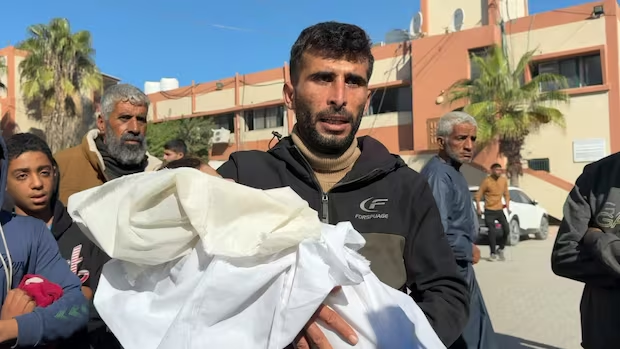
Ahmed Arqiq walked through a crowd of mourners, carrying the lifeless body of his nine-month-old baby, Kinan, wrapped in a white blanket. With every laborious step he took, passersby offered their condolences. He silently whispered prayers over his son’s body. The previous morning at 4 a.m., the 37-year-old man said he rushed his son to the Kuwait Specialty Hospital in Khan Younis, southern Gaza, but it was too late. “I was wrapped up, [but] “His head, his clothes, his pants… they were all soaked in water,” Arqiq told CBC News freelance cameraman Mohamed El Saife, holding the baby’s death certificate as he recounted the night’s events. Earlier this month, heavy rains hit parts of Gaza, causing flooding and damaging many shelters. A storm caused a sand embankment to collapse, killing five people. Hundreds of people have been living in makeshift tent cities for years, including the Arqiqs, who were displaced from their home in 2023 when Israel’s war in Gaza began. SEE | Ahmed Arqiq carries his son’s body to the funeral prayer: Winter in Gaza brings death, hypothermia and floods. The United Nations is calling on Israel to allow tents into Gaza as winter sets in. They say that the cold and rain have already killed children and adults in the territory. The deaths include a nine-month-old baby who died of hypothermia last week. In the Gaza Strip, in the week before the baby’s death, many parts of the enclave flooded, leaving people trapped under meters of water with their belongings soaked. For the Arqiq family, that meant the baby’s clothes and blankets were soaked and they couldn’t dry him completely. Kinan, the youngest of three brothers, eventually died of hypothermia, the first death from this condition in Gaza. “My son died of cold,” Arqiq said. I found him dead.” “He was living in very bad conditions.” Dr. Jamal Al-Hams, medical director of Kuwait Hospital, said the baby was dead on arrival. He said the baby had no other underlying medical conditions. “The cause of death was due to… the severe and extremely cold weather he was exposed to in his tent,” he said. “He was living in very bad conditions.” Temperatures in Gaza tend to drop at night in the winter, where they can range from eight to 10 degrees Celsius or even as low as seven In a press release issued on Tuesday, Shaun Hughes, country director of the United Nations World Food Program for Palestine, said Gaza was facing a “deepening” housing, sanitation and food security crisis. A displaced Palestinian man stands in a partially flooded tent camp during a rainy day in Gaza City on November 7 (Dawoud Abu Alkas/Reuters) 2026 claimed that at least 11 children had reportedly died of hypothermia that winter and said the situation “underlines the deadly impact of exposure to cold conditions without adequate shelter.” In January 2025, the UN reported that eight newborns and 74 children died of hypothermia in the previous month alone. The war began on October 7, 2023, after a Hamas-led attack on Israel killed about 1,200 people, according to Israeli figures, and about 250 more were taken as dead. hostages. Since then, more than 74,000 Palestinians have died in Gaza, according to the Gaza Health Ministry. Aid is still needed, organizations say A year after the fragile ceasefire between Israel and Hamas, the flow of aid has improved, but demand still exceeds supply, humanitarian groups say. “When you are in Gaza, it doesn’t feel like a ceasefire,” Hughes said. Palestinians grow their own food. “Fishing in the sea is prohibited and also endangers lives,” he said, due to the risk of shooting. “Unemployment exceeds 80 percent, so without humanitarian assistance, people have little or no alternative means of survival.” A Palestinian lights a fire outside his tent in a camp set up inside a school, in Khan Younis, on November 18 (Ramadan Abed/Reuters) Trucks with winter supplies have entered Gaza as part of the Israeli military’s winter preparedness plan for the region, according to the Coordination of Government Activities in the Territories subunit published in particularly vulnerable as they lose body heat more quickly. He said aid delivery has been hampered by prolonged Israeli security checks and crossing closures “Gaza is becoming a large camp for internally displaced people. [internally displaced persons]. “It’s one of the worst I’ve ever been through,” he said. Back at the Kuwaiti Hospital, Arqiq took his son to the hospital courtyard, where a funeral prayer was held. The small wrapped body lay on a coat on the ground as rows of family, friends and passersby lined up to pray before the body was carried to the grave. “He was like a flower,” Arqiq said, tears rolling down his cheeks.