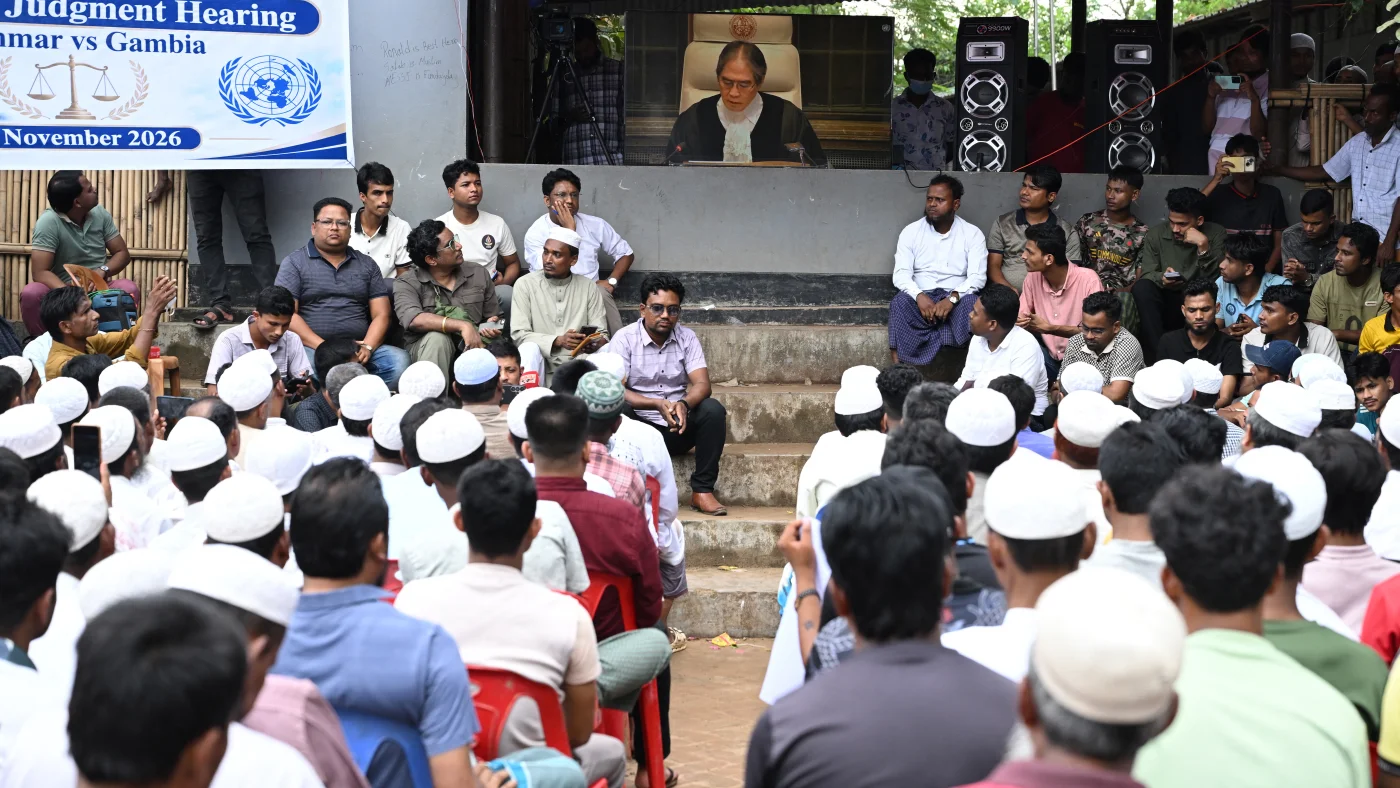
Rohingya refugees watch the International Court of Justice’s ruling on whether Myanmar committed genocide against Rohingya Muslims, on a screen at a camp in Bangladesh’s Cox’s Bazar on November 19. Salahuddin Ahmed/AFP via Getty Images hide caption toggle caption i Salahuddin Ahmed/AFP via Getty Images The United Nations’ top court ruled Thursday that Myanmar committed genocide against its Rohingya minority, the first time in the court’s 80-year history that it has held a state responsible for the crime. International Court of Justice judges voted 9 to 6 that the 2017 military crackdown was carried out with the intention of destroying the long-persecuted Muslim minority. At the time of writing, Myanmar’s military-backed government has yet to respond to the ruling. Brought by The Gambia under the 1948 Genocide Convention, the ruling will have repercussions far beyond Myanmar, according to a legal expert. But for Ma Roga Bibi, a Rohingya who fled Maungdaw township in northern Rakhine state, the impact was immediate. “I feel wonderful and grateful,” said the 18-year-old, who lives in Bangladesh, the world’s largest refugee settlement. “It was a historic and emotional day.” Genocidal campaign For several weeks in August and September 2017, the Myanmar military attacked and burned hundreds of Rohingya villages to the ground. The soldiers committed rape and massacred women, men and children. The court estimated that about 10,000 Rohingya were killed. It cited estimates that up to 2,109 Rohingya children under the age of five were killed and found that the violence was systematic, including the burning or partial burning of 392 villages. Judges of the International Court of Justice (ICJ) attend a public hearing before the reading of the court’s ruling in the genocide case brought by Gambia against Myanmar, in The Hague on Thursday. Jeroen Jumelet/ANP/AFP via Getty Images hide caption toggle caption i Jeroen Jumelet/ANP/AFP via Getty Images Ma Roga Bibi, then 9 years old, was one of the estimated 700,000 people who fled to Bangladesh, joining earlier waves of refugees. The camps stretch along a narrow coastal strip a few kilometers from Cox’s Bazar, a busy coastal city near Myanmar. Rohingya are denied citizenship on both sides of the border. “Recognition alone is not enough,” he said. “We need justice, accountability and the opportunity to return home with dignity.” She wants to be a doctor, adding: “In our Rohingya community, there are no female doctors.” Khin Khin Myint, 18, a refugee leader with the Rohingya Youth Voice activist group from Buthidaung township, also in Camp 16, said Rohingya women and girls have experienced “unimaginable suffering.” “We want the world to listen to survivors, recognize their bravery and include women in decisions about our future,” she said. “We hope that the international community will go beyond a declaration of sympathy.” Defense rejected Myanmar had argued that its military was carrying out counterinsurgency operations against an armed group, the Arakan Rohingya Salvation Army. The court said the military did not distinguish between civilians and suspected insurgents, and that the scale and nature of the violence could not be explained by counterterrorism. “The execution of Rohingya men and boys in some places, widespread sexual violence, attacks on children and babies, methodical burning of villages and attacks on fleeing civilians are not consistent with the intention of carrying out counterinsurgency operations,” said ICJ President Judge Yuji Iwasawa. Rohingya refugees watch the International Court of Justice’s ruling on whether Myanmar committed genocide against Rohingya Muslims, on a screen at a camp in Bangladesh’s Cox’s Bazar on Thursday. Salahuddin Ahmed/AFP via Getty Images hide caption toggle caption i Salahuddin Ahmed/AFP via Getty Images Antonia Mulvey, executive director of Legal Action Worldwide, a Geneva-based human rights group, said the court found evidence from the U.N. and human rights organizations credible, and that counterterrorism operations were no defense to Myanmar’s argument. He said the ruling will affect future genocide cases, including South Africa’s case against Israel, on issues such as genocidal intent and state responsibility. “Although each case must ultimately be decided based on its own evidence,” he said. The ruling is binding on Myanmar and all States that have ratified the Genocide Convention, he explained. All countries should review trade deals, including supplies of weapons and jet fuel, and financial and economic ties with the junta, he said, while supporting accountability and reparations for the Rohingya. But the court, which hears disputes between states, cannot enforce its decisions. A group long denied recognition In Myanmar, the Rohingya are widely considered outsiders from Bangladesh, despite having generations of roots in Myanmar. Iwasawa, however, identified the Rohingya as a distinct ethnic group, saying their language and art set them apart and that they self-identify as such. He said they have been discriminated against by Myanmar “for decades” and qualify as a protected group. The United States had previously reached a similar conclusion. In 2022, the Biden administration formally determined that Myanmar’s military had committed genocide and crimes against humanity against the Rohingya during its 2016 and 2017 operations. But tensions have risen between the Trump administration and international justice bodies. In a statement to NPR on Thursday, the State Department expressed support for Rohingya refugees but raised questions about the International Court of Justice. “Proper interpretation of the Genocide Convention is of utmost importance, as is avoiding politicization of the ICJ. We are studying the decision to fully assess its implications,” the State Department said. In October, US Ambassador to the UN Mike Waltz wrote online: “The ICJ should not be allowed to lower the legal threshold for proving genocide” so it can then be used as a weapon against US and allied soldiers. However, international human rights organizations and the United Nations applauded the court’s ruling. UN Secretary-General António Guterres called it “a powerful recognition of the Rohingya victims of the genocide” and said it reaffirms that “impunity for such horrific acts must not remain.” The ruling does not order Myanmar to grant citizenship, saying the issue falls outside the scope of measures being considered to prevent future atrocities. However, Myanmar must take steps to investigate people suspected of involvement in the crimes and prosecute them if warranted, the court said. It also concluded that Myanmar must provide restitution and compensation, with the amount to be set in future proceedings. The order to allow the return of displaced Rohingya runs into a harsh reality: the territory is now controlled by the Rakhine ethnic armed group, the Arakan Army. Rakhine state has been devastated by conflict between the army and the group, which now controls most of it. Su Mon, senior analyst at independent conflict monitor Armed Conflict Location & Event Data, said Rohingya in Myanmar and in camps are “threatened by multiple armed groups,” including Rohingya armed groups, the Arakan Army and the military. Almost all are stateless, he said, and have few viable ways to earn a living or get food. Many are “on the verge of acute famine” due to a shortage of aid in the camps and the junta’s blockade in Rakhine. “Unless the overall conflict dynamics in Rakhine State improve or credible security guarantees are ensured by all armed actors, the prospects for displaced Rohingya returning to their homes remain bleak,” he added. He urged the army to stop airstrikes, drone strikes and the use of advanced weaponry in northern Rakhine, lift its blockade and give full access to humanitarian groups, including to areas controlled by the Arakan Army. Lorcán Lovett reported from Thailand. Michele Kelemen contributed to this report from Washington, DC.