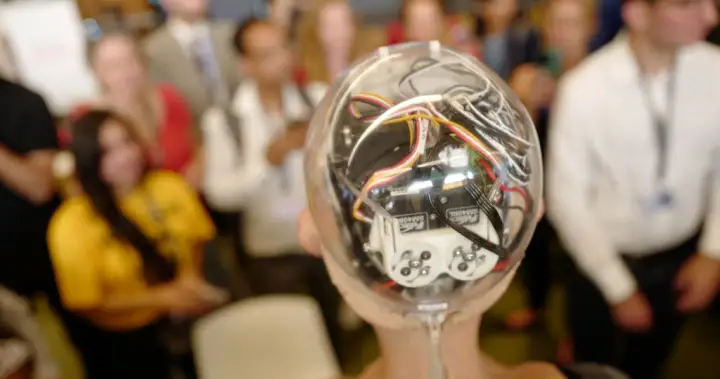

Cambridge Dictionary has chosen “human” as its word of the year, a decision it says belies the growing prominence of artificial intelligence. “AI is changing the way we talk about being human,” Colin McIntosh, the dictionary’s lexicographer, told the Associated Press. “Fears about what humans stand to lose when we outsource our thinking have made us reconsider the extent to which we rely on AI: from top mathematicians to teachers of young children,” he continued. content or elements authentically created from AI-generated media and to denote “craftsmanship” in person, which is now perceived as a superior quality of an experience or product. “Increasingly seen in compounds such as human-written, human-generated, and human-made, it now also denotes that something is created by or typical of people, as opposed to AI,” its website says. In a similar vein, data from a recent survey released by Best Buy suggests that Canadians want to return to physical media when it comes to purchasing gifts because they feel more personal, tangible and nostalgic; Headphones, headphones, video game consoles and turntables or vinyl records are popular categories this year, Best Buy said. Get daily national news Get daily Canadian news delivered to your inbox so you never miss the day’s top stories. Dictionaries often select newly introduced vocabulary as a means of reflecting the ever-changing landscape of language and culture, but the word “human” is derived from Latin and has been in use since the 15th century. Cambridge defines it as “having the qualities, defects and feelings that people have, as opposed to gods, animals or machines.” “AI is making us think more about what it means to be human,” Microsoft co-founder Bill Gates said in a comment on the Cambridge Dictionary selection. “The measure of AI success should be how much it improves human life.” Other contenders for 2026 included “agent,” for an AI system that can make decisions and operate without human control, and “analog,” for experiences or objects that do not involve the internet or technology. Artificial intelligence has featured heavily in Word of the Year distinctions in several dictionaries in recent years. More on trends More videos “AI” itself was chosen by the Collins Dictionary in 2023, a year in which Cambridge chose “hallucinate,” referring to AI’s tendency to fabricate information. Last year, Merriam-Webster named “slop” as word of the year for low-quality content produced by AI, while Collins opted for “vibe coding” for the AI-assisted software development method. The word “Maxxing” was selected as the word of the year by Dictionary.com. The popular social media term, shortened to maximize, can be used alone or combined with another word to imply that someone is optimizing an action or moment as much as possible. While not related to AI, it comes from online trends defined by the need to constantly update and refine physical appearance to achieve maximum attractiveness. 2:03 Concerns about ‘Looksmaxxing’ grow after influencer Clavicular’s suspected overdose and hospitalization, with files from the Associated Press and Uday Rana of Global News © 2026 Global News, a division of Corus Entertainment Inc.