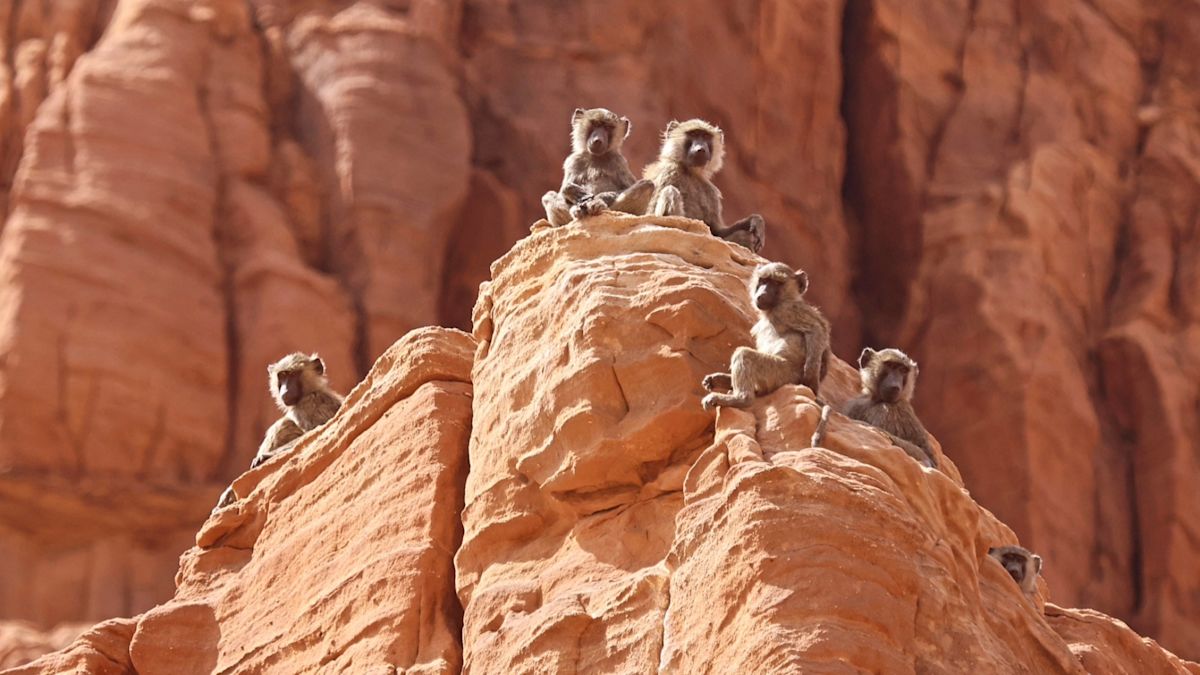
An isolated group of primates makes their home on the rugged Ennedi sandstone plateau in northern Chad. In this region in the middle of the Sahara Desert, about the size of Switzerland, olive baboons (Papio anubis) have lived a life separate from other primate species. Weighing 40 to 60 pounds, some olive baboons are about the size of our early hominid ancestors. But their size doesn’t keep them safe from hungry Verreaux’s eagles (Aquila verreauxii). New research published today in the American Journal of Biological Anthropology details how these eagles appear to be preying on these almost human-sized baboons. The discovery is changing the way scientists think about predator-prey interactions during human evolution. Our ancestors were vulnerable to various predators, including crocodiles, big cats, and even eagles. However, scientists believed that our species (Homo sapiens) and our hominid ancestors have been escaping these predators for about the last 2.5 million years. No primate larger than 28.6 pounds (13 kilograms) has been confirmed to have been killed by birds of prey, so our body size appeared to be too heavy for even large eagles with a wingspan of 71 to 86 inches long to pick up. In this study, the team describes skulls and bones of adult male baboons that bear the hallmarks of predation by eagles. There were claw holes in the skulls and several scratches and “rakes” in the shoulder bones. The figure in the article describes an encounter with an eagle baboon and shows the bony markings associated with eagle predation. Image: Catherine Hobaiter. “We saw the eagles while searching for the baboons, but we never imagined they could be a threat to them,” Catherine Hobaiter, co-author of the study and a primatologist at the University of St. Andrews in Scotland, said in a statement. “Then we found the first skull with a puncture mark, and then another, and another.” Using these remains, the team was able to calculate how much the deceased baboons weighed. One individual weighed more than 26 kilograms (57.3 lb), well within the range of a hominid species. “Having worked in this region for about three years, I had the opportunity to visit these gueltas (water pockets that form within the rock formations) and often observed Verreaux’s eagles. I had never imagined that these predators would attack primates of this size until the research team stumbled upon evidence,” added Dr. Jean Didier Akpona of the African Parks Network. “This discovery leads us to further explore the mystery surrounding the gueltas of the Sahara Desert.” Illustration of a hunting scene of the speculative confrontation between an adult male baboon and a Verreaux’s eagle, drawn to scale. Image: Javier Lázaro (CC-BY-ND).Javier Lazaro(http://www.lazaroIllustration.com/)To defend themselves from eagles, our primate ancestors “attacked” or charged at the attacker to try to scare them away. Modern primates that live in places with eagle predators often move in large groups mixed with other primate species. This also reflects the evolutionary history of our early ancestors, who lived alongside other species of hominids and other primates. While some conflicts arose, there were also many cooperative advantages to staying together, such as eagle harassment. The team hopes to learn more about the lives of Ennedi baboons to see what other evolutionary secrets they may be holding. “Baboons are some of the best-studied monkeys in Africa, but our first observations from Ennedi upended all sorts of notions about what these baboons should be doing, from their diet to their social lives, I can’t wait to see what new ‘rules’ they break next!” concluded Hobaiter.