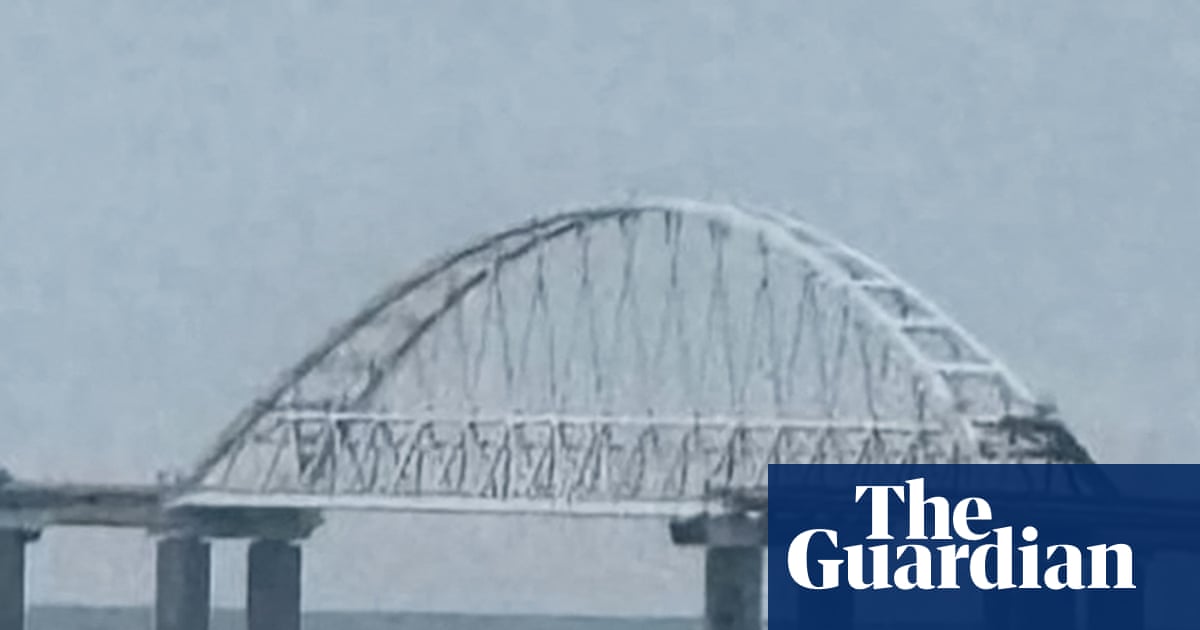
At ten o’clock on Monday night, a Ukrainian soldier scribbled a message on a kamikaze drone. It simply said: “The bridge is screwed.” Then he added: “We will stand firm and Moscow will fall.” It was a freezing night, with a starry sky and no clouds. Lines of ice had formed on the drone’s voluminous wings. It would soon launch toward its target, about 500 kilometers to the south. The Ukrainian drone that participated in the last attack on the Kerch bridge. Writing in Cyrillic reads: “We will stand firm, Moscow will fall.” Photograph: “Leon”/Magyar’s Birds Typically, soldiers gathering in this muddy field in central Ukraine attacked oil refineries deep in Russia. In recent months the work had become almost mundane: many of them had been beaten. The objective of that night, however, was unique. It was a structure personally associated with Vladimir Putin and his grandiose imperial ambitions. “We knew what the goal was. Everyone was excited and excited,” one person who participated in the special operation, using the pseudonym “León,” told The Guardian. Its seventh Deep Strike Center is part of “Magyar’s Birds,” a brigade named after the call sign of its founder, Robert Brovdi, head of Ukraine’s unmanned systems forces. Leon said: “No one gets excited about oil refineries anymore. This was different.” Soldiers prepared for the launch, then watched as the biplane-type drone, laden with explosives, disappeared across the steppe of southern Ukraine. Ukraine releases footage of Crimean Bridge attack – video For the next four hours, hundreds of attack drones followed the same linear trajectory, flying first over land and then over the Black Sea. Early in the morning they reached their destination: the Kerch Bridge connecting occupied Crimea with Russia. Putin inaugurated the monumental road-rail crossing in 2018, crossing it in a Kamaz truck. This was four years after his covert troops, known as little green men, took over the peninsula. President Putin talks to workers while inspecting the road section of the Kerch Bridge in 2018. Photograph: Alexei Nikolsky/Pool Sputnik Kremlin/AP Russian propagandists had described the bridge as impregnable. It was, they said, a building as strong and inflexible as the iron leader of its country. For Ukraine, on the other hand, it was a hated symbol of Russian arrogance and colonial thinking. Furthermore, officials noted, it was illegal. kyiv had tried to blow it up twice: with a truck bomb in 2022 and with a marine drone the following year. This time, the Ukrainian army’s careful multi-stage plan worked perfectly. “It was a well-coordinated operation. Waves of drones launched from different locations. The goal was to overwhelm Russia’s well-organized air defense system, rather than the bridge itself,” León explained. As expected, the opening salvo pinned down Russia’s home defenses. According to internal sources, Ukraine then launched a second wave of drones. Its function was crucial and different: to act as a radio signal retransmission system. Previously, Ukrainian units had used Starshield, the military equivalent of Starlink, for medium-range attacks into occupied territory. Elon Musk’s SpaceX owns the satellite Internet network, overseen by the Pentagon and the Trump administration. Satellite image of the Kerch bridge. Photograph: Vantor/Reuters Ten days ago, however, limits were mysteriously imposed on Ukrainian drones, so they could no longer fly faster than 161 km/h (100 mph). SpaceX insists there is no slowdown; a statement that Ukrainian President Volodymyr Zelenskyy says is false. On Monday night, kyiv appears to have circumvented American restrictions by establishing its own extraordinary and innovative real-time radio and video connection. Once the relief was in place, a third wave of attacks could begin. This time they presented Flamingos, a powerful Ukrainian-made cruise missile capable of carrying 1,000 kg of explosives, enough to seriously damage the bridge. An unknown number of missiles (some reports say at least four) were launched from southern Ukraine and sent towards Crimea. A video of one of the Flamingos shows it moving inexorably towards the target. The onboard camera captures a ghostly night scene. The crossing appears in view on a grisaille background. Suddenly a gigantic steel arch appears. The power is cut off. Other images show the moment of impact: an orange fireball tearing through the surrounding darkness. Photographs taken Tuesday morning after the attack show a scene of watery devastation. A huge arch had collapsed overnight on the Kerch straight, crossing a large concrete patch of road. No one will be driving across the bridge anytime soon. The adjacent railway arch section was also damaged. “We were very happy, exchanging messages all night,” León said. A drone view of what appears to be rising smoke and explosions at the Kerch Bridge. Photograph: Ukrainian Security Service/Reuters A source in Ukraine’s armed forces said the timing of the operation, hailed by Zelenskyy as “unprecedented”, was deliberate. It took place ahead of a meeting Thursday between Xi Jinping, Donald Trump and Putin in the Chinese city of Shenzhen, on the sidelines of an Apec summit. “The bridge is a symbol of Putin’s rule. Destroying it sends a message to the other two big leaders that Putin is not as strong as he pretends,” the person said. He added: “We understand that what we did shows the world that the king is naked. Putin is weak and vulnerable and we have just proven it. The operation was designed specifically for this specific historical moment. Putin’s plan was to brag at the summit about how powerful he is. In reality, he cannot even protect the most important and symbolic pillars of his regime.” Image taken from a video released by the Ukrainian security service showing damage to the bridge. Photograph: Telegram/@V_Zelensky_official/AFP/Getty ImagesIn addition to Putin’s political embarrassment before his peers, the deactivation of the Kerch bridge has practical consequences. Since annexing Crimea, Russia has militarized the peninsula, effectively turning it into a giant, fortified military base. Since 2022 it has been used as a launching pad for drone and missile attacks against the port of Odessa and other Ukrainian cities in the region. Russia’s southern occupying army has relied on the bridge for regular deliveries of ammunition, equipment and fuel. With the crossing partially closed (train travel reportedly reopened on Tuesday), Russia will have to use an under-fire land corridor instead, connecting its Rostov oblast to the Moscow-controlled parts of the Ukrainian provinces of Zaporizhzhia and Kherson. Map showing the Kerch Bridge “We have disrupted their logistics towards Crimea. There will be a lot of problems for the Russian army in the south,” Leon predicted. Debris from the bridge impact is clogging the narrow shipping corridor through the Kerch Strait, which links the Sea of Azov and the Black Sea. The Azov Sea now looks like a lake. Passenger ferries cannot move and the busy ports of Mariupol and Berdyansk are isolated. The soldiers returned from their mission jubilant and euphoric. Returning to their headquarters, they gathered as usual to observe a minute of silence, in memory of those killed in Russia’s bloody war. “We had our daily ritual as usual. Then there were congratulations for a very successful and important operation,” León said. Then he added: “We are giving them their money back.” The Betrayal of Luke Harding: Trump, Putin and the New Age of Conquest is published by Guardian Faber. To support The Guardian, order your copy at guardianbookshop.com. Shipping charges may apply.