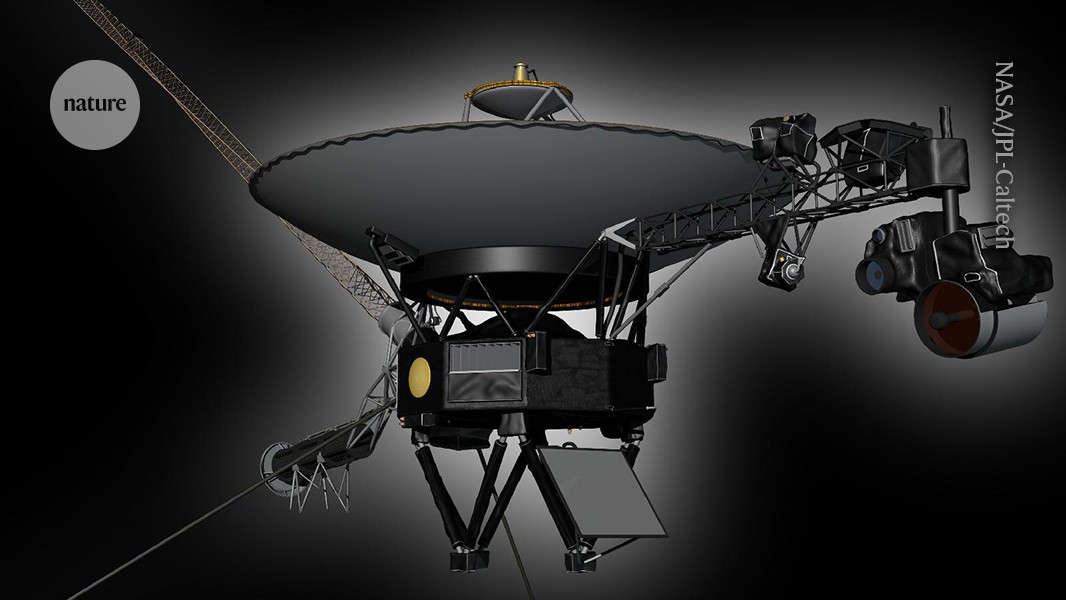
NASA’s Voyager 1 spacecraft (artist’s illustration) still cruises through space even when its power supply fails. Credit: NASA/JPL-Caltech A spacecraft is about to set a deep cosmic record. Tomorrow at 5:16 a.m. EST, NASA’s Voyager 1 will reach a distance of one light day, or 25.9 billion kilometers, from Earth, farther than any human-made object so far. That means it will be so far away that a signal traveling at the speed of light from the Earth’s surface will take a full 24 hours to reach the pioneer spacecraft. Voyager 2 enters interstellar space after 41 years The probe has been flying away from Earth for more than 49 years. “It’s taken more than half a typical human lifetime to reach that distance, so at that level it’s amazing,” says Deana Weibel, an anthropologist at Grand Valley State University in Allendale, Michigan, who studies space exploration. At the same time, he notes, Voyager 1 is only a fraction of the distance to the closest star to the Solar System: Proxima Centauri, which is 4.2 light years away (nearly 1.3 parsecs, or more than 1,500 light days). Voyager 1 and its twin, Voyager 2, launched from Earth in 1977 to explore the outer Solar System. Both left the heliosphere (the realm in which the Sun protects the Earth and other bodies from the influence of deep space) years ago, and are now hurtling through interstellar space, where they experience frigid temperatures approaching -80ºC. Their plutonium capacity is dwindling, and mission controllers have to shut down the probes’ scientific instruments to conserve as much energy as possible. Voyager 1 is expected to lose communications with Earth in 2029 and its twin will do so in 2031, when its power finally runs out. Until then, they continue doing science with the few remaining instruments—sending back the only direct observations of interstellar space ever made. Every day, Voyagers measure what happens in the space between the stars, including the surprising effects of particle storms streaming from the Sun. History in the making Between 1979 and 1989, Voyagers reshaped scientific understanding of the Solar System as they flew by Jupiter, Saturn, Uranus and Neptune. Their discoveries include volcanoes on Jupiter’s moon Io, the first known volcanism beyond Earth, and a crusty crust of water ice on Jupiter’s moon Europa, which is now thought to hide a potentially life-sustaining ocean beneath it. Voyager 1 travels faster than Voyager 2 and left the heliosphere in 2012 (see ‘Leaving it all behind’). Voyager 2 followed six years later. Source: NASA Although they are now in interstellar space, the spacecraft continues to measure changes caused by the Sun. They discovered how explosions of solar material sometimes pass through the heliosphere to produce shock waves in the otherwise quiet interstellar realm. Voyager has observed these perturbations as changes in the magnetic fields, energetic particles, and other environmental variables they measure. Starting in 2020, for example, an incoming pressure front caused the magnetic fields around Voyager to increase dramatically and then decrease six years later. Researchers are working to find out why this is the case. “I think people didn’t anticipate the extent to which these influences could be felt,” says Jamie Rankin, a space physicist at Princeton University in New Jersey and deputy Voyager project scientist. That suggests that stars beyond the Sun might also be influencing the interstellar medium more than previously thought, Rankin says, “so that’s where it gets fun.”