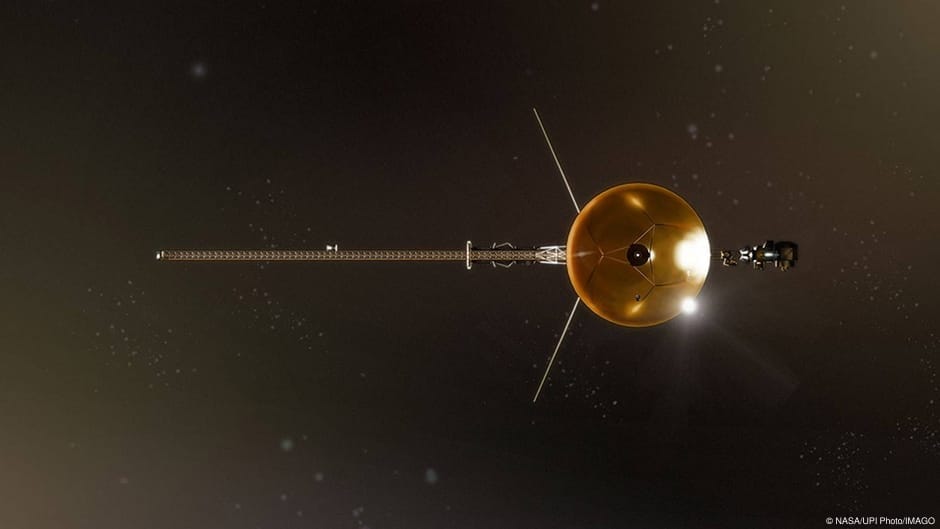
Do you hate long-haul flights? Well, imagine having to travel 3,300 years to reach your destination. Imagine leaving in 1977 and arriving in 2026, on November 18 at 11:16 am Central European Time to be precise, and then, not stopping but continuing the journey. NASA’s Voyager 1, a spacecraft launched nearly half a century ago, has traveled within one light day of Earth. A light day is the distance light travels in 24 hours: about 26 billion kilometers (or about 16 billion miles). In other words: light does in one day what took the spacecraft 49 years, two months and 11 days. But Voyager 1 is not only very far away, it is also traveling at an incredible speed of 61,000 km/h (38,000 mph). When Voyager 1 launched, it was synchronized with a planetary alignment that was as rare as the spacecraft itself: one that occurs only once every 176 years. What scientists wanted to investigate was the alignment of Jupiter, Saturn, Uranus and Neptune. Once the original mission was accomplished, Voyager 1 used the planets Jupiter and Saturn to perform a gravitational slingshot. It flew close to each planet, was pulled and accelerated by its enormous gravity, and spun faster than before. And that’s how Voyager 1 reached its speed. How did Voyager 1 get so far and where is it going? In the vacuum of space, nothing stops you. On Valentine’s Day 1990, from beyond Neptune, Voyager 1 took the only exterior portrait of the solar system ever taken by a spacecraft. In 2012, it became the first man-made object to reach interstellar space. Your journey continues. In about 40,000 years (long after its plutonium energy supply runs out) it will continue flying and pass by the star Gliese 445, which is more than 17 light years from Earth. They are light years, not light days. A light year is the distance that light travels in one year. Voyager 1 will take about 18,000 years to reach the light-year milestone. Voyager 1 is destined to roam the Milky Way “perhaps forever,” as NASA says. There were two Golden Records, one on Voyager 1 and one on Voyager 2, a second spacecraft on the same mission in the 1970s. They were protected with this golden aluminum cover. Image: United Archives/Picture Alliance Voyager 1 is an ongoing science experiment The spacecraft is the first human-made object to be within one light-day of home. “If you want to say hello to Voyager, you send your message and then you go home and wait two days before you finally get a response,” says Suzanne Dodd, project manager for the mission at NASA’s Jet Propulsion Laboratory. But you get an answer. Even today it sends data that helps scientists on Earth. “[It’s] It still works very well, sending data from a region of space that no other man-made spacecraft has ever explored,” says Kareem Badaruddin, mission director at JPL. Something you didn’t know about Voyager 1 No story about Voyager 1 seems complete without mentioning The Golden Record, a phonograph record, which is part of the spacecraft’s payload. The spacecraft carries other Earth objects such as messages and artifacts from Earth to extraterrestrials. But the Golden Record is what we tend to focus because it contains sound bites representing languages and cultures from across our planet. We are told that it is highly unlikely that any intelligent life form will receive the charge or even know how to play the Golden Record, but if they get the record and figure out how to play it, the first thing they will hear is a controversial voice, not one from the Earth unit, as was the original idea President (1986-92), whose hidden wartime past as a German army officer in the Balkans came to light a decade later. of the launch of Voyager 1. Waldheim was alleged to have participated in Nazi crimes. NASA launches new telescope to explore the hidden universe. To view this video, please enable JavaScript and consider upgrading to a web browser that supports HTML5 videos.