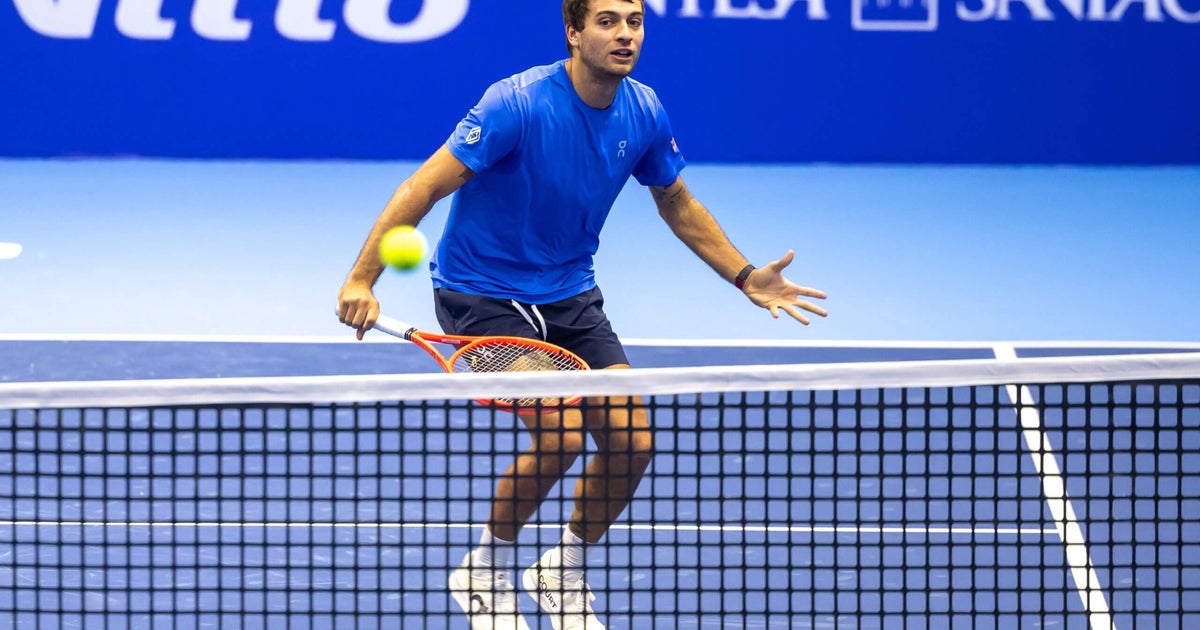
The Turin public is used to seeing the extraordinary of one of their own. For the past two years, Jannik Sinner’s name has resonated around the Inalpi Arena at the ATP Finals. The Italian won the season-ending championship in 2024 and 2025, and each match sparked a chant that echoed through stands packed with fans dressed in red, white, green and orange. Olé, olé olé olé, Sinner, Sinner. Olé, olé olé olé, Sinner, Sinner. This year, they have another name to sing, just with less orange. Sinner is out with a right knee injury that has sidelined him since winning Wimbledon, but French Open finalist Flavio Cobolli is making his ATP Finals debut, and doing so in extraordinary fashion as well. Cobolli, 24, enters the event as world No. 6, despite having lost more points than he gained this year. He is the first player to finish in the top 10 with such a record since data became available in 1991, as first analyzed by Jeff Sackmann of Tennis Abstract. The tennis scoring system is known for its ability to create statistical quirks. Players can win individual matches despite losing more points than their opponent, and even the most dominant players in history win just over half the points they play in their career. Roger Federer, 20-time Grand Slam champion, turned that into a philosophy for a graduation speech; It is the basis of a sport that does not have a clock. But the curious case of Cobolli cannot be explained solely by the scoring system. The way Cobolli wins and the player he is also contribute. In 2026, Cobolli won 60 percent of his matches, with a record of 36-24. He has won 55 percent of his sets (90-73). But he has won just 49.8 percent of his points and a similar percentage of his games. How do tennis rankings work? Ava Wallace and Lia Griffin As of 2026, Cobolli is 7-1 when winning between 49 and 51 percent of points played. Only nine of his 36 wins have seen him win 55 percent of the points or more, but 16 of his 24 losses have seen him win 45 percent of the points or less. He has five wins with less than 50 percent of the points won in 2026. The rest of the field in the ATP Finals has nine between them, split between three players: two for Ben Shelton, five for Frances Tiafoe and two for Rafael Jódar. Cobolli is also 19-12 in tiebreakers this year, a 61 percent record that would put him among the elite if maintained throughout his career. On average, tiebreaker results closely match a player’s results in normal sets (55 percent won this year for Cobolli), so he is unlikely to hold that record. The numbers offer ballast to a Cobolli theory that has become increasingly clear since his rise in the sport: He has one of the widest gaps between his top tier and his bottom tier on the ATP Tour. When it is good, it is very good; when he is committed, he is very committed; and when it is not good, it is not good at all. These types of evaluations can be unsatisfactory, because a player’s level is always determined to some extent by his opponent and the way his skill and technique allow him to react to the scenarios in which he finds himself. As seen at the Paris Masters last week, Taylor Fritz can’t suddenly become a net runner against Carlos Alcaraz because the mechanics of a point demand it. The broader statistics also confirm Cobolli’s swinging game. Of the men’s top 50, he ranks 41st (10th worst) in points lost in his service games in 2026, according to data from Tennis Abstract, and ninth worst in percentage of service games won. His winning percentage is 23rd out of 50 and 17th in winning volume. He ranks 39th in break point conversion. But point percentages don’t determine a player’s ranking: match wins, and they happen there, do. While 10 of Cobolli’s losses in 2026 were first-round defeats, when he won his first match, he lost the next only twice, turning first-round wins into deeper runs with regularity. He only lost one first round at a major, while suffering from diarrhea from the first over against Arthur Fery at the Australian Open. Now he is in the ATP Finals, where a victory in the round-robin carries 200 points. Cobolli has three matches, against Alcaraz, Tiafoe and Daniil Medvedev. His game does not like fast indoor courts, with a long forehand swing and a first serve that is arguably more powerful when starting on the plus side. But if he wins, the Italian public will sing their hero’s name this year, however they do it.