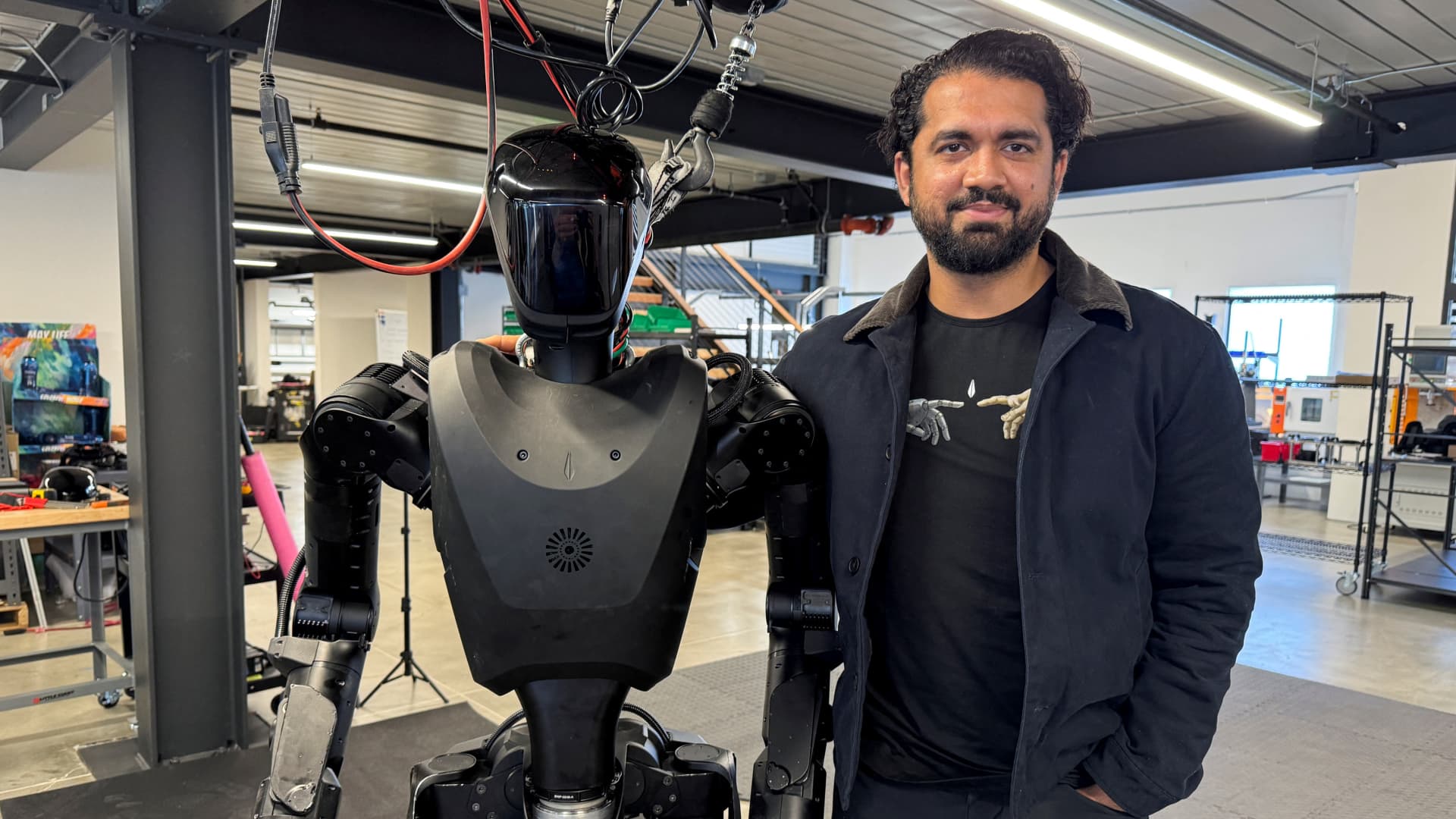
Sankaet Pathak, CEO and founder of Foundation, a company building a Phantom-01 humanoid robot, poses for a photo during an interview with Reuters at his company’s factory in San Francisco, California, U.S., February 4, 2026. Aleksandra Michalska | ReutersFoundation Future Industries, a maker of military humanoid robots advised and backed by Eric Trump, did not pay its employees last month as its cash reserves dwindled, according to people with direct knowledge of the matter. Workers have yet to receive paychecks after the San Francisco-based Foundation failed to pay their payroll on Oct. 30, said the people, who requested anonymity to speak candidly about a private company. The situation has particularly angered some within the startup because its CEO and co-founder, Sankaet Pathak, borrowed $4.6 million from the company last year to buy a luxury home, money that could have been used to pay workers, the people said. Public records show that an LLC that names Pathak as sole principal purchased a $4.6 million property in Sausalito, California, with “panoramic, cinematic views” of the San Francisco Bay in October 2025. A spokesman for Pathak acknowledged receiving a detailed list of the main points of this story on Thursday, but did not respond to requests for comment. Pathak’s previous startup, a financial technology company called Synapse, collapsed in 2024, leaving thousands of Americans without access to their savings accounts. The foundation’s liquidity crisis comes at a precarious time for the company, which Pathak said is close to unveiling a next-generation weapons-ready robot that will help the United States compete against its Chinese rivals. At the same time, Pathak is looking to raise hundreds of millions of dollars in financing at a valuation of $3 billion. The company has made headlines this year for Pathak’s claims that its robots could soon take on battlefield duties in Ukraine or patrol the U.S. border with Mexico. Broadcast interviews and articles about the Foundation also include claims that the company has earned $24 million in contracts with the Pentagon. “What we are about to reveal in the coming months [is] “It’s going to be the strongest humanoid robot that exists anywhere in the world, including China,” Pathak said in a television interview in April. “At a glance.” That April interview featured Eric Trump, the US president’s son, as a Foundation investor and senior strategy advisor. It is unclear how large his involvement is. Eric Trump and his brother Donald Trump Jr. have invested in a number of defense companies, including makers of military drones and autonomous weapons. at least $3.2 billion in government business. “We have to win robotics in the United States of America,” Eric Trump said in April. “When you go up and interact with these robots… they hit you with their fists, give you high fives, and follow your orders.” “This looks like corruption at first glance.” Phantom-01, a humanoid robot developed by San Francisco-based startup Foundation for military purposes, stands at the company’s factory in San Francisco, California, US, on February 4, 2026. Aleksandra Michalska | ReutersEric Trump did not respond to requests for comment. His spokesperson recently told the Financial Times that Eric Trump “had no involvement in the Foundation.” management, operations, strategic decisions, or business activities, including the solicitation, negotiation, acquisition, or performance of any government contract.” While Eric Trump’s announcement sparked speculation within the Foundation that a Democratic-led Congress could investigate the company, the Foundation itself did not actually win the $24 million in contracts, even though that claim was widely reported in the media. Instead, it acquired Florida-based Boardwalk Robotics in late 2024, and the government research contracts won by that company explain the claim, said a person with knowledge of the In 2024, CNBC reported that letters Pathak sent to potential investors cited an imminent investment and a $300 million purchase order from General Motors, claims that the automaker rejected said at the time that it was “embarrassed” by the marketing materials. million dollars at a valuation of $3 billion since at least January. Pathak is the sole member of the Foundation’s board of directors, a structure that has raised concerns among potential investors about corporate governance, the people familiar with the matter said. “This is what happens in a company without governance,” the people said. one of the people said. “Are you going to let it all fall apart and go into the sunset?” Bridge loan from an existing investor, the people said. Pathak told employees this week in a memo that he was working to raise money to pay back wages. The company was founded in April 2024 by Pathak, Tribe Capital CEO Arjun Sethi, and LeBlanc, a co-founder of Cobalt Robotics, a maker of guards. autonomous security, according to a fundraising speech at the time. The foundation hired dozens of robotics engineers and artificial intelligence experts, managing to attract some from Tesla and the Amazon-owned autonomous vehicle company Zoox. Before the Foundation, Pathak was known as the founder of Synapse, a kind of intermediary that enabled financial technology companies such as Mercury, Dave and YieldStreet to offer savings accounts and credit cards with the help of small community banks. Its collapse left more than 100,000 Americans with a combined $265 million in deposits excluded from their FDIC-backed accounts. While some customers received partial payments during Synapse’s bankruptcy process, thousands remain without access to their money after more than two years. A bankruptcy trustee, former FDIC Chair Jelena McWilliams, said up to $96 million in customer funds went missing. bankruptcy proceedings concluded last year without discovering where the funds went—until the Consumer Financial Protection Bureau sued Synapse last year, opening a $55 million fund to help customers. Pathak withdrew $320,000 in Synapse loans as it neared bankruptcy in 2024 amid disputes over unparalleled accounting books, according to consultant and freelance journalist Jason Mikula. jury to investigate possible criminal conduct at Synapse, the Wall Street Journal reported last year. The report did not mention Pathak specifically. The controversy did not deter Eric Trump from investing in Foundation and Pathak, whom he called a friend in the interview broadcast in April. “I walked into his factory and I couldn’t believe what I saw,” Eric Trump said. “I tell you, he’s doing a phenomenal job.”