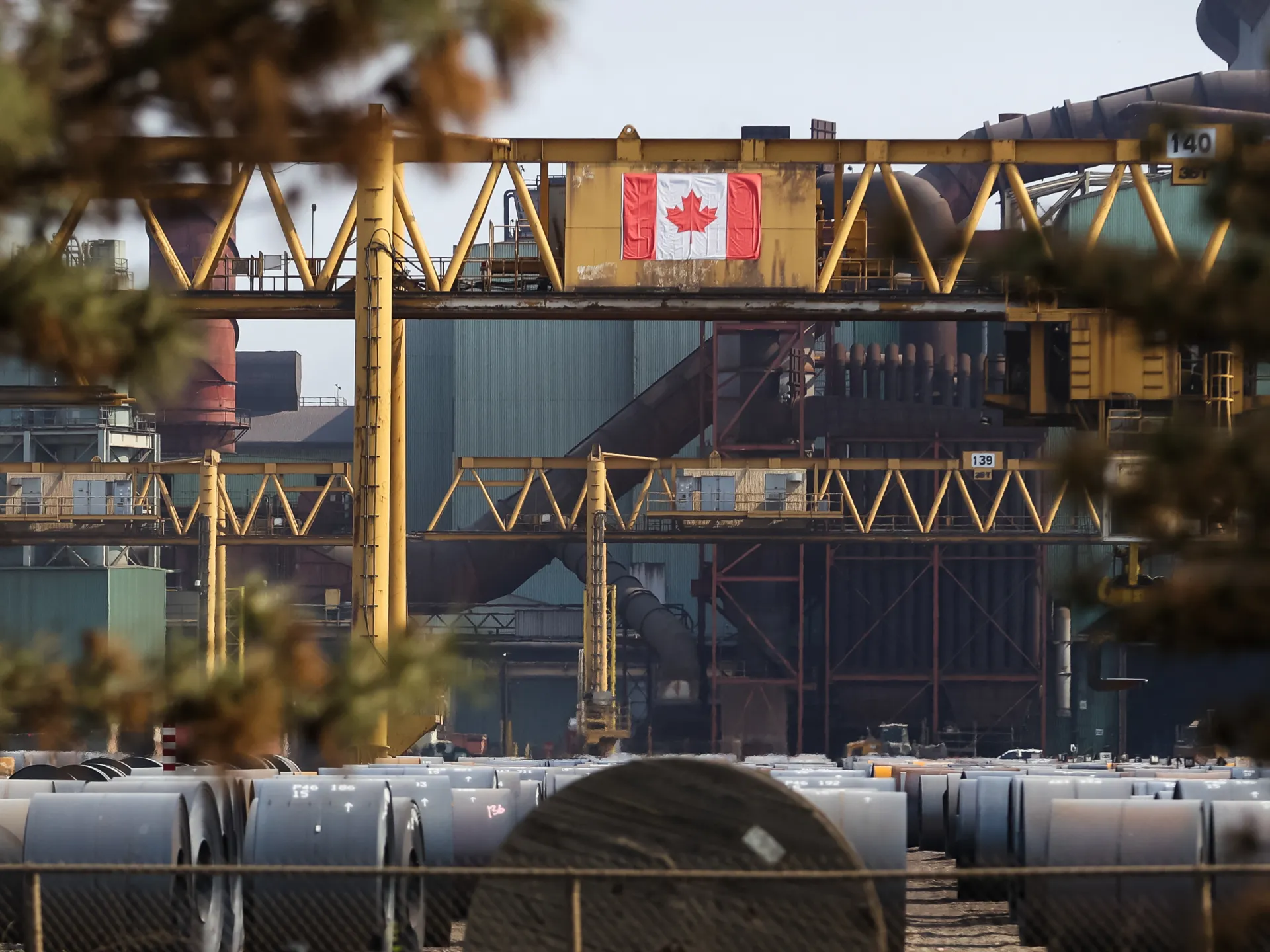
Hamilton, Ontario, Canada – Chelsey Masteij had heard there might be layoffs at Stelco, so she decided to use some of her vacation days. She was making the most of her free time with her new dog when she received a call telling her not to come back to work. The 34-year-old had spent years trying to break into the male-dominated steel industry before finally landing a job at the company’s Hamilton plant about three years ago. Exhausting and physically demanding, but Masteij came to love the routine and the close-knit community of coworkers he came to consider family. When she shared photos of herself with Al Jazeera, all in protective gear at the plant, she joked that she barely had photos outside of work. Masteij thought he might stay at Stelco until he retired. Instead, she was fired on October 9. The news was very shocking and he spent much of the next two weeks sleeping. “I was a complete mess,” he told Al Jazeera, his voice breaking as he recalled the experience. “I was a little depressed.” Now, instead of working 12-hour shifts, Masteij spends much of his time at home, cutting expenses while collecting employment insurance. Masteij is among hundreds of Canadian steelworkers facing layoffs after Stelco’s U.S. owner, Cleveland-Cliffs, announced in late September that it would temporarily close parts of its operations in Hamilton and Nanticoke, Ont. Stelco blames the move on U.S. President Donald Trump’s tariffs, which it says have made it harder to sell Canadian steel to U.S. customers, and on competition from cheaper foreign steel coming into Canada. But government officials and plant workers, including Masteij, aren’t convinced that’s the whole story. “Right now, there are a lot of lies about what happened,” Masteij said. While U.S. tariffs have hurt the Canadian steel industry, the union representing Stelco workers questions whether Cleveland-Cliffs is using tough market conditions to serve its own business interests, with Canadian workers paying the price. “Everyone knows. “We are being used as pawns, that these layoffs were not necessary,” said Ron Wells, president of United Steelworkers Local 1005, speaking to Al Jazeera in his Hamilton office. The pressures Stelco faces In June 2025, Trump doubled tariffs on steel and aluminum imports, including those from Canada, to 50 percent, making them more expensive for American buyers. According to Stelco, Canadian exports of rolled and clad steel to the United States – used to make everything from cars to construction materials – fell 58 percent in the second quarter of 2026 compared to the quarterly average before the trade war. But demand has also fallen in Canada, where the auto industry, a major buyer of the cold-rolled steel produced at the Hamilton plant, has also been hit hard by Trump’s tariffs, said Colin Mang, assistant professor of economics at McMaster University in Hamilton. “When they say there is less demand for the product coming out of Hamilton, “And that will have consequences for employment in Canada, but it will have a positive financial impact on Stelco and on Cleveland-Cliffs,” he said. Ron Wells, president of United Steelworkers Local 1005, stands in his office in Hamilton, Ontario. Union represents hundreds of Stelco workers facing layoffs [Tamara Khandaker/Al Jazeera]That was the first time Wells heard that jobs could be at risk. The union later offered to help Cleveland-Cliffs lobby Ottawa for stronger protections against foreign steel imports, believing Canadian workers could have more influence over the government. “They never accepted our offer,” Wells said. Instead, the next call brought news of the layoffs. Within a month, about 30 attended an information session organized by the union in Hamilton, where they could learn about employment insurance and retraining opportunities. Many were frustrated by the lack of clarity over how long the shutdown would last. Some asked how their benefits would compare to their salaries, while others wondered if they would qualify for the full amount. Retirement. A drone photo shows the Stelco Hamilton Works steel mill, owned by Cleveland-Cliffs, in Hamilton, Ontario, on September 29, 2026. [Carlos Osorio/Reuters]Some are already considering traveling west to find work. “It’s hard for them to make those decisions,” Wells said, describing what he had been hearing from members. “Do I leave my family, go west and make some money? Because you don’t know how long this is going to last.” Masteij worries what that could mean for Hamilton, a city where generations of families have worked in steelmaking, an industry that has shaped its identity for more than a century. “I’m a steel city girl, and I can’t imagine the city without steel manufacturing,” she said. “We are losing merchants.” Were the layoffs necessary? But as workers grapple with what the layoffs mean for their families and their city, the union has been asking another question: whether these layoffs were necessary, and it’s not alone. The American company has been criticized by the Canadian government, which is threatening legal action, accusing it of reneging on promises it made when it bought Stelco in 2024. These included maintaining at least the same number of workers. union and most non-union jobs in Canada, and pushing for trade policies that would benefit the steel industries in both Canada and the United States. Cleveland-Cliffs denies violating the agreement and says it expects to meet its employment commitments for the year. He also maintains that the layoffs are necessary to “ensure Stelco’s survival” amid U.S. tariffs, weaker demand and competition from cheaper foreign steel. But the union and the government point to Stelco’s recent financial performance. Earlier this month, Goncalves reported the company’s best quarter since the acquisition. “Mr. Goncalves is not a victim,” Canadian Industry Minister Melanie Joly told Canadian public broadcaster CBC, referring to the company’s profits. “He’s never made so much money.” Experts have also questioned Gonçalves’ claim that Canadian steelmakers are struggling due to “an avalanche of imports.” Mang notes that nearly 80 per cent of Canada’s cold-rolled steel imports come from the U.S., as does about half of the galvanized and painted steel coming into the country. “What you’re trying to sell to people is the idea that all this European or Asian steel is coming to Canada,” he said. “This comes from your own country.” The union and the government have also asked why, while Gonçalves pushes for stronger protections in Canada against foreign steel, he has also been a strong supporter of Trump’s tariffs on Canadian steel. In testimony before US lawmakers in January, Gonçalves argued that no country, including Canada, should be exempt from steel tariffs. In an interview with Politico last year, he said he was “very happy” with the 50 percent tariffs on steel imports, adding, “I have my fingerprints on that 50 percent.” He believes the company is using Canadian workers to pressure Ottawa to impose more restrictions on foreign steel, while helping Trump argue that his tariffs are working. Mang explained why Goncalves’ seemingly contradictory position could make sense for Cleveland-Cliffs. “You want trade barriers in both countries to seal their domestic markets from each other and also from the rest of the world,” Mang said, “so that their companies in each country can benefit in their own domestic markets.” Cleveland-Cliffs has been under increasing pressure from Ottawa, which gave the company 15 days from Oct. 22 to meet its commitments to Canadian workers or face legal action. Amid that pressure, comments Goncalves made to CBC late last month appeared to support the union’s suspicions that the layoffs have less to do with difficult market conditions and more to do with Cleveland-Cliffs’ broader business interests. When asked why he supported tariffs on Canadian steel despite promises to protect workers and defend the Canadian steel industry when Cleveland-Cliffs bought Stelco, he said: “I bought Stelco because I could no longer afford Stelco to flood the market here in the United States to the detriment of my own company.” The admission caught the attention of Joly, who said the comments could strengthen the government’s case against Cleveland-Cliffs if Goncalves meant he had bought Stelco to keep its Canadian operations idle. He added that Ottawa could force the company to sell its Canadian assets. On Nov. 6, when Ottawa’s 15-day deadline expired, Joly asked Canada’s Competition Bureau to investigate the 2024 acquisition and whether the company’s conduct violated Canadian competition law. “If the negotiations and acquisition were carried out in bad faith, Canadians deserve to know. The company must face the consequences,” he said in a statement. Cleveland-Cliffs maintains that it has met its obligations under the Investment Canada Act. Goncalves has rejected the prospect of a fire sale, but suggested he could sell Stelco himself within a year. “I’ll sell the company after we operate it for a while, and now that I know I’m persona non grata in Canada, I’ll do it,” he told CBC. In a statement to The Canadian Press news agency late last month, he said he hoped to bring back laid-off workers before Christmas. “It will depend on Canadian customers buying Canadian steel, made by Stelco,” he said. Jazeera reached out to Cleveland-Cliffs for comment on the union’s allegations and Goncalves’ comments. Chelsea Masteij working at Stelco’s Hamilton steel plant in Ontario, Canada [Courtesy of Chelsey Masteij]What’s next for workers? For Masteij, even as she waits to find out if she will be revoked, she is preparing for the possibility that her time at Stelco is over. Her low seniority means she would be one of the last to be called back. Masteij plans to use the time he is eligible for employment insurance to take a heavy equipment training program, hoping it will open the door to other opportunities and give him something to focus on. The training could also help her if she returns to Stelco, which is still what she hopes. For Wells, what’s especially frustrating is how the company treats workers, given the years of hard work and sacrifices many have made in their jobs. “It’s not glamorous. You work in shifts, at night, during the day, in the heat and the cold,” he said. “Our members miss holiday meals with their families or their kids’ hockey games because they are expected to work.” “And that’s why this is particularly difficult because that loyalty is not being rewarded,” Wells added. “In reality, they are being exploited, if anything.” He worries what a protracted legal battle could mean for those workers. “Our members don’t have a lot of time,” he said. “We hope things will be resolved as soon as possible.”