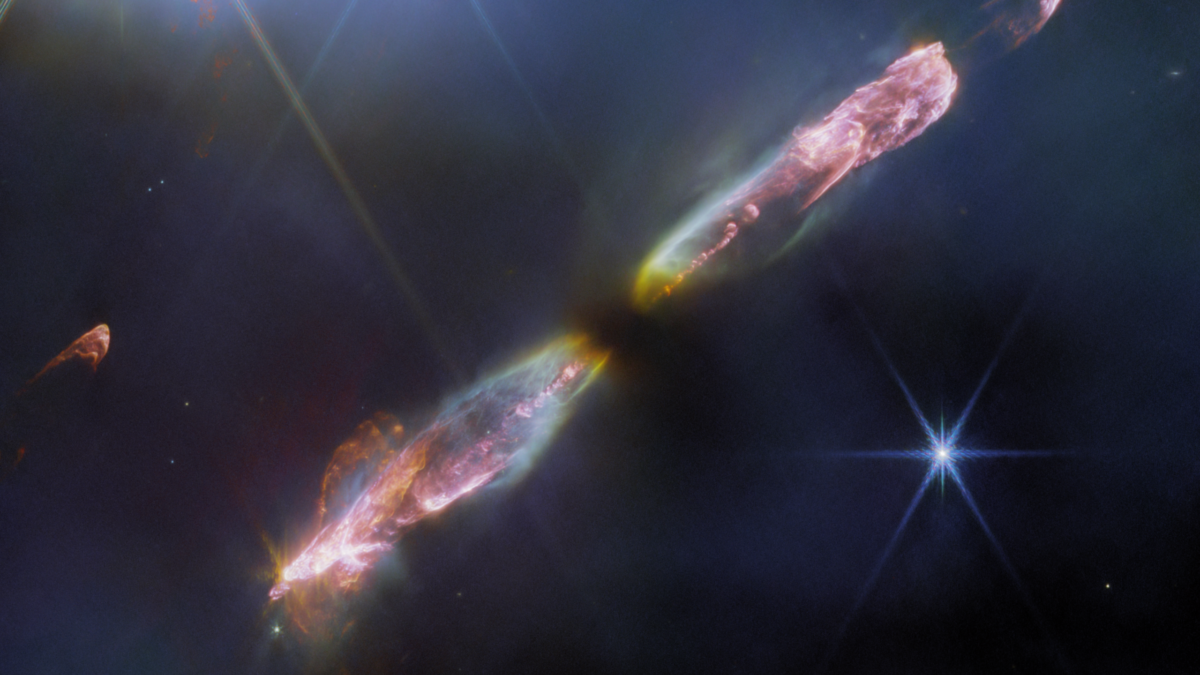
One of the most important molecules in the Universe has been hiding its light for decades. It is the basis of almost all interstellar gas-phase chemistry, including the formation of complex organic molecules that constitute the ingredients of life. Its name is trihydrogen cation (H3+), and it is so important that it is often referred to as “the molecule that created the Universe.” It has been detected lurking in interstellar clouds and is partially responsible for the brightness of Jupiter’s auroras, but the particular type of light it should emit as it rotates, predicted since 1986, has eluded all searches, including attempts to observe it in laboratory environments. Now, using JWST, a team of astronomers led by David Neufeld of Johns Hopkins University has finally detected that elusive light, shining from a gas thousands of light years away. And the discovery could help us understand the physics of the giant shock waves generated by newborn stars, as well as what happens to this critical molecule in the midst of all that fire and fury. HH 168 is located within the high-mass star-forming region Cepheus A. (NASA, ESA, R. Fedriani and Gladys Kober) To understand why this discovery is so incredible, we must look at the peculiar shape of the trihydrogen molecule itself. It consists of three hydrogen nuclei grouped together, sharing only two electrons between them. The shape they form is an equilateral triangle, which means that the molecule has neither a permanent dipole moment nor an allowed pure rotation spectrum. That means that as the molecule spins, its electrical charge remains evenly distributed, with no imbalance generating the electromagnetic radiation that molecules normally emit when they spin. Still, in 1986, astrophysicists Fu-Shih Pan and Takeshi Oka of the University of Chicago calculated that trihydrogen should be able to emit a very weak amount of light. while spinning. Here is the legal loophole. As the molecule rotates, centrifugal forces slightly distort its perfectly symmetrical shape. This creates a small electrical dipole moment, allowing it to emit radiation. The resulting transitions are so extraordinarily weak that they are considered “forbidden,” not because they violate the laws of physics, but because they are prohibited by the usual rules governing molecular radiation. The arrangement of the nuclei in the trihydrogen cation forms an equilateral triangle. (Benjah-bmm27/Wikimedia Commons/Public Domain)For four decades, that prediction remained unconfirmed. The signal was simply too weak to detect, even in laboratory experiments. But what Pan and Oka’s article didn’t predict was the killer combination of JWST and a newborn star throwing a tempestuous tantrum of cosmic proportions. Herbig-Haro objects are some of the most spectacular phenomena in the galaxy, born from the violent outbursts of young stars. When a star forms, it feeds on the material that rotates around it. But not all that material ends up in the star. Powerful magnetic fields help fling some of it back into space in tightly focused jets, traveling at hundreds of kilometers per second. When those jets collide with the surrounding molecular cloud, they generate immense shock waves, heating the gas to thousands of degrees and causing it to glow with light. It’s a fairly brief but important phase in the life of a star, and one that astronomers are interested in learning more about. However, because it often develops within the thick nebula from which the star is born, it can be very difficult to see. This makes Herbig-Haro objects particularly interesting targets for JWST. The infrared light to which the telescope is adapted penetrates the obscuring dust more effectively than visible light, allowing you to observe these turbulent stellar nurseries. But when Neufeld and his colleagues began examining JWST observations of an object called Herbig-Haro 168, or HH 168, something was a little peculiar. Buried among the infrared emissions from the hot, shocked gas were a series of extraordinarily faint spectral lines. And their wavelengths coincided with those of the forbidden rotational transitions of the trihydrogen cation, calculated by Pan and Oka 40 years earlier. Not a single line either. The team identified 26 distinct lines, all detected with high statistical confidence. The strongest of those lines registered a staggering 72 sigma, leaving virtually no doubt about detection. For the first time, astronomers had captured the molecule emitting light that had never been observed anywhere in the Universe, and not just a small amount. Compared to what their models later predicted, it was clearly incandescent. But the presence of the sign was only part of the story. Equally interesting was where it appeared among the turbulent gas impacted by the baby star’s jets. Maps of the gas impacted in HH 168, showing how the newly detected trihydrogen emission follows the distribution of hot molecular hydrogen. (Neufeld et al., arXiv, 2026) It closely tracked the emission of ordinary molecular hydrogen (H₂), suggesting that both molecules were responding to the same violent conditions. But explaining exactly how those conditions produced such a bright trihydrogen emission proved a little more complicated. When the researchers tried to reproduce the observations using shock wave models, neither method worked perfectly. One model did a good job of reproducing the emission from ordinary molecular hydrogen, but underestimated the signal from trihydrogen by a factor of five or six. Another came much closer to matching the trihydrogen emission, but was based on conditions outside the range for which the model had been validated. Therefore, more work is needed to find out why the emission was so bright. But there is one last piece of the puzzle that suggests that whatever is happening, the Universe can do it with relative ease. When the team examined archival JWST observations of another Herbig-Haro object, HH 211, they found the same telltale emission there, too. That’s really wonderful. Pan and Oka have been right all along: what was missing was a tool sensitive enough to confirm it. And now trihydrogen itself may become a tool, one that scientists can use to better understand the chemistry that transforms the simplest element in the Universe into the impressive complexity of the cosmos. The research, which has been accepted for publication in The Astrophysical Journal Letters, is available on the arXiv preprint server. This article was fact-checked by Rebecca Dyer and edited by Rebecca Dyer. While we take pride in our process, we are human. If you spot an error, please let us know.