One of the leading cancer organizations in the United States is raising the alarm over prostate cancer and directly urging men to get screened.
The American Cancer Society has updated its screening guidelines for the early detection of prostate cancer to include a direct recommendation for screening every two years, starting at age 50, for men at average risk of the condition, and annual screening starting at 45 for Black men as well as those with a strong family history.
The update, published Thursday in CA: A Cancer Journal for Clinicians, marks a significant shift from the previous screening guidelines, which emphasized “informed decision-making” that urged men to discuss prostate cancer screening with a health care provider.
“We’re hopeful with this recommendation that men seriously consider being screened for prostate cancer as we outline in our guidelines. … And once you hit age 70, then you’re back in the individual decision-making process,” Dr. William Dahut, chief scientific officer of the American Cancer Society, said about the updated screening guideline.
The previous screening guideline was published in 2010, and at that time, “it wasn’t really clear at that point that with prostate screening, the benefits outweigh the harms,” Dahut said.
But since then, “two things have been happening: First of all, over time, we’ve been doing things to minimize the harms of screening,” he said. Second, “we now have long-term data from studies done primarily in Europe, where men who have been screened for prostate cancer every two years actually have a decrease in prostate cancer mortality.”
The American Cancer Society says the updated guideline reflects stronger evidence showing that screening for prostate cancer with a PSA test significantly reduces the risk of dying from the disease.
“Leaving it to each patient and doctor meant a lot of men were simply never offered the test. A clear recommendation fixes that,” said Dr. Neeraj Agarwal, medical oncologist and co-director of the Prostate Cancer Program at the Dana-Farber Cancer Institute/Harvard Cancer Center, who was not involved in the updated guideline.
American Cancer Society prostate cancer screening guideline
For men at average risk: PSA‐based screening every two years from ages 50 through 69
For men at high risk: (including Black men, and non-Black men with a first-degree relative who was diagnosed with the disease before age 65 or multiple first‐degree relatives who were diagnosed at any age) PSA‐based screening every year from ages 45 through 69
For all men: Individualized decision‐making for ages 70 through 74; no screening recommended in 75 and older
For men with abnormal PSA levels: retest, preferably two weeks to three months after the initial test, before considering further evaluation
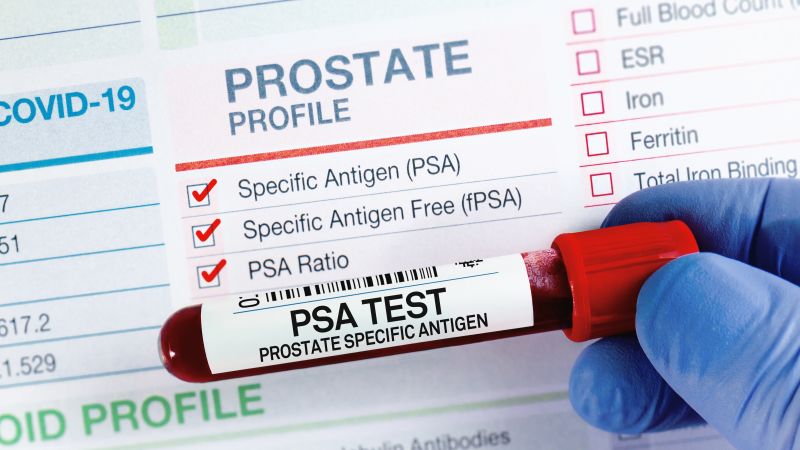
A PSA test is the main screening tool and most common method of screening for prostate cancer. It measures the level of prostate-specific antigen, or PSA, in a sample of your blood.
PSA is a protein produced by the prostate gland, and high levels of PSA in the blood may be caused by cancerous cells in the prostate. But an elevated PSA does not always indicate cancer – it could also be due to an enlarged prostate, common for men as they age, or, less likely, prostate infection.
The new screening guideline describes an abnormal PSA level as being 3 nanograms per milliliter or higher for men 69 and younger, and 6.5 ng/mL or higher for men 70 to 74.
“Your first PSA can be really powerful, especially when obtained in your 40s and 50s. It establishes a baseline,” said Dr. Yaw Nyame, a physician and associate professor at the Fred Hutchinson Cancer Center who served on the expert panel that reviewed the American Cancer Society’s updated screening guideline.
“If that first PSA is under 1 ng/ml, your lifetime risk of prostate cancer is much lower,” Nyame said. “So that first number you get when you’re young can be used as a strategy to improve the way that you approach screening.”
Prostate cancer is the second-leading cause of cancer death among men in the US, behind only lung cancer, and diagnoses have been on the rise. The rate of prostate cancers diagnosed in the US climbed about 3% per year from 2014 through 2022, and there have been more late-stage cancers diagnosed during this time.
Many physicians warn that too many prostate cancers are still being found after the disease has become more difficult to treat, suggesting an urgent need for more screening.
“We’ve seen over the last decade an increase in prostate cancers, driven primarily by men who have advanced prostate cancer,” Dahut said. “So please, talk to your primary care doctor about our updated guidelines and seriously consider prostate cancer screening if you’re within the age range.”
It’s estimated that about 1 in 8 men will be diagnosed with prostate cancer during their lifetime, according to the American Cancer Society.
“This year, more than 330,000 people in the United States will be diagnosed with cancer in their prostate, and many of them will be cured if their cancer is detected early and treated,” Nyame said.
When prostate cancer is detected in its early stages, before spreading, almost all patients – more than 99% – survive at least the next five years.
“While it has been known for a number of years that PSA screening in appropriately selected men saves lives, data for this continues to strengthen,” Dr. Justin Gregg, associate professor of urology and health disparities research at the University of Texas MD Anderson Cancer Center, said in an email.
A European study published last year in the New England Journal of Medicine found that men who were offered repeated PSA testing were 13% less likely to die from prostate cancer than those who were not invited to screen.
“I am happy that the American Cancer Society is encouraging PSA-based prostate cancer screening to help save lives,” said Gregg, who was not involved in the updated guidelines. “While the removal of ‘shared decision making’ language may concern some, the document clearly states that clinicians should go over the benefits, limitations, and harms of PSA screening before a patient decides to initiate screening, which is very important.”
However, not all cancer screening guidelines have done away with the “shared decision-making” language.
The American Cancer Society’s update comes at a time when federal screening recommendations from the US Preventive Services Task Force still stress individualized decision-making, recommending that “the decision to undergo periodic prostate-specific antigen (PSA)-based screening for prostate cancer should be an individual one” for men 55 to 69.
USPSTF recommendations help guide doctors and inform insurance coverage. Its recommendations are given grades, and the Affordable Care Act requires that insurers cover prevention services that get an A or B grade from the group at no cost to patients.
The task force’s prostate cancer screening recommendation, issued in 2018, carries a C grade. But the task force’s website indicates that the recommendation is in the process of being updated.
For millions of older Americans, Medicare already provides coverage for prostate cancer screening.
“Oftentimes, private insurers will follow Medicare, but they’re not mandated to do that,” Dahut said. And many states have laws requiring private health insurers to cover tests to detect prostate cancer, including the PSA test and digital rectal exams, in which a clinician inserts a gloved finger into a man’s rectum to feel the prostate for anything abnormal.
“The PSA blood test itself is generally covered. Medicare covers it, and many private plans do, too. The real problem is what comes next. If the PSA is high, the MRI, biomarker tests and biopsy are often billed as diagnostic care, so patients can face deductibles and coinsurance. In one large study of privately insured men, more than three-quarters had out-of-pocket costs for follow-up testing after an abnormal PSA,” Agarwal said, referencing a study published in the journal Cancer in 2024.
“A formal recommendation helps because insurers and policymakers pay attention to guidelines, and it strengthens the case for coverage that includes the whole pathway,” he said. “But coverage mandates usually follow the USPSTF grade or new legislation, so I’d expect the biggest change to come if those move.”
The PSA’s role as a marker to help screening for prostate cancer was discovered in the 1970s. In the early 1990s, it was demonstrated that the PSA blood test could be used as a first-line screening test for prostate cancer.
“It’s been around since the late ’80s. It does help us find and cure cancers earlier, but PSA tests also have a high false positive rate, meaning the majority of men who have a PSA test that is abnormal have it because their prostate is enlarged, and PSA is just reflecting that effect,” Nyame said.
“So the PSA test is not perfect,” he said. “However, it is an effective screening tool when it comes to reducing prostate cancer deaths, but it can come at that cost of unnecessary testing, patient anxiety and even unneeded treatments.”
Some concerns emerged in the 2000s that the benefits of regular screening didn’t outweigh the risks of overdiagnosis and overtreatment.
A version of the USPSTF’s screening recommendation issued in 2012 advised against PSA-based screening for prostate cancer, citing concerns about what was then perceived as the test’s lack of ability to reduce prostate cancer death and the “inevitability of overdiagnosis and overtreatment,” in which many men who were diagnosed had unnecessary biopsies or treatment for cancers that turned out to be low-risk. These low-risk cancers would never have caused harm or progressed to threaten the person’s life.
After that, screening numbers fell, and more cases of advanced prostate cancer emerged.
“That’s the thing that’s been really challenging to observe presently is that we’ve watched the rate of metastatic cancer increase,” Nyame said. “Many of us are seeing more aggressive cancers in our practices: men coming in with PSAs that are too high, and we’re losing out on the opportunity, when they’re diagnosed early, to cure their cancers because of the delays in diagnosis.”
That 2012 USPSTF recommendation was replaced by the 2018 version advocating for shared decision-making around PSA testing, largely due to clinical trial data from Europe demonstrating a reduction in prostate cancer deaths with PSA screening and a better understand of the limitations of other trials. And in the years since, other technologies have allowed doctors to be more selective about who gets a biopsy for an elevated PSA by limiting it to those with the highest risk of cancer.
“We now have MRI, biomarkers and genomic tests, and we know that many low-risk cancers can simply be watched” and not require treatment, Agarwal said.
“These MRI and biomarker tests have helped us now in determining which patients have really low-risk prostate cancer and should not undergo surgery or radiation,” he said. “So we have decreased the risk of treatment and increased the benefit of PSA testing.”
A group that can benefit most from regular PSA testing is Black men, Agarwal said. He thinks they should start screening closer to age 40 rather than 45, as the American Cancer Society’s updated screening guideline recommends.
“Every year matters, and if you delay the screening, we know that you lose the window of opportunity to diagnose the patients with curable disease,” Agarwal said.
He added that screening guidelines from the Prostate Cancer Foundation and the American Urological Association both suggest that Black men should beginning screening around age 40.
Although recommendations may differ among organizations, most experts agree that prostate cancer screening is not a one-size-fits-all approach, and certain groups – especially Black men – face a significantly higher risk of developing and dying from the disease.
“Prostate cancer tends to show up earlier and more aggressively in Black men. Modeling studies estimate that Black men reach the same level of clinically significant disease three to nine years earlier than other men,” Agarwal said.
“And if you just look at the data on Black patients, 1 in 6 patients who are Black have a lifetime risk of being diagnosed with prostate cancer. The death risk is two to four times higher in Black patients than other men,” he said.
He added that improving men’s access to screening “matters a great deal.”
“That includes access to a doctor who offers PSA testing, follow-through after an abnormal result, MRI, specialist care, active surveillance when appropriate, and timely treatment. Neighborhood, income, and insurance status and trust in the health system all play into it too,” Agarwal said.
“In equal-access systems such as the Veterans Affairs Medical Centers, the outcome gaps between Black and White men are much smaller,” he said. “That tells me much of this disparity is fixable if we get the right care to the right men at the right time.”
Last year, Sens. John Boozman, an Arkansas Republican, and Cory Booker, a Democrat from New Jersey, introduced legislation to expand private health insurance coverage for preventive prostate cancer screenings in men who are at high risk of developing the disease, including Black men.
The bill, dubbed the PSA Screening for HIM Act, “would require insurers to provide coverage for PSA screening for high-risk individuals,” without cost-sharing requirements, such as co-payment, said Gregg, of UT MD Anderson. He added that the American Cancer Society’s updated guidance could turn a spotlight on the legislation.
“While I am not sure what will happen,” Gregg said, “updated recommendations like these may provide evidence to support bills such as this.”
The new screening ACS guideline is “recentering” how PSA testing is viewed and approached – and it’s timely, Nyame said.
“I think it’s going to have an incredible impact, not only on policy where we need some improvement to support increased access to PSA testing for all men across the US, but I think clinically, it’s going to give clinicians time back,” he said, “It’s going to simplify a process that should be simple that we have made really very complicated for primary care doctors.”