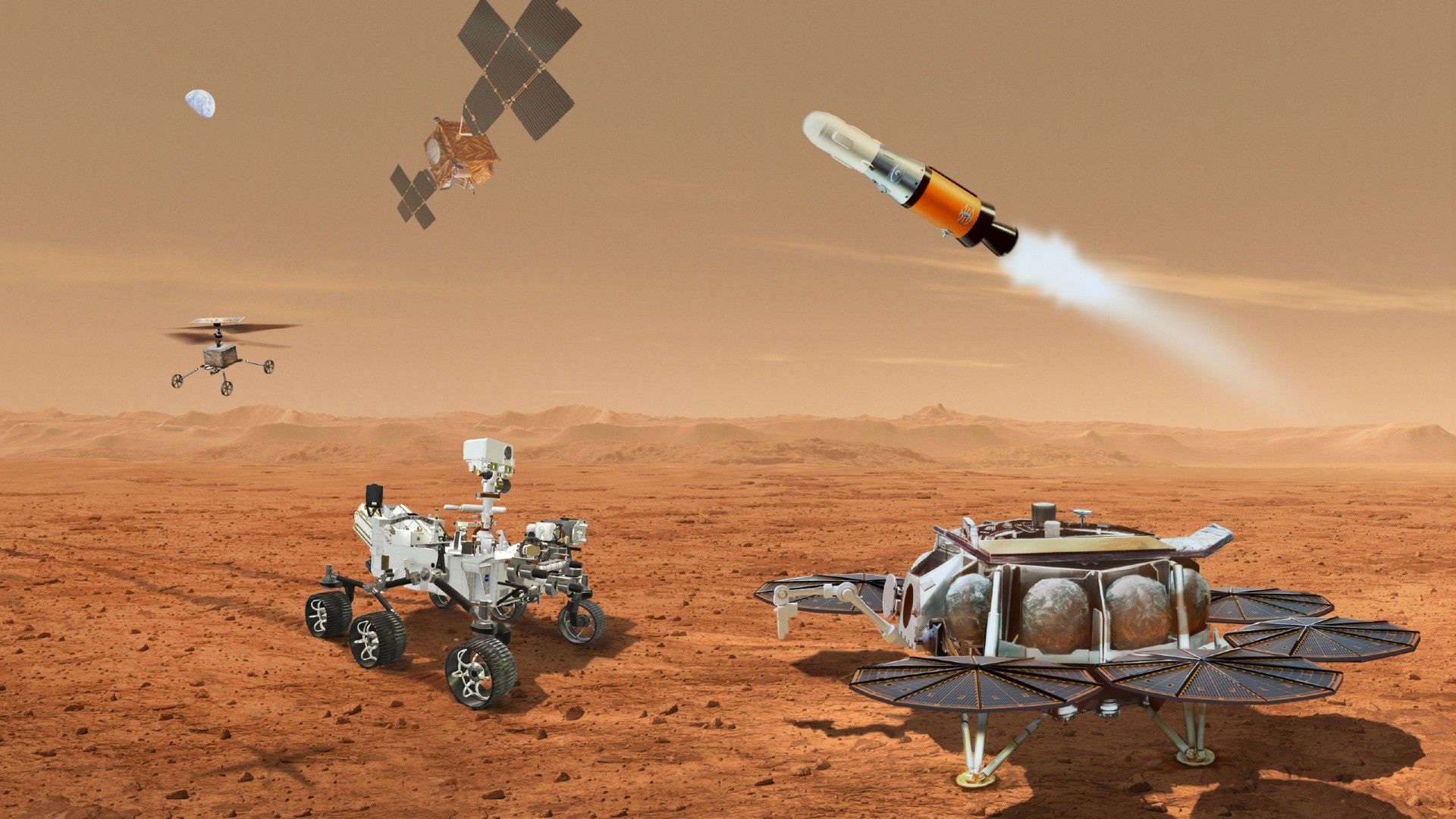
Follow Us Add us as a preferred source on Google Newsletter Subscribe to our newsletter A long-term goal of NASA has been the ability to robotically transport specimens from the Red Planet to Earth. NASA is launching a new initiative for its troubled Mars Sample Return (MSR) program, called Perseverance Sample Retrieval Architecture, or PSRA in space shorthand. The plan is to establish a new NASA strategy to collect Mars samples collected by the Perseverance rover and launch them back to Earth. The PSRA initiative was noted on November 9 by Tiffany Morgan, director of NASA’s Mars Exploration Program (MEP), during the virtual meeting of the Mars Exploration Program Analysis Group (MEPAG). Here is the PSRA strategy: Develop unbiased recommendations for recovering Martian samples collected by NASA’s Perseverance Mars rover and delivering them to Earth Evaluate proposed mission requirements Review previous lessons learned Evaluate current capabilities and acquisition options Morgan noted that there will be a PSRA strategy team kickoff in January 2027 and a final report expected in the winter of 2027-2028. You might like Pick-me-ups The backdrop to PSRA’s activity is that there is already a rover busy on the Red Planet trapping and bagging samples. NASA’s Perseverance Mars rover remains lurking inside Jezero Crater after its landing in February 2021. That car-sized robot has been grabbing selected specimens from around the area and cautiously dropping the sealed pick-me-ups onto the surface of Mars, as well as stuffing them inside the rover itself. Those collectibles may well contain signs of past life on the enigmatic, dusty and sinister Red Planet. NASA and the European Space Agency have been intensively drawing up plans for years to send future spacecraft to Mars and transport those fragments and smells from the atmosphere torn by Perseverance to Earth for rigorous inspection here on Earth using state-of-the-art equipment. This photomontage shows each of the sample tubes deposited by NASA’s Perseverance Mars rover at the Three Forks sample repository, as seen by the WATSON camera at the end of the rover’s robotic arm. (Image credit: NASA/JPL-Caltech/MSSS) Impact of the stickers However, over the years, multiple reviews of a NASA Mars Sample Return (MSR) project by independent groups have reported findings of impact on the stickers. In fact, a final price amounted to about $11 billion, and the samples will be returned to Earth in 2040. NASA itself considered that this discovery was too expensive and not feasible in an acceptable time frame. What to read next Another evaluation group ended up considering it feasible to return Mars samples as early as 2035 for a less expensive ship and a filming cost of about $8 billion. How the PSRA review addresses the cost of MSR and a host of other concerns is in the TBD column. Why do you show now? First of all, why are Mars samples delivered by robotic means? Why not let a human expedition bring the goods? Also speaking at MEPAG was Bruce Jakosky of the Laboratory for Atmospheric and Space Physics at the University of Colorado Boulder and the Department of Earth and Space Sciences at the University of Washington. Jakosky called for an integrated approach to planning human missions to Mars. He highlighted recommendations derived from a workshop he participated in, held last May and hosted by Explore Mars, Inc. That report focused on the impact of MSR on reducing risk to human missions, rather than focusing on the science, Jakosky told Space.com. “The purpose is to understand the risk to astronauts and hardware. The risk includes that of compounds that are present in the soil and that are dangerous to astronauts if breathed in,” Jakosky said. “This includes perchlorates and chloromethanes that have already been identified, and the detection of other species that could be present. It also includes dust that astronauts can breathe and that can affect hardware wear,” he said. During the MEPAG meeting, Jakosky highlighted the importance of returning samples before human missions to Mars, such as: Identifying and characterizing known hazardous chemicals to ensure astronaut safety (e.g., perchlorates and chloromethanes), and searching for potential additional hazardous substances. chemicalsCharacterize very fine dust particles that could cause respiratory problems in astronautsCharacterize the properties of dust and regolith for spacesuit design and wear patternsSearch before the arrival of humans for evidence of existing life that may interact with terrestrial lifeImprove the effectiveness of astronauts on the surface and scientific return from human missions by providing initial context and analysisDemonstrate a successful round trip to MarsDemonstrate a successful round trip, including entry, descent, landing and ascent from the surface of Mars. Demonstrate the implementation of planetary protection protocols. While human missions would not use the same approaches, what we learn from doing them would make the approach for humans much easier to plan and implement. China Program Diagram of China’s proposed Tianwen 3 Mars sample return mission. (Image credit: University of Hong Kong/Zengqian Hou, et al.) Another pressure factor for NASA in another MSR review is that China is advancing its Tianwen-3 sample return mission to Mars. According to the China National Space Administration, the country’s Tianwen-3 probe will have a lander, an ascender, a service capsule, an orbiter and an Earth reentry module. Tianwen-3 appears to be on track to begin the journey. 2028 on two Long March-5 heavy-lift carrier rockets from the Wenchang space launch site in China’s southernmost island province of Hainan. China’s Tianwen-3 mission is dedicated to bringing approximately 500 grams of Red Planet collectibles back to Earth in 2031.