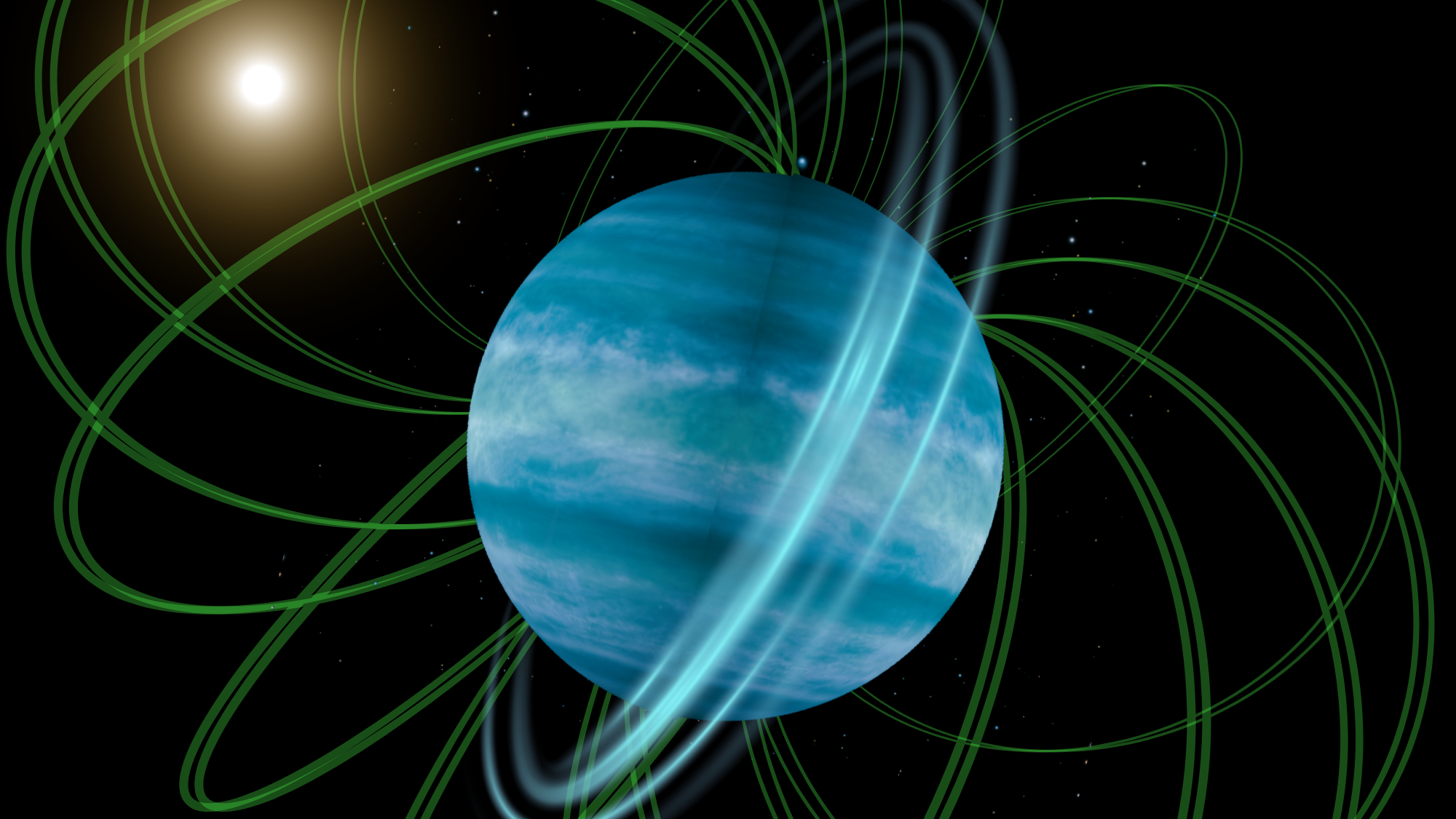
Follow Us Add us as a preferred source on Google Newsletter Subscribe to our newsletter The opposing magnetic fields of Uranus and Neptune may be due to extreme conditions found deep within them. Unraveling the mystery behind these worlds’ magnetic fields is giving us new insight into the little-known interiors of the ice giants. Only one spacecraft has ever visited Uranus and Neptune, the Voyager 2 spacecraft which passed by Uranus in January 1986 and Neptune in August 1989. Voyager 2 discovered that its planetary magnetic fields were, to put it bluntly, unstable. Uranus’s magnetic field was offset from its axis of rotation by 59 degrees and is not even centered on the planet’s core, but is only two-thirds of the way down. Neptune is similar, with a disordered magnetic field displaced 47 degrees and centered halfway between the core and its visible cloud tops. If we compare these planets to Earth, which has a stable magnetic field tilted only 11 degrees with respect to our planet’s rotation, we can see how extreme the ice giants’ magnetic fields are. Various explanations for the ice giants’ strange magnetic fields have been proposed over the years. Uranus as a whole is tilted 97 degrees and effectively orbits the Sun, and is speculated to have been toppled billions of years ago by a collision with a long-lost Earth-sized planet. Is it possible that this collision also skewed its magnetic field? This could be a plausible explanation if Neptune’s magnetic field were not equally biased without having experienced a collision. Clearly, whatever the cause, it must be intrinsic to the nature of the two ice giant planets. Now, a new study by US and UK scientists, based on computer simulations and measurements of the two planets’ magnetic fields by Voyager 2, may have found a solution. The solution to the strange magnetic fields of the solar system’s ice giants may come down to how planets generate their magnetic field through the dynamo effect. This arises from the convective and rotating movement of an electrically conductive liquid within a rotating body, which is capable of generating and maintaining a powerful magnetic field. You may like Inside the Earth, the electrically conductive fluid is the molten iron on the outside of the core of our planet, and the magnetic field it generates has clear north and south poles, what we call a dipole, a phenomenon that we can also see in the two magnetic poles of a simple bar magnet. However, the conditions inside Uranus and Neptune are somewhat different. As ice giants, they contain many volatiles: ammonia, hydrogen, helium, methane and water surrounding a probable rocky core. Additionally, Uranus and Neptune are substantially larger than Earth, at 14.5 and 17 times the mass of our planet, respectively. This increase in mass creates overwhelming conditions inside the ice giants. “Deep within Uranus and Neptune, pressures and temperatures become extremely high,” research team leader Chi Yan of the University of Texas at Austin, who led the new findings, said in a statement. “Under these conditions, which can cause water molecules to break up into ions, the material can become increasingly electrically conductive as depth increases.” Diagrams showing the intricate magnetic fields of Uranus (left) and Neptune (Image credit: Yan et al.) Given the increasing electrical conductivity and compositions of the two planets, computer simulations were able to replicate the strange magnetic fields of Uranus and Neptune. This showed how the magnetic field structure co-evolves along with changes in fluid motion driven by convection and temperature within the planets. It also seems that this coevolution might not be over yet. Simulations indicate that the magnetic fields of both planets can change quite significantly in just a few decades. What to read next “Earth’s magnetic tilt varies only about one degree in 50 years,” Yan said. “Our models show that ice giants can behave very differently. In some reaches, the inclination oscillates tens of degrees over decades. In others, it shifts only slightly in the same period.” Uranus seen by Voyager 2 in 1986 (Image credit: NASA/JPL-Caltech) NASA has prioritized a new mission to return to Uranus in the early 2040s, while the China National Space Administration’s Tianwen-4 mission, launching to Jupiter in 2029, will deploy a small probe to reach Uranus using a gravitational slingshot. Until then, scientists are coming up with creative ways to not have to rely solely on measurements of magnetic fields from the 40-year-old Voyager 2. For example, Tom Stallard of Northumbria University in the United Kingdom, co-author with Yan of the new research paper, has been leading the James Webb Space Telescope (JWST) observations of the faint infrared lights of auroras on both Uranus and Neptune. Auroras are generated when charged particles from the solar wind interact with a planet’s magnetic field, propelling some of those charged particles into the atmosphere above the magnetic poles. (Neptune actually has a quadrupole component, which confuses its defined north and south magnetic poles.) As such, the location of auroras is a good indicator of what is happening with a planet’s magnetic field. “We are busy working on what these observations contain, but the shape and structure of the aurora, as well as other strange patterns in the ionosphere [upper atmosphere]promise to provide us with a way to understand how magnetic fields have changed, [which is] an important step,” Stallard said. The hope is that by combining JWST’s aurora observations with Voyager 2’s magnetic field measurements and results from computer simulations, it will be possible to estimate the configuration of the magnetic fields on Uranus and Neptune today and see how they compare to the 1980s. This would provide an experimental test to help show whether the new model describing magnetic fields is on the right track, although we won’t know for sure. until that a new mission is coming to the ice giants’ backyard. The findings were described on November 3 in the journal Communications Physics.