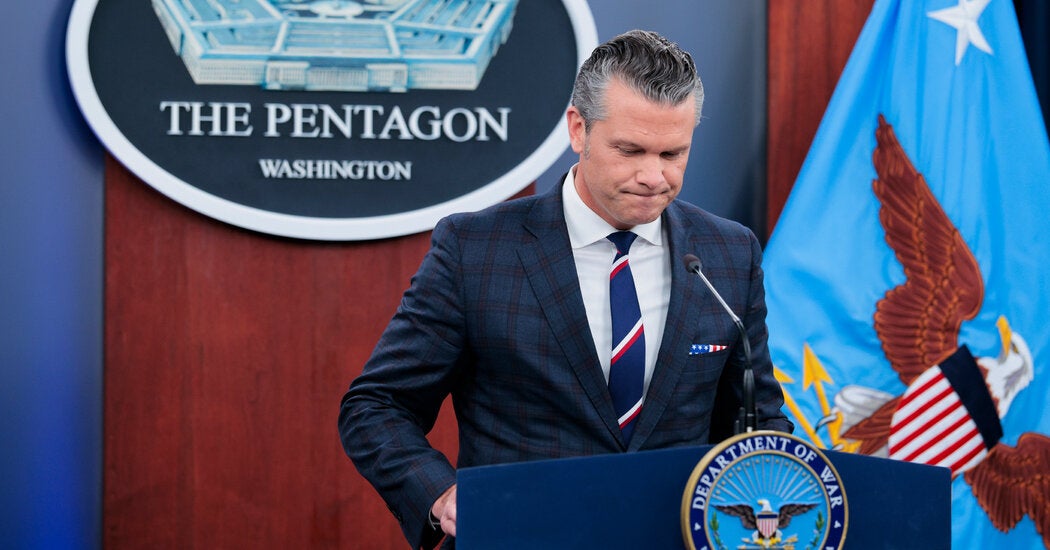
Defense Secretary Pete Hegseth faces eight articles of impeachment brought by Rep. Thomas Massie, R-Ky. They accuse him of violating federal law and the Constitution through military operations against Iran, Venezuela and Yemen, the murder of civilians and retaliation against a sitting US senator. Three of the charges focus on the war with Iran, which Massie claims was illegal from the beginning. The remaining articles focus on decisions Hegseth has made overseeing the Pentagon, including his revocation of protections against civilian casualties and military strikes against suspected drug traffickers in the Pacific and Caribbean. “We’re not impeaching him for being bad at his job,” Massie said during a news conference at the Capitol on Monday after reading his resolution on the House floor. “In fact, he was very effective in killing schoolchildren in Iran. The argument here is that he has violated the laws and the Constitution.” Hegseth held a press conference Tuesday morning in which he called the articles a smear effort by a “disgruntled and defeated congressman,” and the Pentagon has said it “will not back down or be deterred.” President Trump defended Hegseth on Sunday, saying, “He’s guilty of two things, basically winning two wars.” Congressional Authorization Secretary Hegseth knowingly executed and implemented illegal orders to initiate a war against a foreign nation despite the absence of Congressional authorization, an attack on the United States that gave rise to the national emergency contemplated by law, or an imminent threat requiring immediate defensive action, thereby substituting illegal executive action for Congress’s constitutional and statutory judgment. The first charge invokes the War Powers Resolution of 1973, which was enacted without a veto and limits the president’s ability to initiate or escalate military actions abroad without the consent of Congress. It claims that the war, which began on February 28 when US forces launched joint attacks with Israel against Iran, was illegal from the beginning because it did not meet any of the conditions set out in the statute to authorize a conflict. These include a declaration of war, congressional approval for the use of military force, or an attack on the United States. The resolution refers to the March 17 resignation of Joe Kent, who at the time was serving as director of the National Counterterrorism Center and said Iran did not pose an imminent threat to the United States. The administration has maintained that the president has the constitutional authority under his powers as commander in chief to conduct the military campaign without any action by Congress. Article II: Defying Congressional Vote to End Iran Secretary of War Hegseth executed, and continues to do so, illegal orders in violation of Section 5(c) of the War Powers Resolution of 1973, section 1544(c) of title 50, United States Code. The House voted June 3 to order the withdrawal of U.S. forces from unauthorized hostilities in Iran. On June 23, the Senate approved the same measure, a concurrent resolution that alone did not have the force of law but was a clear statement of Congress’s opposition to continuing the conflict. Massie maintains that the votes complied with a provision of the War Powers Resolution that requires the withdrawal of U.S. troops if Congress passes a concurrent resolution ordering it. By ignoring the measure, Massie says, Hegseth acted “in contravention” of the war powers law. “The law is written,” he said Monday. “Pete Hegseth is obligated to follow the laws on the books, not the laws he wants to follow.” There is legal uncertainty about such a charge. A 1983 Supreme Court ruling, INS v. Chadha, casts doubt on congressional mechanisms that attempt to bind the executive branch without submitting legislation to the president for his signature, which the concurrent resolutions do not require. Article III: Continuation of the Iran War Beyond a Legal Deadline Direct the Department of Defense to treat the mandatory termination requirement as discretionary. The third article focuses on a 60-day deadline in the war powers law that determines when military action that was not authorized by Congress must end. The statute allows for an additional 30 days in limited circumstances if necessary to facilitate the safe withdrawal of U.S. forces. Trump and his administration ignored both deadlines, arguing that they were not subject to the law. The president and his advisers have claimed at various points that the war was over, including in May, around the 60-day mark, when they declared that Operation Epic Fury, the original mission, “concluded” amid a ceasefire, and then classified subsequent attacks as a separate military operation. “The war never ended,” Massie said. “There was never a legitimate cessation of the war.” Article IV: Circumventing Laws to Prevent Civilian Deaths By directing the Department of Defense in a manner that predictably dismantled the safeguards necessary to distinguish civilian objects from military objectives, Secretary Hegseth carried out the murder of civilians and abused the trust of the men and women under his command by requiring them to conduct military operations within a system of targeting and legal review that he had deliberately degraded. The article accuses Mr. Hegseth of ignoring congressionally mandated safeguards against civilian deaths and casualties, including eliminating funding for the Army database that tracks them, eliminating most personnel who oversee civilian harm mitigation, and firing military lawyers in several branches. It seeks to link those measures to the bombing of the Shajarah Tayyebeh primary school in Minab, Iran, on the first day of the war, which Iranian officials say killed at least 175 people, most of them children. The resolution cites Mr. Hegseth’s comments during a press conference he held days after the war began, when he said there would be no “stupid rules of engagement” in the conflict. He also refers to a statement by the secretary last year in which he boasted of a force focused on “maximum lethality, not lukewarm legality.” to determine who can live and who can die. This article questions the administration’s attacks on ships suspected of trafficking narcotics in the Caribbean and eastern Pacific Ocean, which began in September 2025. It accuses Mr. Hegseth of positioning himself as an “executioner” who directed the extrajudicial executions of at least 221 people over the course of more than 60 attacks. The article highlights a September 2 attack in which US forces launched a so-called “Double Tap” attack that killed two survivors clinging to the remains of an initial attack, calling it “contrary to US law and customary international law.” The administration has defended the operations as necessary to fight dangerous trafficking organizations, but the resolution declares that the campaign exceeded the Pentagon’s legal authority and endangered American service members by encouraging adversaries to ignore protections for survivors. Article VI: Attacking Senator Mark Kelly Using the powers of his office, Secretary Hegseth retaliated and attempted to intimidate U.S. Senator Mark Kelly for his testimony through a plan or course of conduct intended to interfere with Congress’s constitutional authority to oversee the Executive Branch. The sixth charge concerns Mr. Hegseth’s response to a November 2025 video in which Senator Mark Kelly of Arizona and a group of other Democratic lawmakers informed troops that they could refuse illegal orders. After Mr. Trump accused Mr. Kelly, a retired Navy captain, of sedition and called for him to be hanged for his comments, Mr. Hegseth echoed the rebukes, censured the senator and initiated disciplinary proceedings that could result in the reduction of his military rank and pension. Kelly sued Mr. Hegseth, accusing the Secretary of Defense of violating his right to free speech, and a federal judge agreed and blocked the punishment, although the Justice Department appealed the ruling. The resolution calls the actions against Mr. Kelly retaliation against protected speech and a public campaign to intimidate a sitting member of Congress. Article VII: Kidnapping of a Foreign Leader An act of war against a sovereign country executed under the pretext of narcotics law enforcement. This article addresses the military operation of January 3 that captured President Nicolás. Maduro from Venezuela and his wife, Cilia Flores. More than 150 aircraft and drones and hundreds of US military personnel participated in the operation. The Trump administration has repeatedly said the mission was a law enforcement operation tied to federal indictments, but the impeachment charge calls it an unauthorized “act of war against a sovereign country executed under the guise of narcotics law enforcement.” Article VIII: Starting an Unsanctioned War in Yemen Secretary Hegseth initiated and directed Operation Rough Rider without Congressional authority. It was an unauthorized operation launched without congressional approval or an imminent threat to the United States. The campaign aimed to stop attacks on commercial ships in the Red Sea. It was associated with an early scandal for Hegseth, in which he and other senior administration officials discussed planned military strikes in a group chat that inadvertently included a journalist.