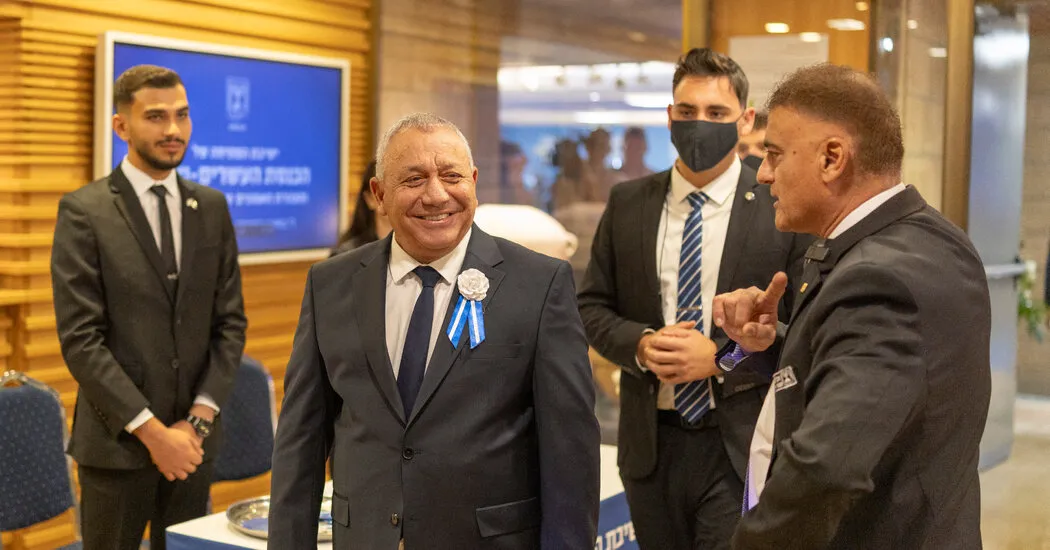
Israel swore in a new parliament on Tuesday with an opposition that has a majority and some influence over the assembly, weeks after an inconclusive election that has yet to produce a government. Parliament, called the Knesset, said in a statement that the ceremony would be a “festive” session, even as it was expected to kick off a tense period of political wrangling in the deeply divided country. “The people who elected you long for routine, security and tranquility,” Isaac Herzog, president of Israel, said in a speech opening the session. “The people you represent here long to see an extended hand that brings unity to the nation and hope.” Herzog has given Gadi Eisenkot, leader of the opposition bloc and rival of Prime Minister Benjamin Netanyahu, the first opportunity to try to form a government. Eisenkot, a former military chief who heads the center-right Yashar party, received support for prime minister from 67 of the 120 members of the newly elected Knesset. Still, last month’s election results have left neither Eisenkot’s diverse opposition bloc nor Netanyahu’s far-right coalition with a clear path to power. Netanyahu will remain as interim prime minister until a new government is formed. Some of Eisenkot’s key Jewish allies have opposed him forming a government that depends on the support of Israel’s Arab-led parties, which collectively won more seats than ever in this new parliament. Without them, Eisenkot’s bloc would fall short of the 61-seat majority needed for a stable government. Hanging over the swearing-in ceremony was also the question of how long this Parliament will last. If efforts to form a government fail in the coming weeks or months, the Knesset would automatically dissolve, sending Israelis back to the polls for a second round of elections. Meanwhile, the anti-Netanyahu opposition bloc of Jewish and Arab parties intends to use its majority in Parliament to try to take control of the legislature even without a new government in place, according to party officials. The first step would be to take control of the Knesset agenda by replacing Parliament Speaker Amir Ohana. a Netanyahu loyalist, officials have said. They also intend to form key parliamentary committees to advance the legislation. Taking control of Parliament as an initial step is “a logical move,” said Gideon Rahat, a political science professor at the Hebrew University of Jerusalem, given that the executive branch of government in Israel arises from the legislature. “It makes sense in a parliamentary system to control Parliament first of all,” Rahat said, before trying to build a governing coalition. Eisenkot’s Yashar party said Tuesday afternoon that it had requested a vote to replace Knesset Speaker Amir Ohana, a Netanyahu loyalist. Yashar said Matan Kahana, a senior party figure and former minister, had been nominated to serve as president, although it was unclear when the vote would take place. Yashar on Tuesday also announced other nominees for positions on the committee that included senior figures from other parties in the anti-Netanyahu bloc. Yashar said the heads of the Jewish-led parties in the bloc had agreed to nominate Avigdor Liberman, former defense minister and leader of the Yisrael Beitenu party, to be chairman of the prestigious Foreign Affairs and Defense Committee. They also agreed to nominate Liran Avishar Ben-Horin, a member of Naftali Bennett’s Together party, to be chairman of the Finance Committee, the party said. Lawmakers opposed to Netanyahu are now discussing possible bills that could reverse some of the controversial laws passed by his government, according to a political aide who spoke on condition of anonymity to discuss private deliberations. Those laws relate to an effort by Netanyahu to limit the powers of Israel’s judiciary, the aide said. Many opposition members have said they intend to push for a state commission of inquiry into the security failures that preceded the Hamas-led attack on October 7, 2023, against Israel, which occurred under Netanyahu’s direction. He and his allies have previously blocked efforts to establish such an investigation, saying it would not uncover the truth. Among the other new faces taking their seats in Parliament are several lawmakers whose relatives were killed or taken hostage in the October 2023 attack, which sparked the war in Gaza. Israel’s newly elected Parliament also includes 33 women and dozens of first-time lawmakers. The youngest member is Yonatan Shalev, 24, of the Together party, which represents army reservists calling for an end to mass exemptions from military service for ultra-Orthodox Jewish men. The exemptions were a key issue in last month’s election and fueled public resentment toward Israel’s ultra-Orthodox community during recent years of war. Heedo Abu Laban and Adam Rasgon contributed reporting.