A traffic jam is growing around Earth, but most of the debris is too small to see or track.
Scientists estimate that more than 230 million pieces of space debris measuring between 1 millimeter and 1 centimeter are circling the planet, along with another 1.5 million larger fragments. Traveling at orbital speeds that can exceed 17,000 mph, even relatively small pieces can seriously damage a functioning satellite.
And the problem could keep getting worse, even if we stopped launching spacecraft.
As companies explore putting artificial intelligence data centers in space and expand satellite networks, researchers warn that collisions could create more debris, setting off a chain reaction that makes parts of Earth’s orbit increasingly dangerous to use.
Now, a new British mission aims to send a robotic spacecraft into orbit to remove dead satellites, while researchers at North Carolina State University are exploring an unexpectedly simple way to encourage cleanup: a deposit system similar to those used for returnable bottles.
A growing junkyard above Earth
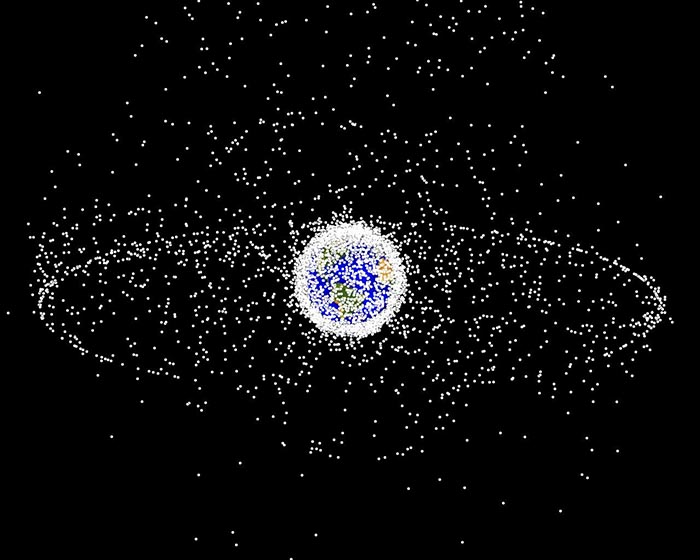
NASA visualizations show thousands of objects surrounding the planet, including discarded rocket components, defunct satellites and fragments from previous collisions.
In one NASA visualization showing tracked objects as of Jan. 1, 2019, approximately 95% represented orbital debris rather than functioning satellites.
The dots are enlarged to make them visible and do not represent the actual size of objects in orbit. The visualization also excludes the vast majority of smaller fragments that cannot be individually tracked.
The European Space Agency’s latest statistics, updated Nov. 2, 2026, estimate:
230 million debris objects measuring between 1 millimeter and 1 centimeter.1.5 million debris objects measuring between 1 and 10 centimeters.About 68,450 objects larger than 10 centimeters, including active spacecraft.Roughly 19,610 satellites still in orbit, including approximately 15,800 functioning satellites.
That means thousands of satellites are no longer operating, while millions of fragments from rockets, spacecraft and previous breakups continue circling Earth.
“The risk with space is we don’t have cleanup crews, right?” said Mark Moretto, an assistant professor of mechanical and aerospace engineering at NC State.
Moretto studies the long-term sustainability of Earth’s orbit, including how collisions and cleanup efforts could affect future space operations.
He said debris can be especially dangerous when it is too small to track but still large enough to disable an active spacecraft.
A collision between two large objects can generate thousands of additional fragments, increasing the number of hazards for other satellites.
Scientists call the potential cascading process Kessler syndrome.
In a September 2026 analysis, the European Space Agency warned that the debris population could continue growing through collisions even if no additional satellites were launched. Over time, some orbital regions could become increasingly unsafe or potentially unusable.
The consequences extend well beyond space exploration. Satellites support GPS navigation, weather forecasting, communications and other services people use every day.
The problem is already affecting astronomy
At Duke University, assistant research professor of physics Arun Kannawadi is seeing another consequence of growing satellite traffic.
As an observational astronomer, Kannawadi studies stars and galaxies using telescope images. But satellites passing overhead can reflect sunlight, leaving bright streaks across the observations.
Scientists can digitally remove those streaks, but doing so also removes information from the affected portions of an image.
“Every time we have to mask them, we lose some some precious data that we are taking,” Kannawadi said.
He worries that as more satellites enter orbit, astronomers could miss rare discoveries hidden behind those streaks.
The issue is particularly concerning as companies propose much larger orbital infrastructure, including computing facilities designed to process artificial intelligence workloads in space.
Those projects could increase the number and size of spacecraft operating above Earth, raising additional questions about collision avoidance, light pollution and how the equipment would eventually be removed.
SpaceX acknowledges growing collision risks
SpaceX, which operates the world’s largest satellite constellation through Starlink, has publicly acknowledged that increasing orbital traffic requires stronger safety measures and coordination among satellite operators.
In an Oct. 6 update, the company reported operating more than 11,000 Starlink satellites in low Earth orbit. It also described plans that could eventually include up to 100,000 Starlink satellites and as many as 1 million satellites dedicated to orbital AI computing.
Those are company plans, not spacecraft already deployed.
SpaceX has called for operators to share more accurate satellite location and trajectory information to reduce the risk of collisions.
The company has developed automated collision-avoidance systems and a space-tracking network called Stargaze. It also says its satellites are designed to operate at relatively low altitudes, where atmospheric drag can eventually pull failed spacecraft back toward Earth.
In previous statements about space sustainability, SpaceX said it proactively removes satellites at risk of becoming unable to maneuver, even when that means retiring otherwise functioning spacecraft.
But the company’s expanding constellation illustrates a broader challenge: Keeping satellites from colliding becomes more complicated as more operators place spacecraft in orbit.
And avoiding collisions does not remove the millions of fragments already there.
A robotic cleanup mission aims to tackle the problem
In October, the U.K. Space Agency announced a £61 million contract with ClearSpace to develop a spacecraft capable of capturing two dead satellites and removing them from orbit.
The mission is scheduled to launch in 2029, with the goal of removing both satellites by 2032.
Using robotic claws, the spacecraft would approach satellites that were never designed to be captured, secure them and guide them toward reentry into Earth’s atmosphere, where they would burn up.
The technology could eventually help remove larger abandoned spacecraft and rocket components that pose significant collision risks.
Moretto said those large objects are particularly important because they can generate enormous amounts of additional debris if they collide or break apart.
Removing two satellites will not substantially reduce the overall debris population. Instead, the mission is intended to demonstrate technology that could make future cleanup operations possible.
The U.K. government also envisions developing spacecraft that can be refueled and reused for future servicing and removal missions.
But the mission raises another challenge: Removing spacecraft from orbit does not necessarily eliminate their environmental footprint.
Where does space junk go when it comes back down?
For many satellites operating in low Earth orbit, the most common disposal method is to let them descend into Earth’s atmosphere, where frictional heating during reentry causes much of the spacecraft to burn up.
The process reduces the amount of debris left in orbit, but it also introduces materials into the upper atmosphere.
Satellites contain metals, including aluminum, that can form particles such as aluminum oxide as they burn up.
Scientists are investigating whether increasing amounts of those materials could affect atmospheric chemistry, including processes involving the ozone layer.
Moretto said Earth naturally encounters material from meteoroids every day, but the composition of human-made spacecraft is different.
That makes the potential environmental consequences an open research question.
Engineers are also exploring ways to design satellites so their materials break apart and burn up in less environmentally disruptive ways.
The trade-off underscores the complexity of space sustainability: Removing debris from orbit can reduce collision risks, but the environmental consequences of disposal also need to be understood.
Could the solution be as simple as a bottle deposit?
Moretto’s research at NC State explores a different approach to the problem: giving satellite operators a financial incentive to remove their spacecraft when they reach the end of their useful lives.
The concept resembles a bottle deposit program.
A company would pay a deposit when launching a satellite and receive that money back after successfully removing it from orbit.
Moretto said a recent study he participated in found that even relatively limited participation could produce meaningful improvements in long-term orbital sustainability.
The researchers modeled a system in which just 20% of satellites participated in the deposit program.
The findings suggest financial incentives could complement regulations and robotic cleanup missions, encouraging companies to plan for disposal before their satellites ever leave Earth.
Moretto also studies the economics of active debris removal through NASA-funded research, examining how cleanup efforts could influence the future satellite population.
The immediate financial benefits of removing a single object are not always obvious, he said, but preventing collisions could help preserve access to valuable orbital regions over the long term.
The challenge is determining who should pay, how international operators would participate and how to enforce responsibility in an environment shared by countries and private companies.
With more satellites being launched and new industries looking to expand into orbit, researchers say those questions are becoming increasingly urgent.
The technology to launch spacecraft has advanced rapidly. Finding ways to prevent them from becoming permanent hazards may be just as important to the future of space.