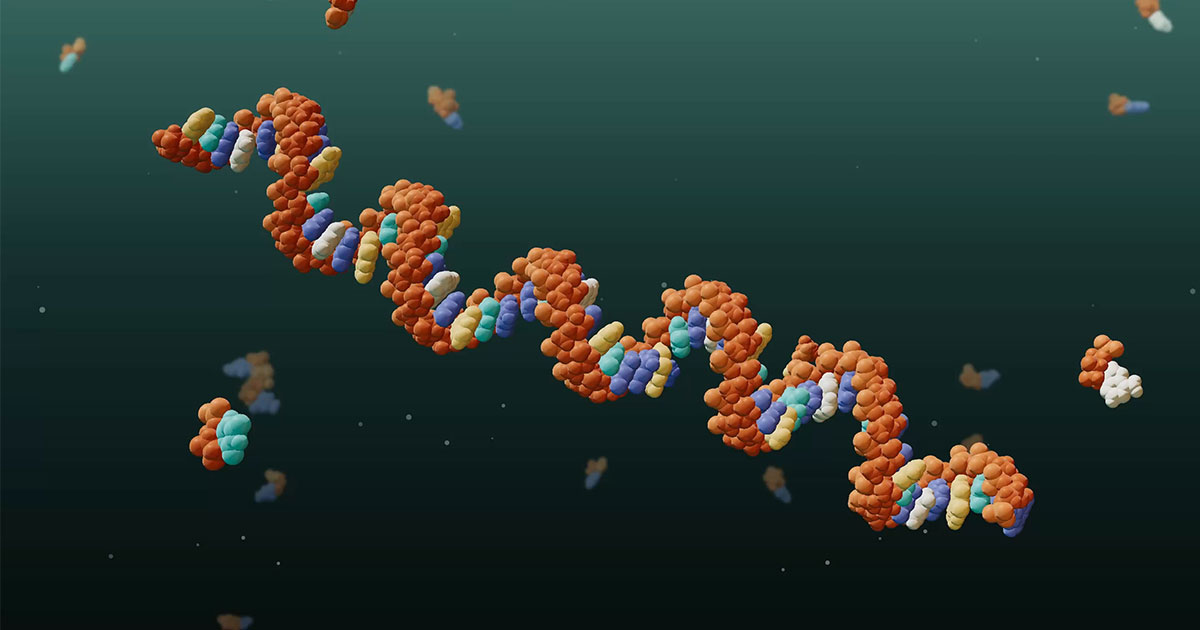
There is hardly a corner of the Earth where life has not taken hold. Living organisms shape clouds, climate, and even rocks. But how life first appeared on an arid planet about 4 billion years ago remains one of the biggest questions for science. Many researchers believe that self-replication (the ability to reliably store and copy genetic information) is the most fundamental ability of life. If that’s true, then early life forms would likely have needed the kind of biomolecules that life uses today to store and copy genetic information. The DNA molecule is the star of this process; It encodes the shapes of protein molecules that allow chemical reactions in cells. To translate the genetic information from DNA into the chemical structure of proteins, cells use RNA. The problem is that in modern cells, proteins are involved in every step of this process: they duplicate DNA when cells divide, transcribe DNA into RNA, and help use RNA to make more proteins. This creates a chicken-and-egg problem: useful proteins cannot be made in cells without DNA, but proteins are necessary to make DNA in the first place. A discovery about RNA in the late 1980s seemed to break the deadlock. Researchers discovered that, in addition to helping convert genetic information into proteins, some RNAs can act as catalysts that enable chemical reactions. They were named ribozymes, in reference to the protein catalysts called enzymes. The existence of ribozymes suggested that RNA can carry genetic sequence information and act as a catalyst, thus doing the work of both DNA and proteins. That makes it possible that in its early days, life (or the complex chemistry that preceded it) was based exclusively on RNA. According to this view, championed by physicist-turned-biologist Walter Gilbert, life began as a world of RNA. Imagine then that, somewhere on prebiotic Earth, individual nucleotide molecules appeared and spontaneously and randomly joined together into chains. By chance, one momentous day, one of these nucleotide chains acquired the correct sequence to act as a ribozyme with the ability to help form other RNAs. Such a prebiotic ribozyme could even act as an autocatalyst, capable of replicating itself. In 1996, this theory received a boost when researchers created a ribozyme that could actually join together individual nucleotides to form RNA. This raised the possibility that RNA could replicate. Because such replication would be vulnerable to the random noise of the molecular world, errors would occur. Some replicated RNAs would have a slightly different sequence than their parent. With such mutations, Darwinian evolution becomes possible: natural selection would favor mutant replicators that make copies at a faster rate. These primitive and evolving molecular systems would not be “alive” in themselves. It is easy to imagine, however, how some RNA molecules could evolve into forms that catalyze metabolic processes or create other complex biomolecules, and from there the path to the first truly living protocells is glimpsed. The “RNA world,” as the idea was called, sounds good in theory. But there are problems with the hypothesis. In 2019, RNA biologist Gerald Joyce of the Salk Institute and his colleagues were exploring a method to produce new ribozymes in the laboratory. They began by creating synthetic ribozymes that could produce other RNAs. They then mixed up the ribozyme sequences a bit to allow them to evolve artificially. Although they eventually found a ribozyme capable of synthesizing the RNA from which it had “evolved,” Joyce and his colleagues found that mutations introduced in each round of evolution tended to kill catalytic behavior. Very few mutants in each successive generation retained the ability to build other RNA molecules. Altogether, the experiments suggest that self-sustained RNA evolution appears to be difficult. Furthermore, all of Joyce’s ribozymes were large, comprising perhaps several hundred linked nucleotides. However, current experiments have only produced spontaneous assembly of RNAs that are relatively small (between 10 and 15 nucleotides long). It is a big leap to go from the random assembly of small, fragmentary RNAs to an RNA world in which large molecules can form, let alone replicate and evolve. The possibility that functional molecules like these come together at random and then remain in some primordial group seems minuscule. But true believers in the RNA world have some reasons to remain hopeful. Recent work by biologist Philipp Holliger of the MRC Molecular Biology Laboratory in the United Kingdom and his colleagues has shown that self-replicating RNAs do not have to be as large as Joyce ribozymes. In their own artificial RNA evolution experiments, Holliger’s team looked for catalytic activity in small RNAs (between 20 and 40 nucleotides in length), allowing for small length changes with each mutation cycle. They found a 45-nucleotide molecule they called QT45 (“quite small”) that could capture another strand of RNA and copy it. “In principle, you can copy any sequence,” Holliger said. And obtaining a 45-nucleotide molecule spontaneously “does not seem like a crazy request,” he added. In fact, the researchers say, catalytic activity could be maintained even if QT45 splits into two fragments, since the parts should still be able to do their job. The researchers also found two other comparably small RNAs with similar activity within an initial group of around 10 trillion different molecules. Since this number of molecules includes only one hundred billionth of all possible RNA sequences of this length, it’s actually a pretty good hit rate, Holliger said. It suggests that this kind of self-copying ability in small RNAs might be common enough that such molecules could have appeared quite easily among random RNAs in some kind of primordial soup. That “could” is working very well. It is not known whether a niche for an RNA world existed, either geographically or temporally, on the early Earth. Holliger and his colleagues have shown that rounds of RNA replication that lead to exponential growth can be driven by cyclic changes in acidity along with cycles of freezing and thawing the solution, a plausible scenario at the icy poles of the young Earth. But any potential habitat would have to have been supportive of life long enough for a spark of life to ignite. Perhaps most importantly, it is not clear that an RNA world is actually alive. Life is not just about self-replicating carriers of genetic information: more ingredients are needed, particularly the existence of some form of metabolism, to harvest energy from the environment and use it to produce useful molecules. Regardless of how life began, it probably needed more than just a string of nucleotides.