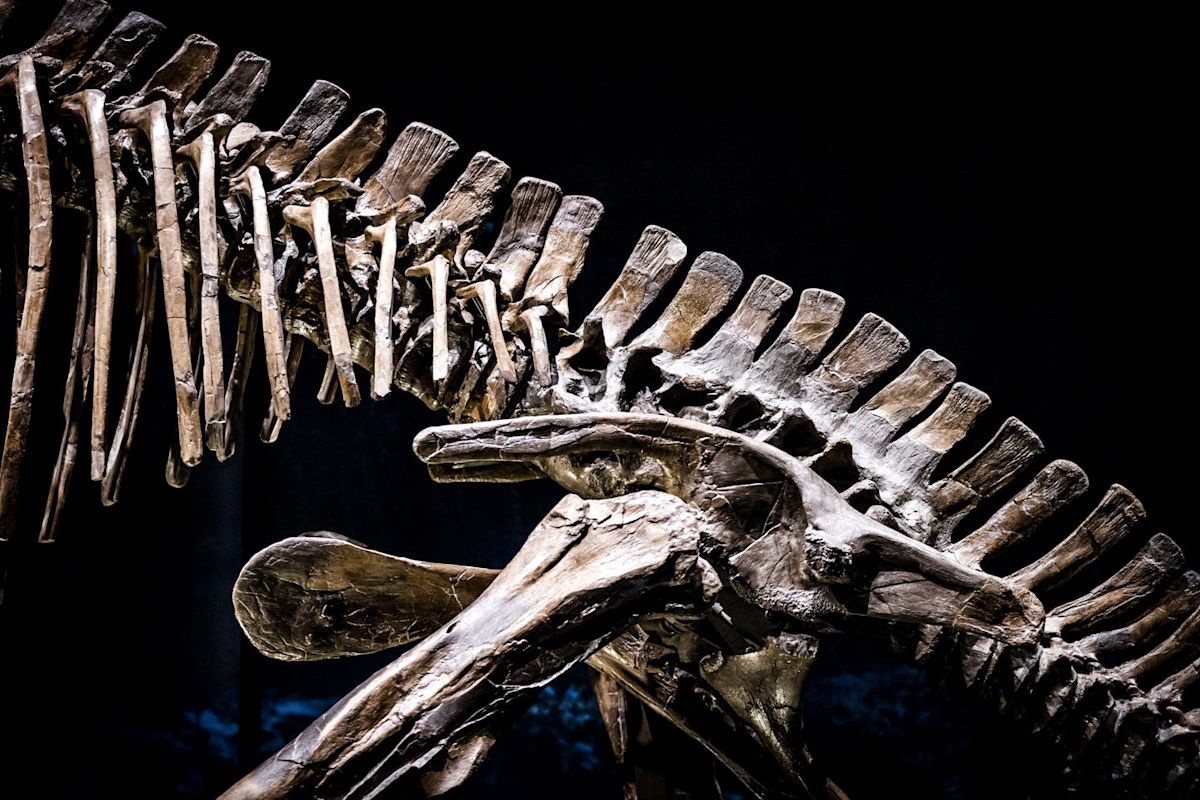
At first glance, the news seems like the first lines of a Jurassic Park sequel. In a study published in the Proceedings of the National Academy of Sciences, an international team of scientists reports finding traces of heme, an organic molecule that helps blood carry oxygen, in the vascular channels of a 115-million-year-old dinosaur bone. The fossil comes from the leg of Aratasaurus museunacionali, a distant relative of Velociraptor that lived during the Early Cretaceous. The fossilized bones were found in 2008 in a mine in the Romualdo Formation in northeastern Brazil. The possible discovery of molecular evidence of blood within bones would be notable because, simply put, blood does not typically remain long after death. “The detection of endogenous biomolecules in vertebrate fossils remains controversial because labile compounds degrade rapidly and are highly susceptible to contamination,” the authors write in the study. “By identifying molecules derived from heme (key components of blood) and confirming their spatial association, the study reduces the likelihood of contamination.” Previous claims about fossilized blood cells have mostly run into the same two problems: contamination and the difficulty of ruling out structures that only appear biological. According to Science, at least 14 previous studies have claimed to have found evidence of dinosaur blood, but none have been strong enough to convince the broader scientific field, although one paleobiologist, speaking to Science, says this new study is “the most comprehensive effort yet.” The story of this particular fossil is heartbreaking, as it is the lucky survivor of a 2018 fire that destroyed the National Museum of the Federal University of Rio de Janeiro. In fact, its scientific name means “the dinosaur born from the National Museum fire.” Although the bones were not particularly well preserved, Kliti Grice of Curtin University and a team of researchers from the US, Japan and Brazil analyzed the fossils using liquid chromatography, mass spectrometry, Raman spectroscopy and transmission electron microscopy. People watch as a massive fire engulfs the National Museum in Rio de Janeiro, one of the oldest in Brazil, on September 2, 2018. STR – Getty Images Together, these techniques detected heme (a key component of hemoglobin) within the vascular channels of the bone, but not in the surrounding rock. That contrast is key, because it suggests that the heme came from the dinosaur and was not leaked from its environment. In contrast, cell-like structures in the surrounding sediment were dominated by compounds derived from chlorophyll, a sign of plant or microbial origin. “A key question was whether the structures we saw were actually biological remains, that is, real blood, or something that may have happened to the fossil later, when the tissues were turning to stone,” Grice wrote in an article for The Conversation. “We evaluated and ruled out several alternative explanations for the structures. In the end, we believe they are most likely authentic remains of fossilized red blood cells.” But for a substance that is famous for its meticulousness with fossilization, how did evidence of blood remain within these vascular channels for 115 million years? Well, like most ancient bones that survive to this day, it comes down to dying in the right conditions. As this dinosaur wandered through what is now northeastern Brazil, at a time when the landmass was still physically connected to Africa, it died and sank into a watery, low-oxygen grave where layers of microbes grew on top. According to Grice, the additional presence of the mineral hausmannite, which can act as an antioxidant, could also have slowed down the decomposition. Over time, the blood cells became mineralized much like the vascular channel and the bones themselves. “The fossil red blood cell-like structures appear slightly larger and rounder than the cells found in modern birds and crocodiles,” Grice writes. “It might suggest that the red blood cells of non-bird-related dinosaurs were shaped differently than those of birds, their modern relatives.” However, North Carolina State University paleontologist Mary Schweitzer tells Science that this difference in the shape of blood cells, as well as the cell’s lack of a nucleus, is too radical a departure from birds and crocodiles, suggesting that these structures are not blood cells at all. Grice says all evidence, whether from microscopy, mineralogy, spectroscopy or molecular geochemistry, points to the first discovery of molecular evidence of dinosaur blood. But as previous studies have shown, more evidence may be needed to conquer the field at large.