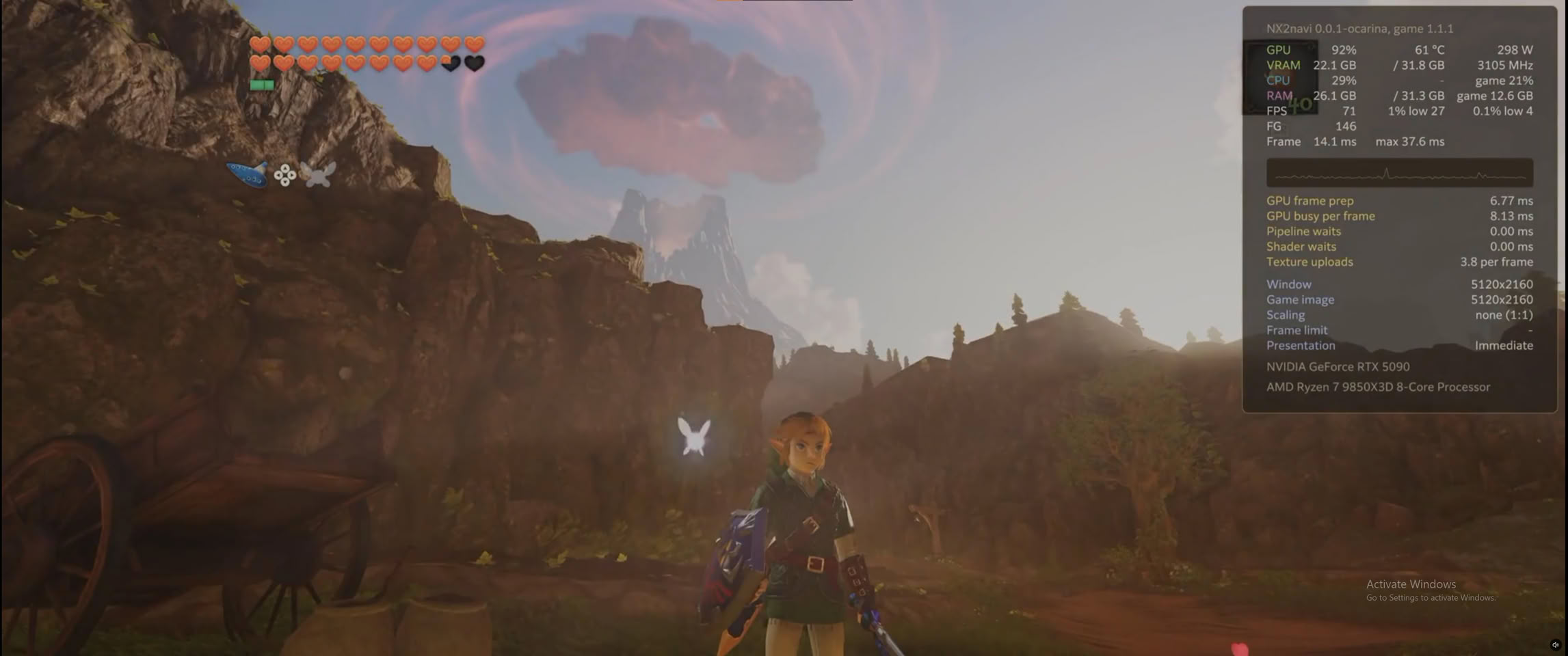
A GitHub developer named tangerineturtle1 has released NX2navi, a native Windows port of the new Zelda: Ocarina of Time remake created using static recompilation. Instead of emulating the Switch 2 hardware, it converts the game to x86-64 code before playing and then draws everything through a custom Vulkan renderer. No game files are included, so players need their own dump of version 1.1.1, and the launcher then creates the game locally, which takes 10 to 25 minutes the first time. RTX owners get DLSS, while FSR 3.1 and its frame generation works on any GPU, and it also supports HDR. Resolution goes beyond 1440p to 5K, the frame rate can be unlocked or set up to 240 FPS (60 FPS is the default), and 21:9 or 32:9 ultrawide displays are supported with the HUD kept at 16:9. The new version was released last week and was already running on an emulator on launch day, albeit poorly. NX2navi is much more advanced, but is still considered early development. Visual errors, occasional crashes, and brief stutters when entering new areas are listed as known issues. You also need 16GB of RAM, about 30GB of storage, and a GPU with Vulkan 1.3 and mesh shader support. A previous presentation on an RTX 5090 was reported to have used 18.6GB of VRAM, although a newer presentation claims memory usage is very low. Fan-made PC ports aren’t new, as RecompLauncher alone lists almost 200 of them. Zelda 64: Recompiled brought Majora’s Mask to PC in 2024, and Unleashed Recompiled did the same with the Xbox 360 version of Sonic Unleashed last year. An emulator mimics the console and translates game instructions on the fly, which costs performance. Static recompilation does that translation once, ahead of time, so the result runs like a normal PC program that’s easier to optimize, although it requires more work per game. However, those projects revived games from over a decade old, while this is a full-price release that’s barely a week old, and Nintendo has a long history of pursuing this sort of thing. Yuzu’s developers agreed to pay $2.4 million and shut down in 2024, Ryujinx went offline months later after Nintendo contacted its lead developer, and a court recently ordered a Reddit moderator to pay $4.5 million for Switch piracy. Getting rid of the game usually means jailbreaking a Switch 2, and there’s nothing stopping people from using copies they never bought. For many players, this will probably end up being pure piracy. Even the project’s README file tells users not to share their builds, which says a lot about the legal risk involved.