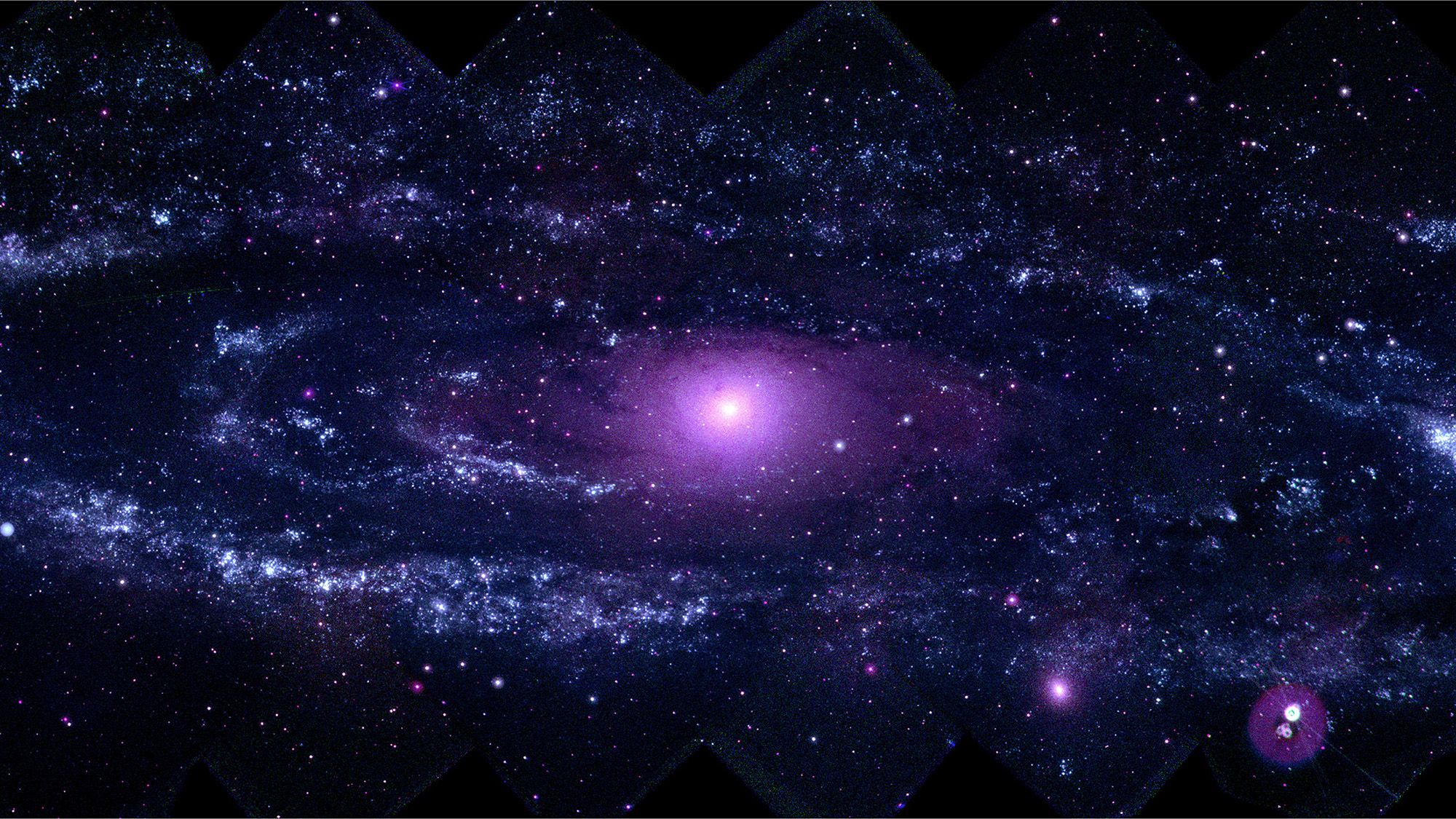
Follow Us Add us as a preferred source on Google Newsletter Subscribe to our newsletter Early Wednesday morning (November 4), NASA’s Neil Gehrels Swift Observatory fell from space and burned up in the sky over Sumatra. It was an exciting and fitting end to a telescope that spent 22 years studying the most powerful explosions in the universe, and even without Swift, its observations will continue to fuel scientific curiosity for years to come. Swift’s most important contributions to astronomy aren’t exactly a feast for the eyes. Designed to pivot into deep space explosions at a moment’s notice, Swift excelled at capturing bright, fleeting, distant specks of light. The multi-wavelength observatory was equipped with optical, ultraviolet (UV) and X-ray instruments, allowing it to capture cosmic bursts of energy across the electromagnetic spectrum, focusing on flashes of light that other telescopes might miss. One of their most significant detections was a gamma ray burst, an incredibly bright burst, likely emitted by a giant star as it exploded into a supernova before collapsing into a black hole. Swift’s famous image of GRB 221009A, or BOAT, short for “brightest of all time,” looks like a speckled orange target, caused by waves from the explosion propagating through space. How the Swift Observatory saw the GRB 221009A gamma ray burst, which may be the most energetic emission of its kind ever seen. (Image credit: NASA/Swift/A. Beardmore (University of Leicester)) But Swift also made millions of observations of the nearby universe, including the galaxies in our backyard. One of its most stunning images is this 24-hour exposure of the Andromeda galaxy (M31), located about 2.5 million light years from Earth. More space photos (Image credit: NASA Goddard Space Flight Center, Tyler Desjardins (STScI)) Andromeda is the closest major galaxy to our own and may be destined for a shared destiny. Scientists suspect that Andromeda and the Milky Way are getting closer and could eventually collide. The merger would add about 1 billion Andromeda stars to our sky, although there would likely be no life left on Earth to appreciate it. You may like In Swift’s view of our invading neighbor, captured with the observatory’s ultraviolet instrument, tens of thousands of Andromeda’s stars shine like sapphires set in a sparkling ring. According to NASA, the observatory detected about 20,000 sources of ultraviolet light in this image, captured over two months, from May to July 2008. These sources include thousands of hot, dense star clusters scattered across Andromeda’s surface. 150,000 light-year-wide ring, as well as the distant galaxy M32 (seen as a bright orb of light at the bottom right of Andromeda’s center). Get the world’s most fascinating discoveries delivered straight to your inbox. In visible light images of Andromeda taken with ground-based telescopes, the galaxy’s bright center obscures many of the fiery young stars emerging into Swift’s view. While Swift probably won’t be best remembered for bright starscapes like this, it’s a powerful reminder that looking at familiar structures in a new light can change everything. TOPICS space photo of the week NASA