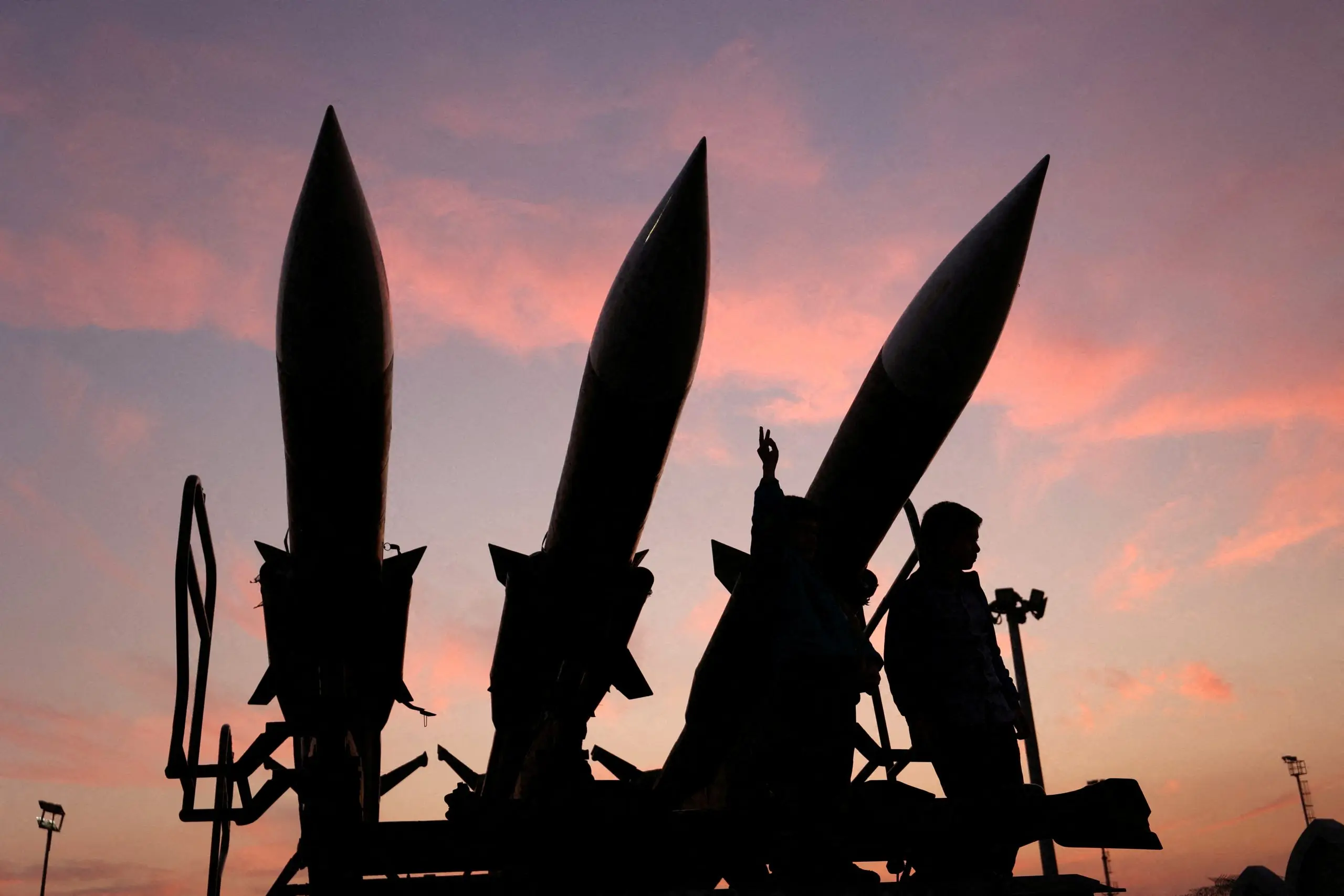
Iran reportedly resumes ballistic missile production. Iran’s indirect attacks target a key Saudi Arabian oil pipeline as host Kayleigh McEnany reports on the expanding conflict. Former Navy SEAL Jack Carr joins the show to discuss Chinese ballistic missile production and satellite intelligence related to an attack that killed three American soldiers. Carr warns that the Houthis threaten global shipping chokepoints near the Red Sea. NEWYou can now listen to Fox News articles! Iran lifted its self-imposed range limit on its ballistic missiles and threatened to launch new homegrown weapons that would “stun the entire world,” just hours after the U.S. military launched a new task force aimed at stifling Tehran’s arms shipments and illicit trade on Nov. 7. The spokesman of the Islamic Revolutionary Guard Corps (IRGC), Brig. Gen. Hossein Mohebbi confirmed that Iran was abandoning its previous ballistic missile range restriction of 2,000 kilometers, or about 1,240 miles, according to The Associated Press. “That restriction has been lifted for us,” Mohebbi clarified after the task force announcement. PHOTO: Iranian missiles are displayed at the Aerospace Force Museum of the Islamic Revolutionary Guard Corps (IRGC) in Tehran, Iran, November 15, 2024. Majid Asgaripour/WANA (West Asia Press Agency) via REUTERS The US Central Command established the “Task Force Iron Gate”, an initiative aimed at the movement of advanced Iranian weapons systems, dual-use materials and revenue illegal trade across the land borders of Iran and the Caspian Sea. “U.S. interagency partners will further limit Iran’s ability to finance terrorism, rebuild weapons factories, and replenish its military,” Admiral Brad Cooper, commander of U.S. Central Command, said in a statement shared on “Of course, it speaks volumes that this effort is taking place within CENTCOM headquarters,” Taleblu told Fox News Digital. Meanwhile, Iran’s IRGC quickly dismissed the new initiative as a “play on words,” stating that Tehran had already made preparations and coordinated with neighboring countries to withstand additional pressure, Fars news agency reported. Mohebbi also warned that Iran was developing new weapons capable of delivering devastating blows in another confrontation with the US and Israel. Exercise at an undisclosed location in Iran, August 20, 2025. (Iranian Army/WANA (West Asian News Agency)/Handout via REUTERS) “There are surprises that will be revealed and deployed on the battlefield if a third wave of confrontation with the enemy breaks out. These surprises will shock the entire world,” Mohebbi said during a news conference in Tehran on Saturday, according to the state-run Islamic Republic of Iran News Agency (IRNA). “If they once again make a miscalculation, or if the Zionists, in pursuit of their own interests, lead the criminal United States to make another miscalculation, they should know that Iran’s next blows will be even harsher and will leave them paralyzed for years,” he added. The previous limit of 2,000 kilometers from Iran already put within its range the entire Arabian Peninsula, the Levant, most of Egypt and parts of Greece and the Balkans. In March, Iran unsuccessfully attempted to attack the joint US-British military base at Diego Garcia in the Indian Ocean, approximately 2,500 miles from the Islamic Republic. Mohebbi also claimed that Iran was preparing to reveal new underground missile facilities, as Tehran seeks to protect its production. of weapons from future attacks. The facilities, described by Iranian officials as “missile cities”, are designed to allow the IRGC to continue making weapons during times of war, according to IRNA. Iran’s Aerospace Force continued to produce missiles and drones during the recent fighting, using domestic expertise without importing foreign weapons or relying on “reverse engineering of weapons captured from the enemy.” Mohebbi also described Iran’s increasing self-sufficiency in weapons production as a “great achievement.” Meanwhile, Taleblu emphasized the importance of the Caspian Sea basin, saying the world’s largest lake has “become a two-way center for breaking sanctions for both Iran and Russia.” “Iranian officials always claim to be self-sufficient in their military industries,” he said, and especially at scale and at a faster pace. “This is why efforts to limit land and sea trade in and out of Iran are a double blow for the regime.” LINDO’ Soldiers from the U.S.-led coalition forces are seen during the handover of K1 Air Base to the Iraqi Army by the U.S.-led coalition in Kirkuk, Iraq, March 29, 2020. (Associated Press) On Sunday, the U.S. Treasury pressured Iraq to close all but two border crossings with Iran as part of Washington’s policy of increasing economic pressure on Tehran, the Minister of Iraqi Foreign Affairs, Fuad Hussein, according to Reuters The Iraqi government had closed the al-Shayeb crossing in southeastern Iraq on October 21, to review security and install equipment to prevent the smuggling of prohibited materials. Iraqi political sources told Agence France-Presse that Washington had pressured Baghdad to close most border crossings between Iran and Iraq to restrict trade and financial exchanges that could help Tehran resist sanctions. Americans, ISW reported. ISW also said that the Iranian ambassador to Iraq, Mohammad Kazem al-Sadegh, was pressuring tribal leaders in Iraq’s Maysan province to pressure Iraqi officials and leaders of the Shiite Coordination Framework to reopen al-Shayeb’s foreign operations. The institute assessed that Baghdad’s limited response likely reflects efforts to balance its relationship with Washington against the influence of Iranian-backed political factions. breaking news for Fox News Digital. Before joining Fox, he worked at The Telegraph with the US night team, in areas including foreign affairs, politics, news, sports and culture.