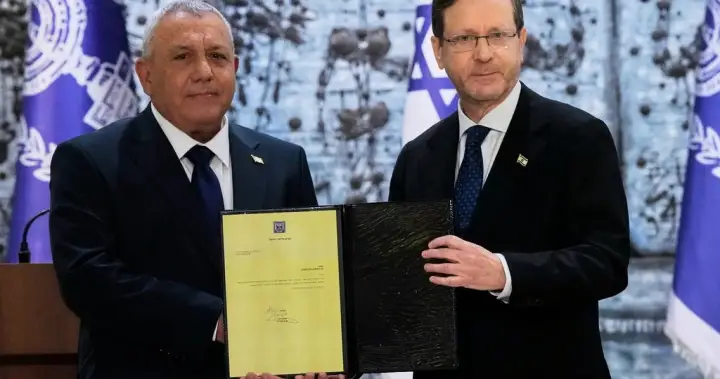
Israeli President Isaac Herzog on Sunday afternoon gave opposition leader Gadi Eisenkot the first opportunity to form the next government. After the formal announcement, Eisenkot, who ran as Prime Minister Benjamin Netanyahu’s main rival, now has to begin complicated negotiations with potential coalition partners. You have six weeks to form a government. At the ceremony in Jerusalem, Eisenkot said he wanted leadership that people can trust, that acts in the public interest and that represents all sectors of society. The October 27 elections gave neither Netanyahu’s bloc nor Eisenkot a clear majority in parliament. Among the kingmakers – and the most politically fraught potential allies – are the Arab-led parties. They made historic gains in the elections and have been the target of Netanyahu and his allies. Eisenkot said Sunday that the conditions for parties to join his governing coalition are support for Israel as a Jewish and democratic state, its declaration of independence, military or national service and recognition of the militant group Hamas as a terrorist organization. While the announcement does not guarantee that Eisenkot will be the next prime minister, Herzog’s decision is another blow to Netanyahu, who lost his parliamentary majority in the election. Here’s a closer look at what lies ahead: There was no clear winner. In Israel, people vote for parties that form alliances. A coalition needs to have a majority of at least 61 seats in the 120-member assembly, known as the Knesset, to form a government. Neither Netanyahu nor Eisenkot won a majority in the elections. Netanyahu’s coalition fell from a high of 68 seats to just 53. The opposition bloc, led by Eisenkot, won 48 seats, and Arab-led parties secured the other 19. Eisenkot faces significant challenges on the path to becoming prime minister. Eisenkot has three options: a power-sharing deal with Netanyahu, support from Arab-led parties (something several members of his bloc do not support), or a deal with ultra-Orthodox parties, which will demand military exemptions for his community. Eisenkot, a former army chief, and his associates made equal military service a central part of their campaign. Specifically, they seek to end long-standing exemptions enjoyed by the ultra-Orthodox. Get the latest national news Get the latest Canadian news delivered to your inbox as it happens so you don’t miss any breaking news. After Herzog announced on Saturday that he would choose Eisenkot, the candidate promised to form a government as quickly as possible. But doing so will almost certainly require compromises or broken promises. 2:01 Israel elections cause political stalemate between Netanyahu and Eisenkot Netanyahu presses baseless claims against Arab voters Netanyahu has repeatedly claimed that the election was “stolen” by Arab parties, who rallied their supporters to vote in large numbers. But he has offered little evidence to back up his claims. Netanyahu is expected to continue his pressure tactics against Eisenkot, saying any alliance with Arab parties would be an act of betrayal. Israel’s Shin Bet security agency has launched an investigation into possible foreign interference in the vote, but the country’s Central Election Commission (and Herzog) say the vote was valid and even if irregularities were discovered, it had no significant impact on the result. Netanyahu called for a government of “national unity” with Eisenkot on Saturday night. But it is still unclear whether the two rivals could reach a power-sharing deal, and these coalitions are fragile and often collapse. Support from Arab-led parties faces opposition within Eisenkot bloc More on the world More videos Eisenkot has the option of forming a coalition with the support of the two Arab-led parties, which won an unprecedented 19 seats in the largest Arab voter turnout. Only one Arab party, Ra’am, has ever joined a governing coalition in 2021. Ra’am has said it will support Eisenkot, but the party does not have enough seats on its own to push Eisenkot into the majority. Breaking with decades of precedent, the second Arab-led party, the Joint List, said it will support Eisenkot from outside the coalition to end Netanyahu’s hold on power. This cooperation is complicated for both parties. For the Joint List, it would mean backing a government that is unlikely to end Israel’s wars or curb settlement expansion in the occupied West Bank. For Eisenkot and other opposition parties, it would mean aligning themselves with parties that not only criticize Israel’s policies but reject its identity as a Jewish state. One of Eisenkot’s partners, the more conservative Yisrael Beytenu party, has already said it will not join a coalition with Arab-led parties. 6:20 Citizens across the Middle East pessimistic Israel’s election will host positive change Cooperation with ultra-Orthodox falters amid anger over military exemptions Eisenkot also says any party that joins him must support conscription or civil service. It is not yet clear whether the ultra-Orthodox religious parties are willing to reach an agreement. These religious parties, which were part of Netanyahu’s outgoing coalition, want to preserve their military exemptions, which they say are necessary to preserve their devout lifestyle. But the exemptions have become especially controversial among the general public during the last three years of war. Anticipating its position as a swing vote, the ultra-Orthodox United Torah Judaism party has left the door open to cooperating with Eisenkot. This week in Israel, Eisenkot is expected to have 28 days to form a coalition, with a possible two-week extension by the president. If he is unable to form a government, Netanyahu could be given the opportunity to form a coalition. If Netanyahu cannot do it either, the country will hold elections again early next spring. The new Israeli members of the Knesset will be sworn in on Tuesday night. Netanyahu and his cabinet will remain in office on an interim basis, with limited powers, until a coalition is formed. Story continues below ad — Lidman reported from Tel Aviv, Israel.