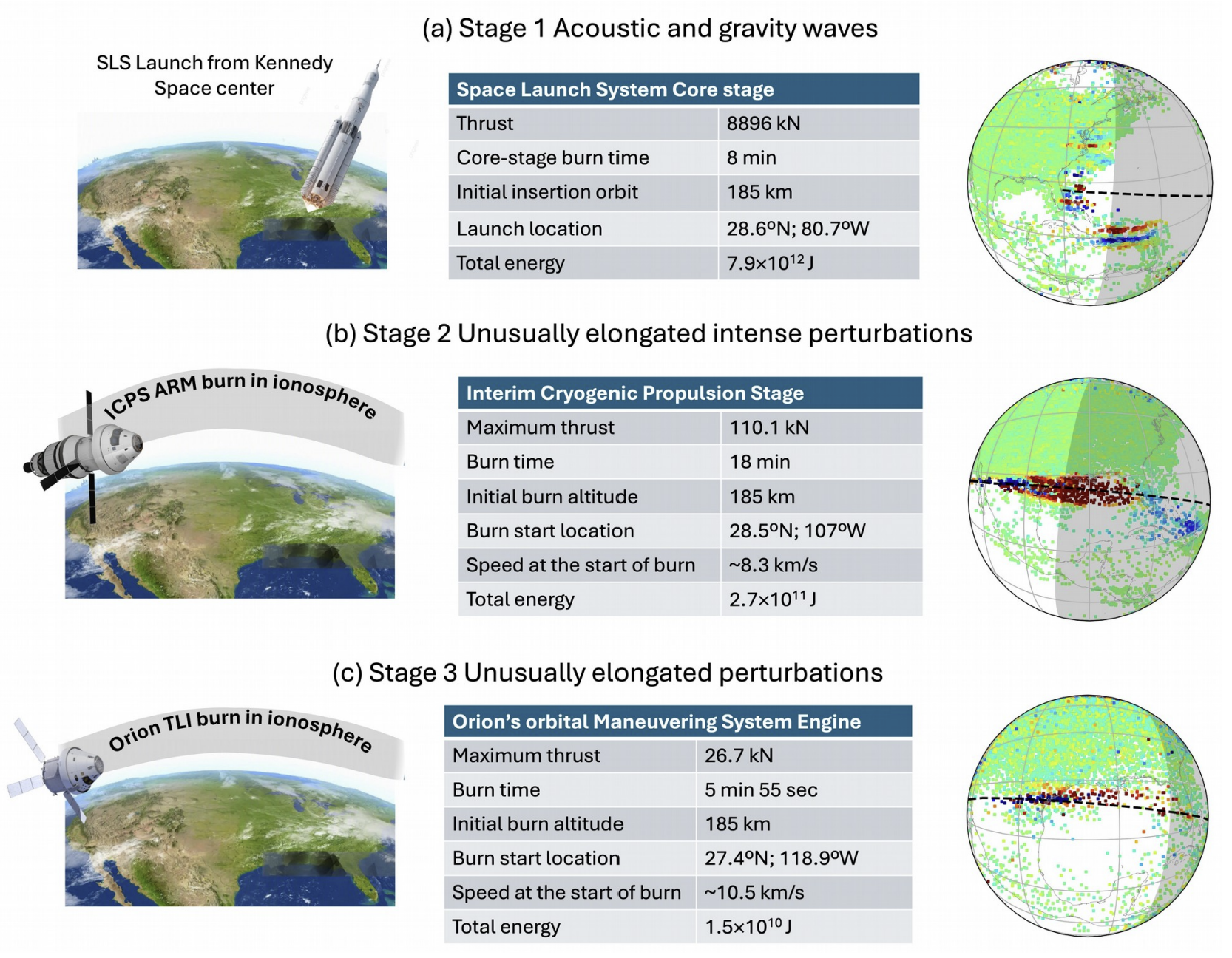
Rockets certainly have a substantial impact if you ever see a launch in person. The noise, shock waves and even heat can be impressive. What is less obvious are the impacts a launch has on our upper atmosphere, or “anthropogenic space weather,” as sophisticated scientists call it. A preprint of a recent study on Artemis II’s impact on our atmosphere shows a surprisingly wide range of effects. In general, the impact on Artemis comes in waves. Each stage of the space launch system performs burns on different parts of the atmosphere, creating increasingly larger waves as the rocket moves through various layers. The first stage is the largest in terms of thrust, but has limited impact on the ionosphere due to how low it was. However, the impact of the second and third stages was so great that it could have sustainably disrupted GPS signals at that time. The waves even traveled through the atmosphere across North America in the form of gravity waves. These ionosphere “holes” may not be a major problem now, but it is something to think about as we ramp up rocket production. While this research was based on thousands of sensors around the world, that doesn’t mean the same budget is needed to analyze the state of the ionosphere at home.