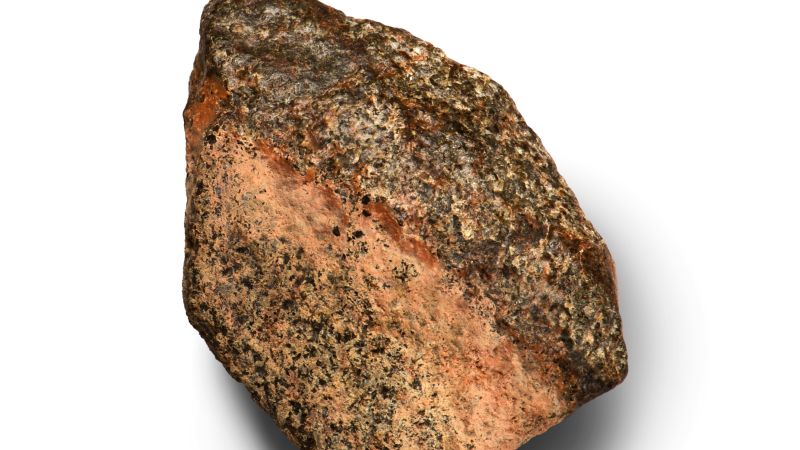
Scientists have identified one of the oldest Martian rocks ever found on Earth and it is revealing new clues about the red planet’s earliest history, including evidence that water altered its crust at least 4.1 billion years ago. The pink meteorite, known as Teghaza 001, has a unique chemical composition that distinguishes it from previously studied Mars samples, scientists say. “This is an ancient and very rare Martian meteorite, and it gives us the opportunity to look at the early crust and mantle of Mars, at a time when life was just beginning on Earth,” said Yang Liu, a planetary scientist at NASA’s Jet Propulsion Laboratory in Pasadena, California, and lead author of a study on the sample published Oct. 29 in the journal Science. This meteorite is believed to have formed from magma derived from the mantle, the inner layer of hot rock of a planet, which then became part of the outer crust. “The chemistry of this sample shows that it comes from an area of the Martian crust that we have not sampled before,” Liu added. Teghaza 001 is named after a salt plain in the West African country of Mali, where meteorite hunters discovered it in 2022. The meteorite consists of eight fragments weighing 798.5 grams (1.76 pounds) in total, with the largest weighing 442 grams (0.97 pounds). The impact of an asteroid or comet that crashed into Mars ejected Teghaza 001 from the red planet’s relatively weak gravity and launched it into space. The meteoroid then began to orbit the Sun, potentially for several million years before being captured by Earth’s gravity and entering our planet’s atmosphere. It’s difficult to determine when the impact on Mars originally occurred, or even when the meteorite landed on Earth, but surface features of the sample reveal that it could have spent some time in the desert before its discovery, according to Liu. “It’s always nice to see a new visitor to Mars, and this one is an old one: one of the oldest on the planet and older than any locally grown terrestrial rock,” said Matthew Genge, associate professor of earth and planetary sciences at Imperial College London, who was not involved in the study. “That alone is fascinating,” Genge said in an email. “It offers a window into the early stages of Mars’ history, a time when water is expected to exist on the planet.” An initial analysis did not immediately reveal that the rock was particularly old, and Liu almost stopped studying it. “When it was first offered to me,” he said, “the sample was classified as shergottite, the most abundant type of Martian meteorite we have on Earth.” Liu had previously analyzed several shergottites, which make up almost 90% of the known collection of Martian meteorites and are typically less than 600 million years old, but ultimately agreed to investigate the sample. He realized that Teghaza 001 contained zircon, a type of crystal that forms when molten rock cools. “Zircons are like a time capsule that allows us to accurately date the age of a rock’s formation,” he said. Dating of the crystals indicated an age of at least 4.1 billion years, meaning the meteorite formed roughly within the first 400 million years of Mars’ existence. To confirm this estimate, the sample was also processed using a new aging method developed by study co-author Hayward Melton, a doctoral student at the California Institute of Technology. “This method uses a laser to vaporize very small regions of a sample, rather than dissolving larger pieces,” Melton said in an email. “Using lasers means we can measure samples like Teghaza 001 much faster than traditional techniques.” The team used a small laser beam (about one-tenth the diameter of a human hair) to analyze the small grains and crystals within the samples. This new technique reduced the time needed to date a sample from a month to a day, Melton added, and left more original material available for further study. The meteorite is a basalt, similar to the rocks that cover the floor of Earth’s oceans and that erupt from volcanoes in places like Iceland and Hawaii, according to Genge. Teghaza 001 has a unique composition that indicates it interacted with water in the ancient Martian crust, new analysis has shown. This can give scientists “a deeper understanding not only of early Mars, but also of Earth, and help us learn why Mars dried out while Earth didn’t,” Melton said. “This, in turn, would have implications for understanding the habitability of planets.” Other peculiar features make Teghaza 001 stand out from Martian meteorites. It is composed mainly of two calcium-rich minerals, but in proportions never before seen in other samples, Liu said. The specimen also contains oxygen isotopes in relative abundance, unlike other known rocks from the Red Planet, according to Liu. The mineral and chemical composition of a meteorite can help scientists determine its Martian origin by comparing it to data collected on the planet’s surface by NASA’s Mars missions, including the Viking landers and the Curiosity and Perseverance rovers. For Teghaza 001, the researchers went a step further and identified 13 locations in the southern highlands of Mars where the rock could have originated. “I think the scientific community will be very interested in this sample and there will be many more discoveries to come,” Liu said. “I’m still very interested in resolving some questions that I couldn’t answer with our paper, which is just at the beginning.” After its discovery in 2022, the meteorite caught the attention of Darryl Pitt, a meteorite collector and president of the meteorite division of the Maine Gem and Mineral Museum in Bethel, Maine. “What attracted me most to Teghaza 001 was a different mineralogy than any Martian sample previously studied, combined with its age,” Pitt said. “This set the table for a potential party of discoveries.” He eventually negotiated a deal for the museum to acquire the rock for an undisclosed amount. “The truly remarkable thing about Teghaza 001 is that it allows us not only to study another planet,” said Genge of Imperial College London, “but also to look deep beneath its surface to see what the planet was like just 500 million years after its formation.” Subscribe to CNN’s Wonder Theory science newsletter. Explore the universe with news about fascinating discoveries, scientific breakthroughs and more.