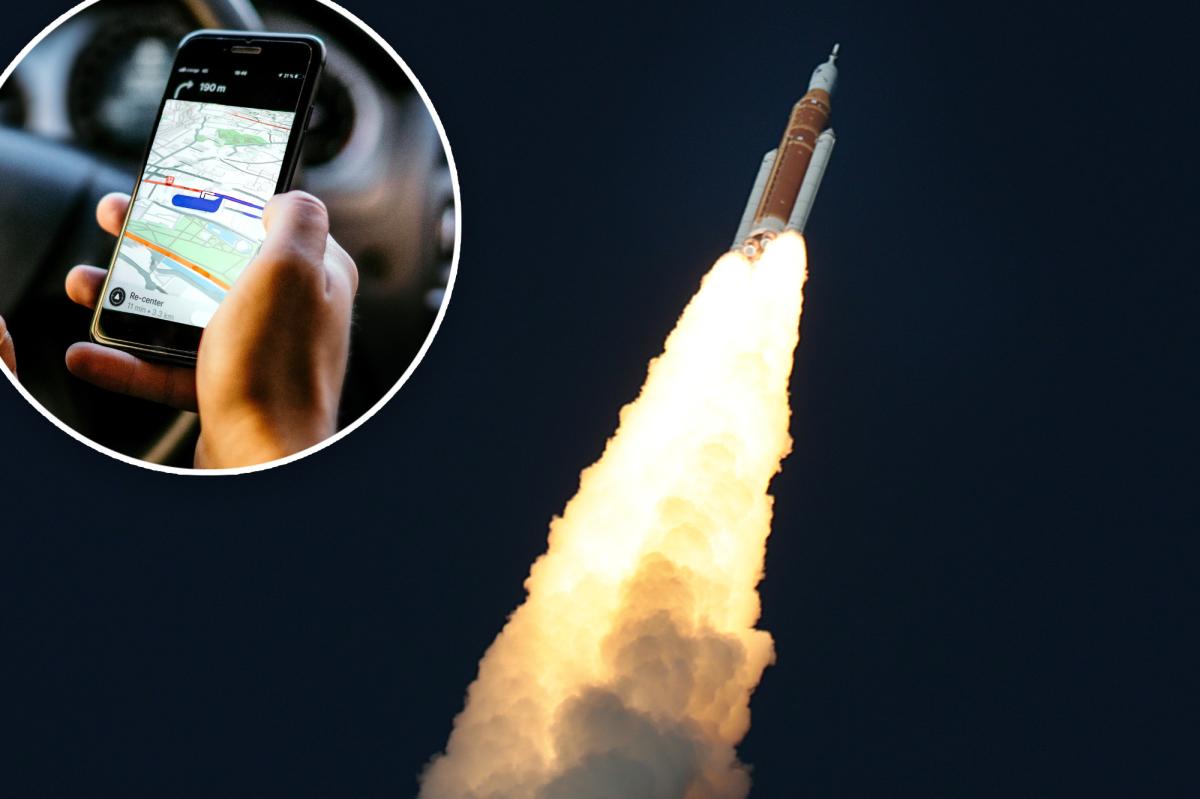
There was a disturbance in the force field. The Artemis II astronauts might have emerged unscathed from their historic lunar mission, but Earth’s navigation team might not have been so lucky. The launch of the spacecraft in April 2026 had an unprecedented impact on our planet’s atmosphere, temporarily disrupting GPS systems and potentially causing an accident, according to an alarming study published in Geophysical Research Letters. “It could have a strong impact not only on autonomous vehicles but also on drone positioning,” study co-author Charles Lin, a professor of earth sciences at National Cheng Kung University, told Space.com. The Artemis II spacecraft punched holes in the ionosphere, disrupting GPS communications. aboutmomentsimages – stock.adobe.com NASA’s Artemis II Space Launch System rocket lifts off from the Kennedy Space Center on Wednesday, April 1, 2026 in Cape Canaveral, Florida. Getty Images The study comes seven months after the Artemis II spacecraft safely transported astronauts to our lunar satellite for the first time in 50 years, hoping to open a path for future lunar missions and potentially even colonization. Following the successful trip, researchers observed two giant holes in the ionosphere, the electrically charged region of Earth’s upper atmosphere. According to the study, these gaps cut swaths 3,100 miles wide across the American continent. The atmospheric holes formed when Artemis II’s massive core stage tore through the atmosphere, followed by two engines firing from its upper stage 115 miles above Earth, more than an hour after liftoff. When the thrusters fired, they spewed exhaust gases that reacted with electrically charged particles in the ionosphere, creating the resulting disturbance as a smaller, short-lived solar storm. The researchers determined the ionospheric impact of Artemis II using data from ground-based GPS receivers, typically used to measure minute tectonic shifts, to measure how long it takes for GPS signals to travel from satellites to receivers on Earth. The solid boosters on NASA’s SLS rocket ignite during the launch of the Artemis II mission. NASA discovered that disturbances in the ionosphere can greatly alter these times. In fact, the impact generated by liftoff was more powerful than any other rocket launch observed to date. And although changes in the electronic density of the force field only resulted in positioning errors of several feet, these were more than enough to derail self-driving cars (which have already had their share of problems), according to the study. “A positioning error of a couple of meters is enough to make an autonomous car change lanes,” Lin said. If extrapolated, this could also wreak havoc on drone navigation. Lin attributed the unusually powerful disturbance to the rocket’s upper stage engines firing directly into the ionosphere, a maneuver that could become increasingly common as humanity ventures further into space. “Rocket launches from Earth to space produce that kind of effect, but we have never seen this kind of orbital maneuver on an interplanetary mission,” Lin said. “In the future, as we see many more missions to the Moon and Mars, these space weather effects will be much more significant.”