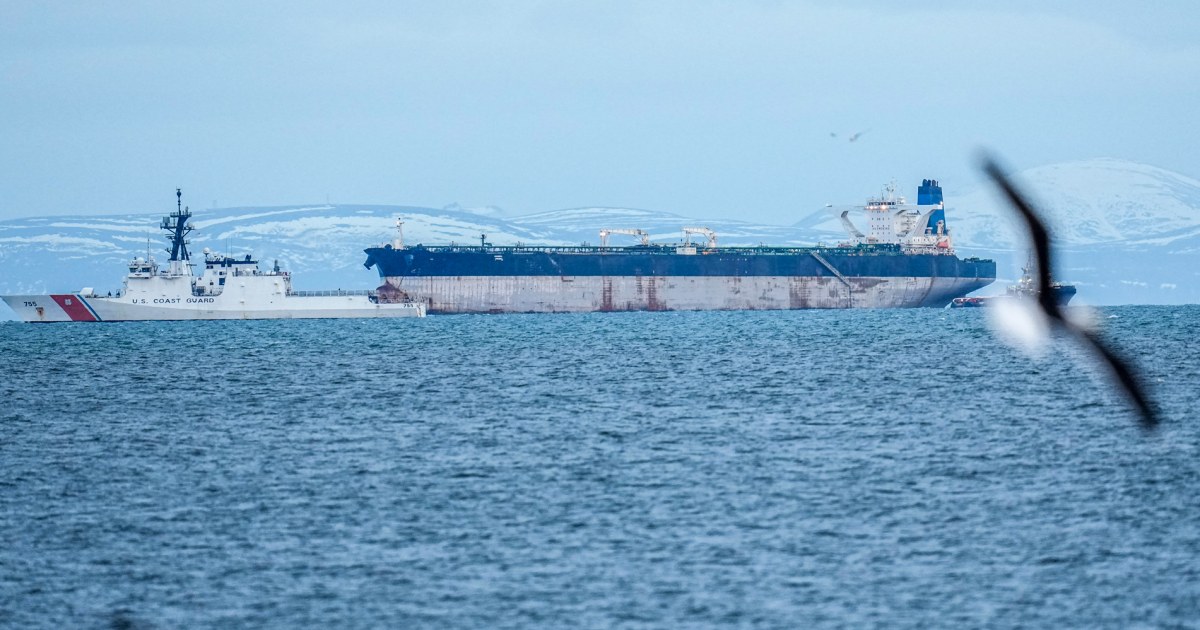
U.S. authorities sold a seized Russian oil tanker to a maritime scrap dealer for far below market value in an “economically irrational” deal aimed at thwarting the owner’s attempt to recover the vessel, the company’s lawyers said in court papers. The Justice Department was ordered to respond to the allegations, made by the ship’s Russian owner, Burevestmarin LLC, at 9 a.m. Friday. The tanker, Bella 1, was seized by the US military in the North Atlantic in early January after a week-long offshore chase. U.S. authorities said the ship, which they believed was carrying illegal Iranian oil, was captured fleeing the U.S. blockade of Venezuela. Burevestmarin’s lawyers dispute the claim that the ship was carrying Iranian oil. The ship was sold to a scrap metal dealer for $9.1 million, company lawyers said, well below the $21 million the Bella 1 would fetch for scrap alone. — without notifying known interested parties and being aware of the challenges to the Court’s jurisdiction — are engaging in precisely this type of economically unreasonable sale for their own convenience,” the owner’s attorneys wrote. They said the sale was conducted “behind closed doors” as part of the government’s “unreasonable and self-interested decisions.” They put the government in a financial bind, making selling these vessels necessary to avoid tens of millions of dollars in maintenance and repair costs. The Department’s attorney Justice Rajbir Datta told the court in July that “the government has spent $60 million maintaining this and making all kinds of mechanical repairs to the asset itself.” A key issue in the current court battle is whether U.S. officials are right to argue that the transportation of Iranian oil benefits the sanctioned Islamic Revolutionary Guard Corps. They are also fighting the Justice Department’s efforts to seize other ships they own, citing what they believe is a legal double standard invoked by the government, court records show. In the case of the ship Galileo, lawyers for the shipowner argued that “on March 20, 2026, the same day that the Government (under seal and ex parte) alleged that the Galileo was a source of influence over the IRGC and the IRGC-QF, it expressly authorized the international sale of Iranian oil, an action that would be illegal under multiple statutes if the shipment of Iranian oil itself were necessarily equivalent to providing a means of support to the IRGC or IRGC-QF or becoming the property of the IRGC or IRGC-QF.” In the case of another vessel, the Skipper, attorneys for Burevestmarin LLC said the Justice Department failed to establish the correct location and may have improperly seized that vessel. The Skipper was on the “high seas,” meaning it was outside the waters territories of the US or a foreign country.