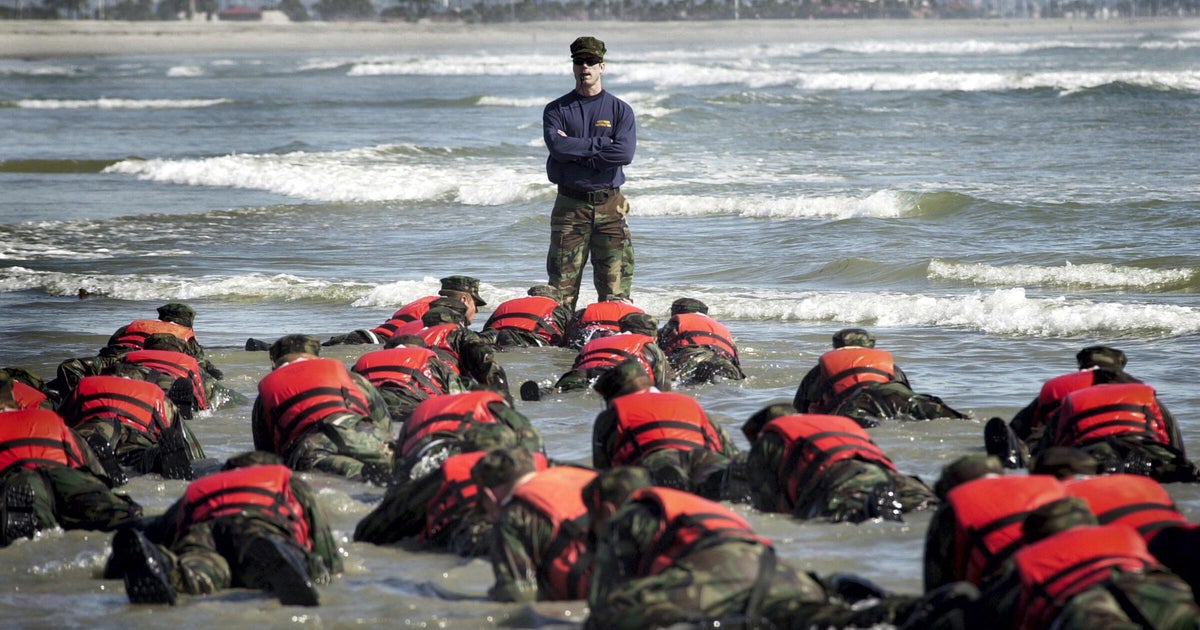
Washington — Two women trying to become Navy SEALs advanced further through the grueling military training process than any woman before them, making history despite failing to complete the demanding course at Naval Amphibious Base Coronado in California. An enlisted sailor and a naval officer entered Basic Underwater Demolition/SEAL, or BUD/S, training several weeks ago, multiple sources told CBS News. They had both reached the third week of training, with Hell Week, the infamous five and a half day endurance test beginning in the fourth week. CBS News has learned that the officer was moved to the next class and ultimately requested to be removed from the course before Hell Week and the enlisted sailor was medically removed from Hell Week. While the two women did not pass the SEAL course, they went further than any other woman who has attempted it since Special Operations opened its doors to women in 2016. CBS News is not revealing the names of the candidates for security and privacy reasons. Gaining access to Hell Week is a feat in itself because nearly half of all candidates, about 45%, are eliminated or transferred to the next class during training in the first weeks leading up to Hell Week, according to data compiled by the Navy between 1998 and 2023 and released through the Freedom of Information Act. Hell Week is widely considered one of the most physically and mentally demanding parts of initial training, which lasts approximately six months. Hell Week is designed to test the candidates’ physical and mental limits. After starting in the middle of the night, candidates sleep about four hours over the next five days and complete tasks such as carrying logs, launching boats into waves, lying in cold ocean water, and running about 200 miles. A Naval Special Warfare Command spokesperson said: “To protect the integrity of the NSW Center’s courses and the privacy of its candidates, we do not discuss the details of any individual selection or non-selection status or where they are in the training process.” Long before the Pentagon formally opened all combat positions to women in 2016, women had served alongside U.S. special operations forces. As early as World War II, women helped gather intelligence or coordinate supply shipments and combat strikes for the Office of Strategic Services, predecessor of the CIA and the US Special Operations Command. In 1988, the Department of Defense adopted the “Risk Rule” policy that restricted women from assignments based on their exposure to combat-related hazards, but during the Persian Gulf War, some women experienced combat even though they had been officially assigned to “non-combat” roles. Her service in the Gulf War led Congress to repeal the combat aviation exclusion in December 1991, allowing women to serve in combat aviation roles. In 1994, Secretary of Defense Les Aspin rescinded the risk rule policy, but maintained the exclusion prohibiting women from serving in direct ground combat units below the brigade level. Nearly two decades later, Defense Secretary Leon Panetta rescinded the 1994 policy, eliminating gender-based combat assignment restrictions. In 2016, women were allowed to try to become Navy SEALs, Army Rangers, and Green Berets. Over the past decade, thousands of women have joined infantry, armor and artillery units, but relatively few have attempted to qualify for elite special operations units, and only a few have successfully completed the rigorous selection and training programs over the past decade. The demands of the Navy SEAL training process eliminated about 68% of candidates at various stages of training, according to Navy data between 1998 and 2023. The greatest attrition occurred during the program’s seven-week first phase, which includes Hell Week, where 66% of candidates were eliminated or transferred to another class. Nearly half of each incoming class (about 45%) does not make it past three weeks before Hell Week; around 29% voluntarily withdraw from the course. Despite Hell Week’s reputation as one of the most demanding endurance tests for the military, more candidates dropped out during the preceding weeks than during Hell Week. About 21% dropped out during Hell Week because they asked to leave or because they had medical or performance issues. The figures suggest that almost four in five candidates who started Hell Week were able to finish it. Attrition decreased dramatically during the later stages of training, with 5% during the second phase, which emphasizes combat diving, and 3% during the third phase, which focuses on land warfare. Less than 1% leave during the rigorous six-month SEAL qualification training course, which is the final leg of the process before being assigned to a SEAL team. In 2021, a sailor became the first woman to graduate from the Naval Special Warfare training program to become a Special Warfare Combat Crewman, according to a previous CBS News report. The Navy said historically only about 35% of candidates who try to join its ranks make it to graduation. Navy Special Warfare Combatant Ship Crewmen, known as SWCCs, are elite maritime operators who train to operate high-speed, heavily armed vessels that transport Navy SEALs in and out of hostile territory, along with other maritime missions. While they undergo separate selection and training courses, SWCCs are part of the Naval Special Warfare Command. Outside of naval special warfare, women have successfully navigated other rigorous special operations training channels. Seventeen women attempted to become Marine Raiders under Marine Forces Special Operations Command, but none had passed as of 2024, according to Military Times, which also reported that 54 Air Force women had begun training to join special operations jobs. Only a handful have completed the training. In 2020, a National Guard soldier became the second woman to complete the Army Special Forces Qualification Course and transition to a Green Beret team; the first was Capt. Kathleen Wilder in 1980, who retired as a lieutenant colonel, according to Army Times. Fewer than 10 women have earned the Green Beret, according to a 2023 report by Military.com. Fewer than a dozen women have joined the historic 75th Ranger Regiment, an elite Army special operations unit that specializes in high-risk raids, airfield seizures and large-scale combat operations. Everyone who serves in the regiment has to pass the selection process and grueling tests during Ranger School regardless of position. One of those women is former Capt. Hailey Gibbons, a West Point graduate who completed Ranger School in 2021. She served as a logistician in the 75th Ranger Regiment until she left the Army in 2023. “If you’re a logistician, if you’re a communications guide, military intelligence, everyone is a Ranger in that formation,” Gibbons told CBS News in an interview. “And then I thought: I want to be part of the team. I don’t just want to help the team.” Undated photo: Captain Hailey Gibbons served as an Army Ranger. Provided by Hailey Gibbons Women have faced resistance from the military community when performing combat roles and testing for special operations, and that continues to be the case. As the two women navigated the first weeks of BUD/S, they came under fire on social media from some former SEALs and military-focused accounts. Defense Secretary Pete Hegseth has repeatedly questioned whether women should serve in ground combat and special operations roles, arguing their inclusion could undermine military effectiveness and physical standards. Shortly before being nominated for the position, the former Fox News host and National Guard veteran said “we shouldn’t have women in combat roles” in a podcast interview with Shawn Ryan, a former Navy SEAL. At her confirmation hearing, Hegseth said women would have access to ground combat roles, “as standards remain high.” He didn’t offer any examples of how standards had been lowered, but said service members had told him that standards had changed “directly, indirectly, overtly and subtly.” Earlier this year, the Pentagon commissioned a study to review the effectiveness of women in ground combat roles. In a statement given to CBS News in January, Pentagon press secretary Kingsley Wilson said the study was intended to “ensure standards are met and that the United States maintains the most lethal military.” Gibbons told CBS News that the standards have not changed for special operations despite Hegseth’s indirect claims. “When you say that the standards have changed and that people have lowered the standards to allow women into their formations, that is absolutely a lie because no brigade commander would approve of that, because then they would be seen as less than and someone they can’t trust,” Gibbons said. More from CBS News Go deeper with The Free Press