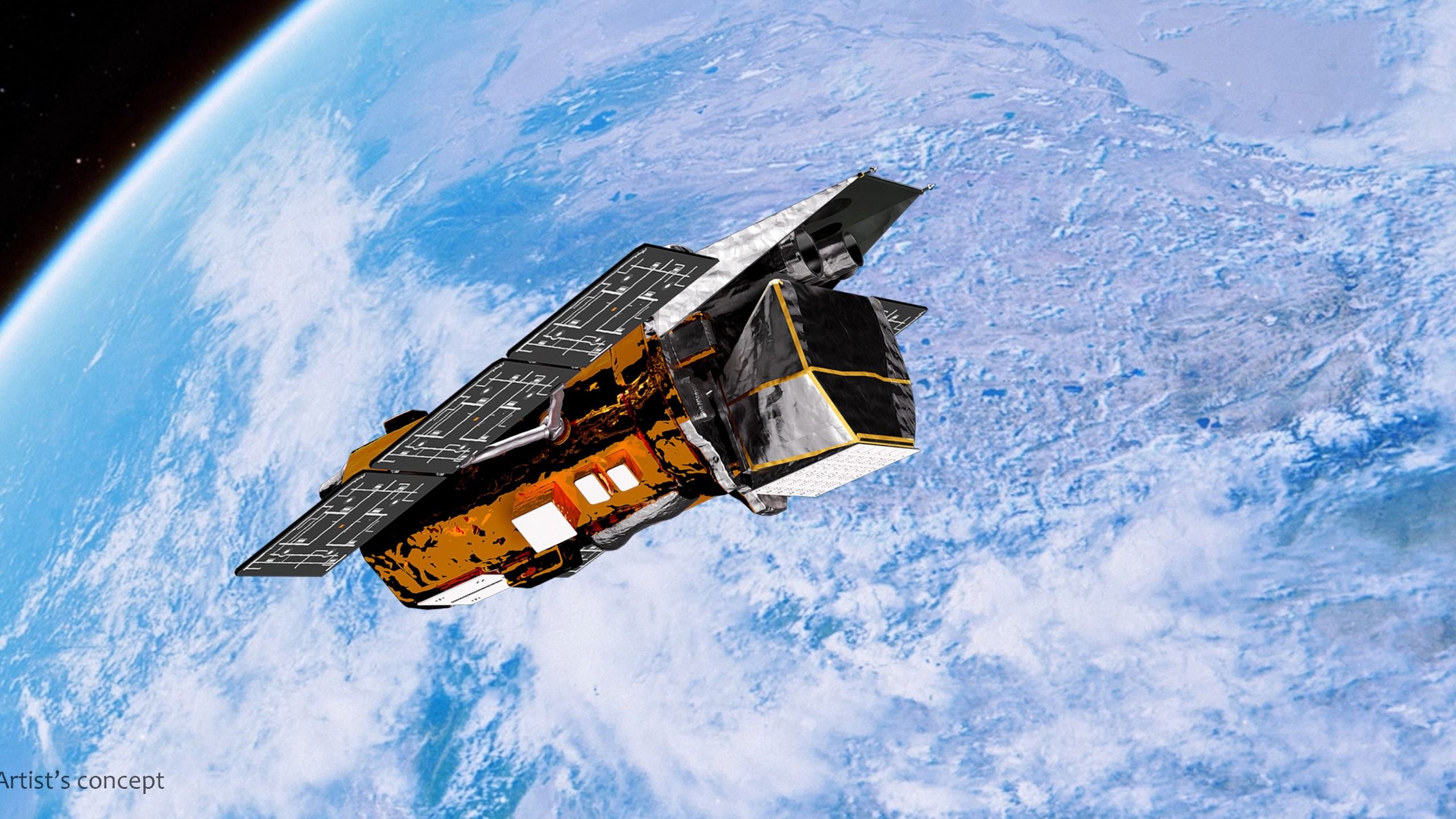
Follow us Add us as a preferred source on Google Newsletter Subscribe to our newsletter NASA’s Swift space telescope has reached the end of its long and winding path. Swift fell uncontrollably to Earth today (Nov. 4), 22 years after its launch, but just three months after a private spacecraft was supposed to boost it to a higher orbit to prolong life. The 3,200-pound (1,450-kilogram) observatory re-entered Earth’s atmosphere at 7:39 a.m. EST (1239 GMT) today over northern Sumatra, according to satellite tracker Jonathan McDowell, who cited data from the U.S. Space Force. The fall probably didn’t have much of an impact; NASA officials predicted in advance that most of the minibus-sized Swift would burn up when it fell, and estimated the chances of any of the surviving pieces harming someone on Earth were just 1 in 2,100. Swift, officially known as Swift Gamma-Ray Burst Explorer, launched into Earth orbit in November 2004 on a two-year mission to study gamma-ray bursts (GRBs), the most powerful explosions in the universe. “Swift” was not an acronym, but rather referred to the observation agility of the spacecraft. “Swift needed to detect and locate gamma-ray bursts, communicate their position to other observatories, and then rotate its telescopes to image the burst locations before their glows faded,” said S. Bradley Cenko, Swift principal investigator (PI) at NASA’s Goddard Space Flight Center in Maryland, in an Oct. 23 statement. “It usually took Swift about a minute to do this.” You might like that Swift didn’t just look at GRBs. He also studied a variety of other bodies and cosmic phenomena, from distant supernova explosions and feeder black holes to asteroids and comets in our own solar system. And it continued to do this long after its warranty expired; in fact, for about 20 years afterwards. The space telescope did not make its final scientific observation until October 20 (Swift underwent a name change during this period: in 2018, it was renamed the Neil Gehrels Swift Observatory in honor of its first principal investigator, who died the previous year). “Swift delivered an incredible and long-lasting return on investment for the nation, designed for a two-year primary mission but productive for more than 10 times longer,” Shawn Domagal-Goldman, director of NASA’s Astrophysics Division, said in the same Oct. 23 statement: “In that time, Swift played an important role in advancing our understanding of the changing universe and was part of a revolution in astrophysics that showed how critical rapid-response observations are to the entire community,” he added. Katalyst Space’s LINK robotic service spacecraft captured this view of one of its solar arrays in Earth orbit in August 2026. (Image credit: Katalyst Space)) Swift was incredibly productive, observing more than 2,000 GRBs and 1,400 supernovae over its long scientific life. But even more data could have been collected if a dramatic rescue mission had been carried out. What to read next In September 2025, NASA awarded Arizona company Katalyst Space a $30 million contract to design, launch and operate a robotic spacecraft that would rendezvous with Swift and boost it to a higher orbit, extending its operational life. Swift was falling back to Earth: it had no thrusters on board to counteract the effect of atmospheric drag, which had been sinking the observatory since its launch. The process was speeding up as Swift went down, so Katalyst had to work quickly. And the company did it, launching its refrigerator-sized, three-armed LINK service spacecraft on July 3, with the goal of capturing Swift in August. However, that did not happen. LINK suffered problems with its propulsion system and reaction wheels that maintain orientation, canceling the planned meeting. Still, it was a worthwhile effort, according to NASA. “From the beginning, it was a high-risk, high-reward mission,” Domagal-Goldman said in a statement on September 25, the day LINK crashed to Earth. “And while we will be sad to see Swift’s mission come to an end, we knew this boosting effort would be worth it either way: advancing American spacecraft maintenance technology, challenging us to meet unprecedented mission schedules, and testing how we operate satellites to extend their time in low Earth orbit,” he added. By the way, today’s Swift accident wasn’t exactly unusual. At least three large objects (dead satellites or spent rocket bodies) fall to Earth every day on average, according to a report from 2025. And that number is sure to increase in the coming years, as humanity builds more and more megaconstellations in Earth orbit.