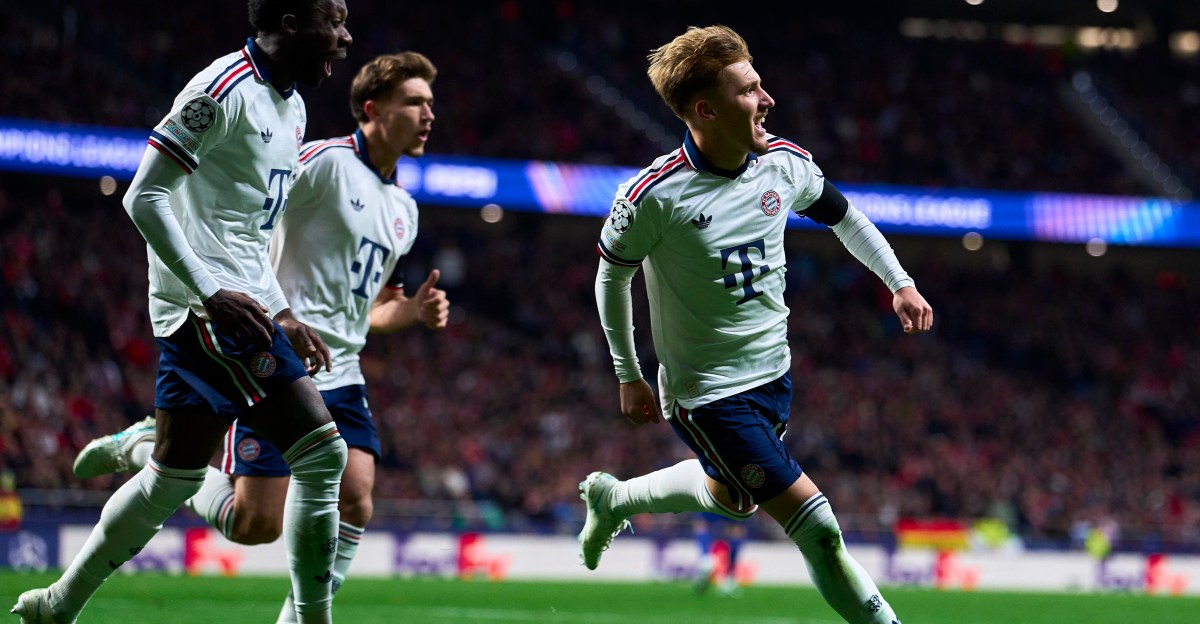
The coordinated denial of space When Diego Simeone chose Atlético Madrid’s lineup and tactics for this match, he knew he had to prevent Bayern Munich from scoring. Goals goals goals. That’s what it all comes down to. This is not Manchester United. When you face the best attack in Europe and you are not PSG, you have to think of ways to stop them. To prevent a team like FC Bayern from scoring, there are different things you can do. You can press high and run hard, like Freiburg and Stuttgart did. It always ends badly. You can pack the box and hope for the best. Sometimes it works, ask Schalke. You can fight the battle in midfield and try to win it, which could have worked for Arsenal. Or you opt for the cynical path, with invisible fouls and fifty-fifty duels, which Borussia Dortmund used with good results. None of them represent a miracle solution. No team has yet beaten the Bavarians. So Simeone opted for the last possible option, the one that was easier said than done. He decided to deny Bayern Munich’s key stars room to operate. Understanding the entire tactical scheme would require too many words to describe. What the Spanish decided was to concentrate their resources on key threats, mainly FC Bayern’s three forwards. This meant diverting attention away from tertiary players such as full-backs and central defenders, which had its own tactical consequences. This is how it worked. Alphonso Davies was marked wide with a defender continuing to push him onto his shoulder. This prevented the Canadian from using his pace to get behind the defence, smothering the left. Meanwhile, Michael Olise, who lacks explosive pace, was heavily marked from the start, with hardly any room to pass and dribble. Harry Kane was isolated and prevented from getting easy shooting angles. This approach came with the trade-off that players like Konrad Laimer and Dayot Upamecano were given the freedom to dominate. Simeone bet that that was enough. He hopes that the opportunities that players had outside the top 10 of the Ballon d’Or do not become exploited. Unfortunately he was wrong. The fact is that there were too many opportunities and too much space to cover. You can’t deny everything to Bayern Munich. And if you commit too much in one direction, you lose your threat in the other. Simeone bet and lost. The margins were against him. Here’s why all this is important. This performance was the best one could come up with from one of the game’s best defensive tacticians. Still, it was not enough to prevent Bayern Munich from winning comfortably. Despite the injuries, despite the coach’s absence, despite playing away from home in the UEFA Champions League. What does that say about the team? Bayern Munich could have scored much earlier, if the team had had more rhythm. This may be the slowest version of the German Rekordmieister in over a decade. Harry Kane is a demon, but he’s not fast. Michael Olise can run and dribble, but his strategies are based on positioning, not pace. The midfield had great passers, but is missing someone who can carry speed. All of this results in a team that moves the ball too fast to keep up. Despite the way he was marked, Alphonso Davies did quite well against Atlético. The reason is that he has real pace, the kind that allows you to outrun defenders. Konrad Laimer isn’t even half as fast, but he still has excellent raw acceleration, which gave him the advantage he needed to outrun defenders centered on Olise. However, he alone cannot defeat his opponents, which was made clear in the attack sequences he wasted. Meanwhile, Dayot Upamecano is fast for a centre-back, but is rarely in a position to use his speed in an offensive capacity. This is where a player like Kingsley Coman or Leroy Sané, a Douglas Costa or Ivan Perišić, could have come into play. Those players had their limitations, but they could advance and give options to the players with the ball. Not ideal options, but options. Vincent Kompany has built a system that allows players to get the ball up the field quickly. However, you often see creators like Kane or Olise receiving the ball with no one to target. That’s the problem, the rhythm is not there to take advantage of. Aside from Davies, this is a largely slow team. A problem that must be solved, but we will have to wait until the winter window. Like so many other things. The Bayern Munich that we saw from October to November of last season was the best that Bayern played in 2025/26. That is not the case of this Bayern. Despite the comfortable victory over Atléti, you know that there are still gears to change. Luis Díaz is still injured, Jamal Musiala is not fit. Harry Kane and Michael Olise are saving energy and Alphonso Davies is not playing his best position. The team cannot run and press for 90 minutes. Every game becomes a delicate balance of game management upon death. Too many errors continue to occur. Without Vincent Kompany, new tactics remain on the drawing board and automations are rusting. This, of course, could be a blessing in disguise. Nothing good has ever come from being the best team in the world… in October. All Bayern Munich has to do is the minimum. Survive the Hinrunde and regroup after winter break. Do it like PSG. If this team can pull it off at the right time, they have the potential to accomplish amazing things. A possible Champions League, maybe even a treble. If things go well. Yes.Sign up for a user account and get:New improved notification system!Fewer adsCreate community postsComment on articles, community postsReceive comments, community posts