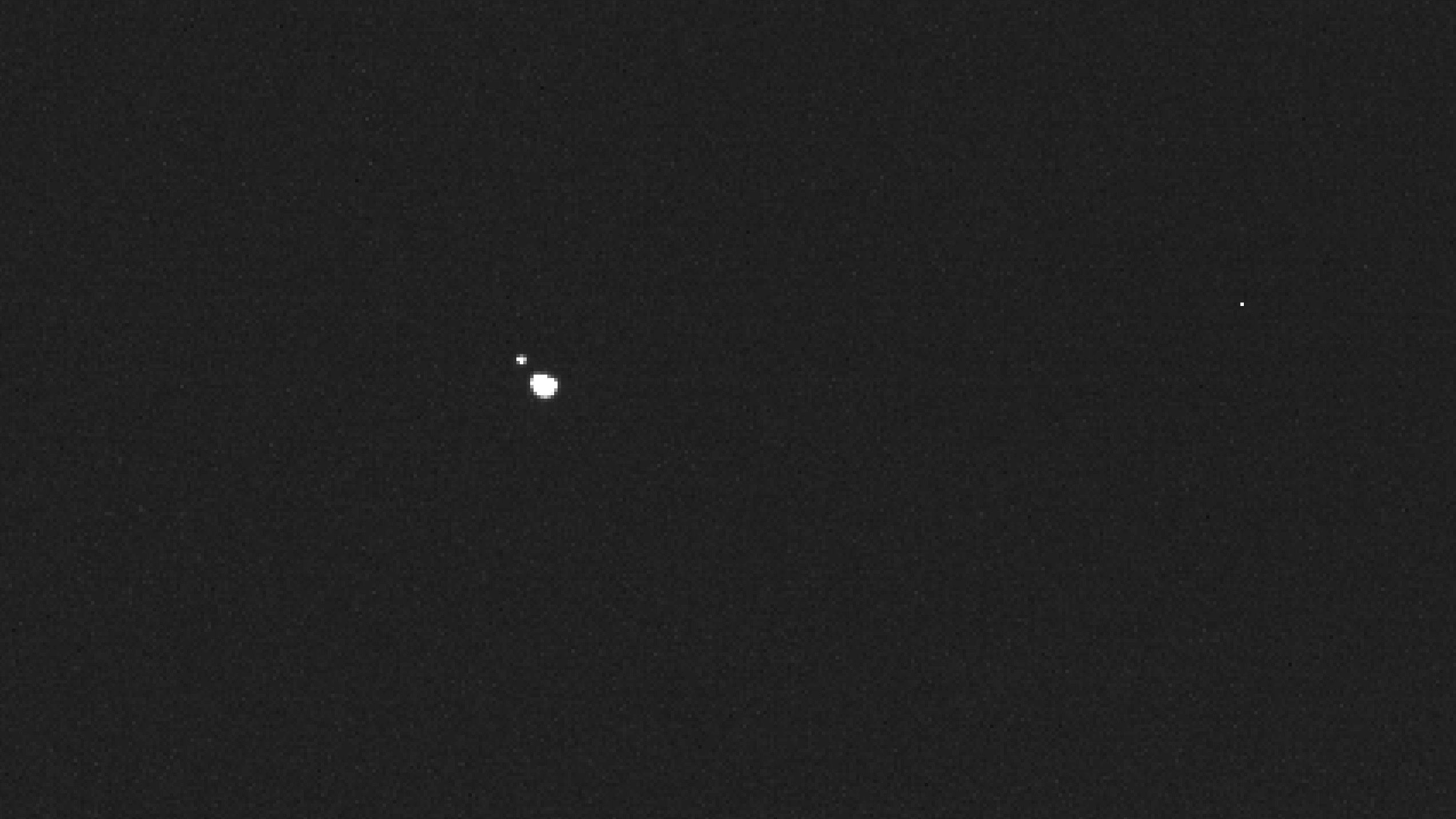
Follow Us Add us as a preferred source on Google Newsletter Subscribe to our newsletter The European planetary defense spacecraft Hera is approaching the binary asteroid system targeted by NASA’s DART deflection test and can now distinguish the two rocky bodies. Hera is nearing the end of its journey to the Didymos asteroid system, having been launched on a SpaceX Falcon 9 rocket in October 2024. The spacecraft imaged Didymos and the smaller Dimorphos on October 1, 2024. 18 from a distance of 1,280 kilometers (795 miles) from the pair, which are currently about 197 million kilometers (122 million miles) from the Earth. “With this image, the smaller Dimorphos asteroid becomes visible for the first time,” Michael Kueppers, Hera project scientist at the European Space Agency (ESA), said in a statement. “Prior to this acquisition, the spacecraft was still resolving the Didymos system as a single point. But now, although Dimorphos is made up of only about one pixel in this initial image, it is clearly well separated from its main body.” The Double Asteroid Redirection Test (DART) crashed into Dimorphos in September 2022, changing the asteroid’s orbit in a pioneering demonstration of planetary defense. Hera’s job is to study the damage and refine our understanding of the impact, as well as the asteroids themselves. Hera performed braking maneuvers in early October to slow its approach and put it on track to rendezvous with the binary system. The spacecraft is designed to make follow-up observations of asteroids using 12 payloads, providing new insights that will prove valuable to planetary defense efforts. The mission also carries a pair of cubesats to take a closer look and eventually land on the 495-foot-wide (151-meter) Dimorphos. You may like A series of images captured by the DART spacecraft as it accelerated to impact the Dimorphos asteroid on September 26, 2022. (Image credit: NASA/JHUAPL) For now, Hera continues to approach and prepare for its arrival, with a big reveal expected to come later this month. “Our views will become much sharper as Hera approaches,” said ESA mission director Ian Carnelli. “On November 25, we will reveal the first detailed images of Dimorphos, the first object in the solar system whose orbit has been measurably shifted by human action.”