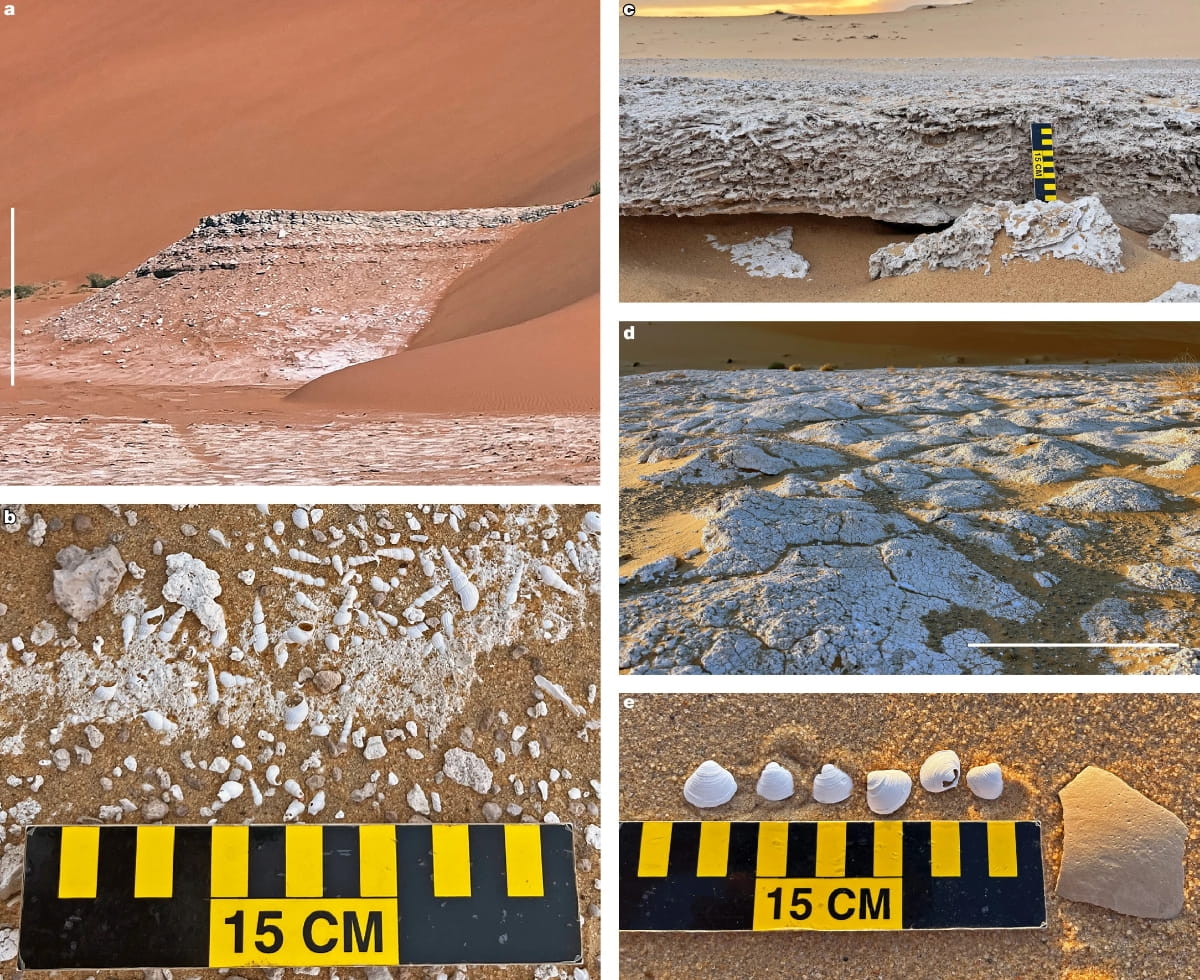
The first humans crossed the world’s largest sand sea with plenty of fresh water around them, but they left nothing behind. A team led by researchers from the University of Vienna and the University of the Algarve now says the missing ingredient was stone. Ancient lake deposits at Rub’ al Khali show that fresh water once covered the desert interior. The photographs include layers of lake sediments partially buried by sand dunes, freshwater snail shells, and a thick carbonate platform filled with shells. The researchers found evidence of a lake at 55 of the 125 study points, but found no stone tools at any of them. Credit: Dellmour et al., Nature (2026), CC BY 4.0 The team drove about 1,500 kilometers across Rub’ al Khali, the vast southern Arabian desert, in late 2023. Eight people in three vehicles spent 35 days checking 125 locations. Approximately 122,000 to 67,000 years ago, monsoon rains filled this basin with lakes. The crew found lake deposits in 55 locations, along with freshwater snail shells and fragments of ostrich eggshells, but no tools. They also did not find any stones suitable for making tools, except for small quantities in 10 places near the edges of the desert. Ground visibility exceeded 95 percent, so any chipped stones would have stood out. Even those 10 raw material locations did not contain artifacts. People lived on the edges of the desert at the same time. The sites of Mundafan, Jebel Faya, Umm al Sha’al and the Dhofar Nejd Plateau date from this period. These groups made tools with local stone. The inner surface of the desert is made up solely of carbonate rock and evaporite, which does not break into sharp edges. The ancient lakes were fed by groundwater, so no river carried useful stones from very far away. About 800 kilometers of basin had none. This map and a cross section show where suitable stone for tool making exists in southern Arabia. Brown areas mark rocks that early humans could break down into tools. The red dots show known Middle Paleolithic and Middle Stone Age sites, clustered where such rock exists. Black circles along the survey route show spots with no tool stone. The blue circles, found only on the western and eastern edges of the desert, mark the 10 places where it was present. The cross section below shows rocks with stones buried under layers of younger sediments throughout the desert interior. Credit: Dellmour et al., Nature (2026), CC BY 4.0 Next, the researchers built a computer model for the entire Arabian Peninsula. It combined the distance to the water with the presence of rock that can chip away. They tested it on 363 known sites from the Middle Paleolithic and Middle Stone Age. The sites were grouped in areas where both resources overlapped. Water alone predicted the location of the site with a score of 0.695 on a standard accuracy scale. Adding stone raised it to 0.768. Of the land near water, 57 percent sits on rock with no stone that can be carved. The authors point to similar patterns elsewhere. On the Messak Plateau in Libya, 91 percent of Middle Stone Age finds are found near a rock outcrop, even though there is water in the nearby lowlands. The eastern desert of Egypt and Tibet show the same link with stone sources. Central Oman presents the opposite case, with abundant flint but little water and very few deposits. Why couldn’t people just transport stone? Previous studies show that most tool material comes from a radius of about 5 kilometers, with sources beyond 20 to 30 kilometers typically supplying only 1 to 2 percent. The closest stone was more than 200 kilometers from the lakes studied. The transported pieces might provide a visit, but not daily tool-making for a group of residents for generations. The same absence is evident in the early Holocene, when the basin was filled with water again and still did not yield cultural material. The authors call the “Green Arabia” of the wet periods a lithic archipelago, with islands defined by both geology and climate. They say dispersal models based solely on water and climate likely exaggerate how much land stone tool users could settle. The team notices its limits. The geological maps are of approximate scale, the shells were identified from photographs and future work could still find small, short-term camps in the interior. Publication: Dellmour, RW, Coco, E., Samawi, O., Al Kindi, M., Al Mahrooqi, A., Bebber, MR,… Rose, JI (2026). Stone and water governed the first human settlements in the desert. Nature. doi:10.1038/s41586-026-11180-5