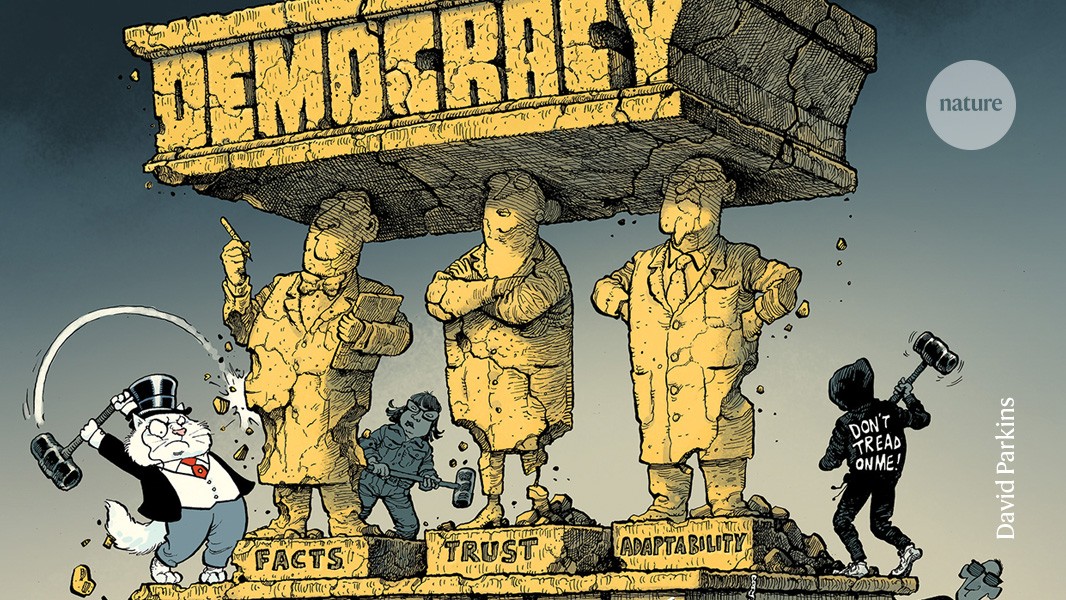
For scientists, ideas about democracy can seem distant from their work. However, around the world, governments are limiting academic freedom and interfering with decisions about what research is funded and who conducts it1. Some scientists also face politically motivated interference and attacks 2. Six principles to support academic freedom in universities As members of the European Commission’s Chief Scientific Advisory Group, we believe that it is urgent to address this concern and that we have a responsibility to make scientists’ voices heard. But, in reality, both things are intertwined3. Science is an essential backbone of democracy. In an increasingly complex and rapidly changing world, people need access to verified information and independent knowledge to make informed decisions4,5. Research helps to generate reliable evidence and encourage critical inquiry, thus allowing a plurality of points of view to be debated and creating conditions in which societies can learn from experience. In May, Ekaterina Zaharieva, European Commissioner for Startups, Research and Innovation, asked us to provide advice on how science can strengthen the democratic functioning and resilience of the European Union. tools to adapt policies and organizations in response to changing circumstances. Shared Factual Baselines Underpin Democratic Decision-Making The first pillar relates to protecting the foundations and integrity of information on which democratic judgments, collective deliberation and, ultimately, action depend. Scientific institutions help societies navigate changing realities by creating procedures to gather evidence about the current situation, past trends, likely outcomes, or management options; evaluate impacts; communicate disagreement; quantify uncertainties; and update conclusions in light of new findings. Artificial intelligence and other digital platforms are changing the way people find information, develop opinions and participate in public life6. This not only provides opportunities to broaden participation and increase transparency, but also produces intensified, increasingly complex or new risks, including those of misinformation, manipulation, bias, polarization and fragmentation6,7. Furthermore, these developments amplify the disproportionate influence of a small number of powerful technology companies and their leaders8, including their ability to “manufacture doubt” and shape public opinion9,10. How to make science part of policymaking again The challenge goes beyond simply correcting people’s misconceptions. Misinformation is often rooted in social media, reinforced by emotions and group identities, and deliberately used for political purposes5,7. It spreads through networks of people connected by identity, grievances or mistrust. These vulnerabilities can be exploited by individuals seeking to advance political or economic interests9, thereby undermining democratic institutions, deepening divisions and fostering instability6. Citizens have legitimate concerns about economic restructuring, regional inequalities, how migration is governed, technological changes, aging populations, climate risks and geopolitical instability. People can lose trust in democratic institutions, especially if they feel they are not being heard, do not understand why something has changed, feel they are being treated unfairly, or see the fabric of their communities being disrupted11. This could create vulnerabilities that can be exploited through disinformation and political manipulation5. For this reason, scientific approaches to democratic resilience must go beyond fact-checking and include the design of effective channels for scientific communication and information sharing, as well as opportunities for meaningful public participation and informed deliberation4,12. These should include transparent data sources on digital platforms; independent media; strong safeguards against foreign interference; secure information infrastructures; independent monitoring and assurance of algorithmic systems; and a better understanding of how the increasing use of AI tools could shape democratic discourse and outcomes13. Science-based governance can strengthen trust in democracy. The second pillar refers to the legitimacy of the experience and the reliability of the institutions. Democratic governance can be considered as a shared social capacity to understand complex realities, deliberate despite differences and act together in the face of social, economic and technological transformations and uncertainty4,6. Their resilience rests on organizations that sustain public trust and active citizenship, and on the ability of people to participate meaningfully in deliberation and collective problem solving4,14. Institutions that are based on scientific evidence and guided by scientific principles are better equipped than others to make effective, transparent and responsible decisions, strengthening public trust in democracy11. During a pandemic or other crisis, or in anticipation of such events, authorities can strengthen trust by clearly explaining how scientific evidence, including limitations and uncertainties, informs their decisions. But for science to strengthen democracy, researchers must also be trusted15,16. Furthermore, the legitimacy of the experience has become increasingly questioned in recent years in Europe and elsewhere5,15. Scientific advice is subject to politicization in many countries, and consensus ideas and clear evidence (such as on climate change) are dismissed as “just another opinion” or as driven by a political agenda5,9. Public trust in expertise has become polarized along political lines5,15. Some officials and politicians might support specific branches of science, for example, by selectively promoting individual researchers or a few disciplines. Such favoritism has implications for funding. Six ways to put the public at the center of science and policy This “divide and conquer” approach to science is often tacitly accepted by the academic community, and many institutions prefer to remain silent rather than risk having their budgets cut. The dilution of scientific knowledge in an increasing flow of online information, often promoted by individuals with vested interests seeking to influence public decisions, may also make impartial scientific evidence and advice less visible. Experience strengthens democratic legitimacy when it is transparent, diverse, independent and open to scrutiny, as prescribed by the rules of science. But it weakens legitimacy when it is perceived as opaque, unclear, politicized, elitist, or disconnected from people’s lived experiences. Ensuring that expert information is democratically legitimate requires institutions and mechanisms that not only structure the interaction between science, policy and society, but also protect the separate and independent roles of organizations, manage conflicts of interest and prevent undue influence. Fundamentally, not all commitments to science carry equal weight. Unbiased access to scientific knowledge is most reliably guaranteed through a diverse, multidisciplinary group of experts. Conversely, the opinion of a single scientist may result in partial understanding (highlighting a particular disciplinary perspective) or reliance on a dissenting voice that differs from the majority opinion. High-level expert groups, which interact directly with high-level decision makers, can identify a broader range of potential concerns. They can better understand the broader implications of policy challenges to provide relevant scientific evidence and advice, while maintaining independence in their analyses, conclusions and recommendations. Have people stopped trusting science? The data tells a surprising story. Public institutions should ensure that scientists providing advice can do so independently and are free to publish their findings. This generally requires stable public funding of research1. Cuts to public science budgets may increase scientists’ dependence on a narrow range of funders, including private and commercial organizations or institutions linked to other countries. Their funding decisions could reflect strategic or political interests and could create real or perceived conflicts of interest if adequate transparency guidelines and safeguards are not in place. The European Commission’s scientific advice framework provides a useful example of how scientific independence can be achieved. It combines topic-specific evidence reviews by multidisciplinary groups of experts with independent policy recommendations from its seven chief scientific advisors. Advisors are supported by a permanent secretariat that helps them align scientific advice with policy needs and safeguards the independence of the advice process. This mechanism also includes rules on transparency and disclosure of conflicts of interest of advisors (see go.nature.com/4jndrg). Scientific expert groups should be able to propose topics, identify questions and communicate evidence, uncertainties and policy options to decision-makers and the public independently. But trust depends on people also having the opportunity to engage with science. Scientific literacy, civic education, public participation in research and access to reliable information are essential elements and must be supported by public and educational institutions. Opportunities for science education are a public good and should be accessible to all.