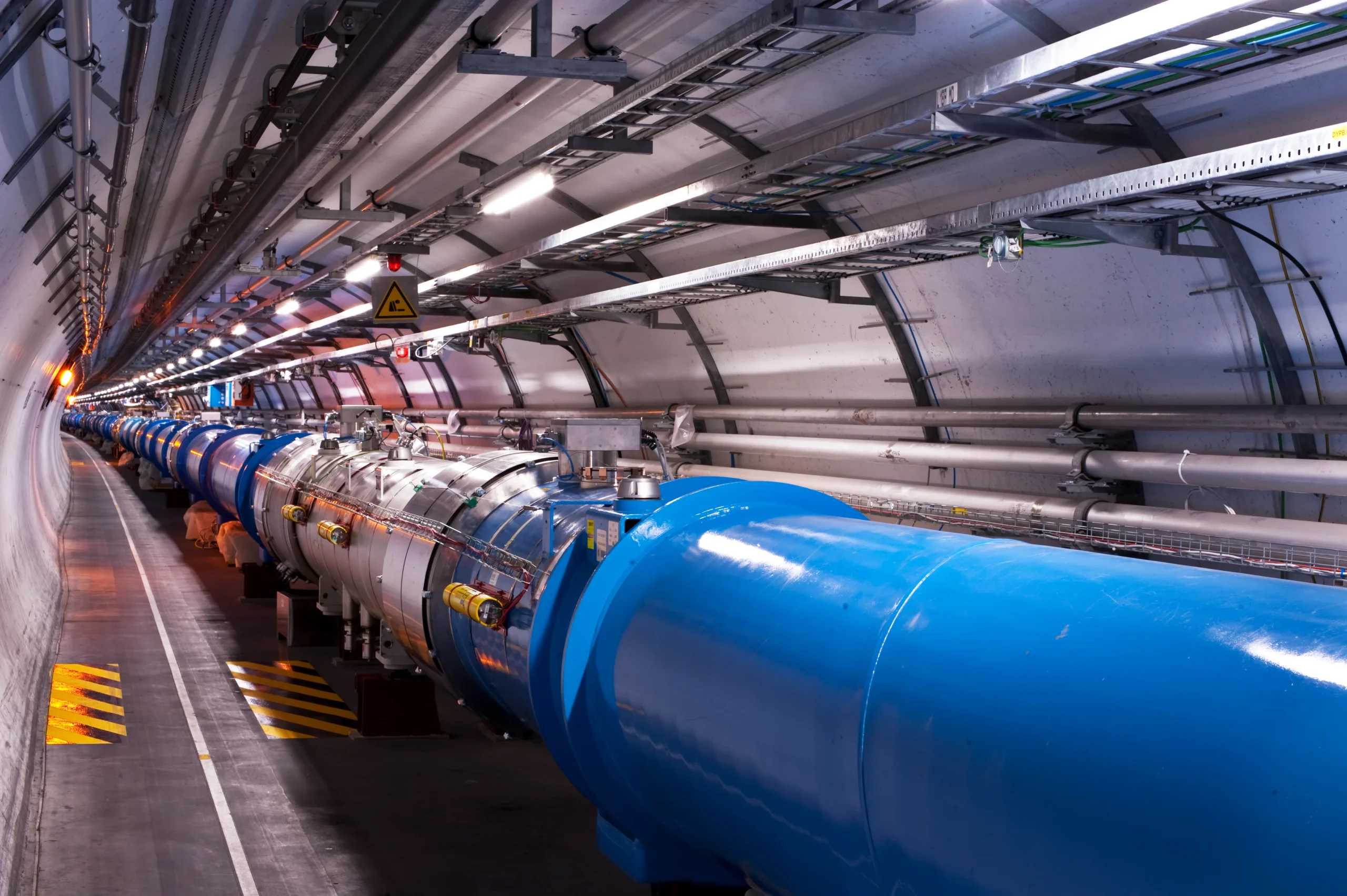
Cambridge physicists have found evidence of an event that occurs only once in 10 billion particles, bringing them closer to understanding dark matter, the Big Bang and a mysterious world much smaller than an atom. British scientists have detected signs of an extraordinarily rare event deep in the building blocks of matter, raising hopes of discovering previously unknown particles that could help explain how the universe began. The breakthrough, led by physicists at the University of Cambridge, is the result of more than 40 years of searching and could help researchers explore a mysterious world of billions. times smaller than an atom. Known as the zeptoverse, this unimaginably small realm is one of the places where scientists hope to find answers to some of the biggest unanswered questions in physics, including what dark matter is made of and why the universe contains so much more matter than antimatter. The research was carried out at the Large Hadron Collider (LHC), a huge underground machine at CERN, near Geneva, which smashes particles at tremendous speeds to investigate what they are made of. Scientists work inside the LHCb experiment at CERN’s Large Hadron Collider near Geneva, where a Cambridge-led research team has detected evidence of an exceptionally rare particle decay after more than 40 years of searching, potentially opening new avenues to investigate the mysterious ‘zeptoverse’ and the fundamental components of the universe. Credit: CERN/University of Cambridge The scientists were studying particles containing what are known as beauty quarks, short-lived blocks of matter produced during collisions. These particles survive only about one and a half billionths of a second before decaying into other particles. The Cambridge-led team has now found evidence of an exceptionally rare event in which one of these particles produces two smaller particles called muons, which are heavier relatives of electrons. Dr Harry Cliff, of Cambridge’s Cavendish Laboratory, who led the analysis, said: “What we find in these latest results is an incredibly rare decay of one of these beauty particles, where it becomes two even smaller particles called muons.” This process only occurs in one in ten billion beauty particles, making it incredibly difficult to find. CERN, which collected enormous amounts of data during 2024 and 2025. With the help of machine learning, scientists were able to examine the results and separate the weak signals they were looking for from countless other particle collisions. The finding could eventually help scientists investigate a world so small that its distances are measured in zeptometers, each equivalent to a trillionth of a billionth of a meter. Scientific theories cannot fully explain it. While the latest results do not establish the existence of any new particles, they give scientists a powerful new way to search for signs of previously undiscovered physics. The evidence has reached a statistical confidence level known as 3.2 sigma, enough to suggest the signal is real, although more data will be needed before physicists can declare a confirmed discovery. A diagram of the LHCb detector at CERN’s Large Hadron Collider, showing the powerful magnets and measurement equipment used to track particles created in high-energy collisions. Scientists at the University of Cambridge have used the experiment to detect evidence of extraordinarily rare particle decay that could help unlock some of the deepest mysteries of the universe. Image: CERN / Wikimedia Commons (CC BY-SA 3.0) exciting,” he added. “We’re knocking on the door of the zeptoverse now. I can’t wait to see what we find as we dig deeper.” The findings, which have yet to undergo peer review, will be presented at CERN today. Scientists hope that further upgrades to the collider’s equipment in the 2030s will allow them to examine these rare events in much greater detail. Professor Tim Gershon, from the University of Warwick, who is leading the LHCb experiment, said: “This fantastic result shows the extraordinary capabilities of the LHCb to probe nature at its fundamentals. level. This project, driven and led by UK physicists, is producing beautiful science.” READ MORE: Scientists and engineers quit jobs as AI changes roles ‘beyond recognition’, study finds. Research involving more than 4,100 technology, engineering and life sciences professionals across five countries reveals growing concern about career prospects, heavier workloads and employers struggling to replace experienced specialists. Do you have news to share or experience to contribute? The European welcomes insights from business leaders and industry specialists Contact our editorial team for more information Main image: Inside the underground tunnel of the Large Hadron Collider at CERN, near Geneva, where scientists collide particles at enormous speeds to investigate the building blocks of the universe A Cambridge-led team has detected evidence of exceptionally rare particle decay that could help physicists explore the mysterious ‘zeptoverse’, a realm billions of times smaller than an atom. Maximilien Brice / CERN / Wikimedia Commons (CC BY-SA 3.0)