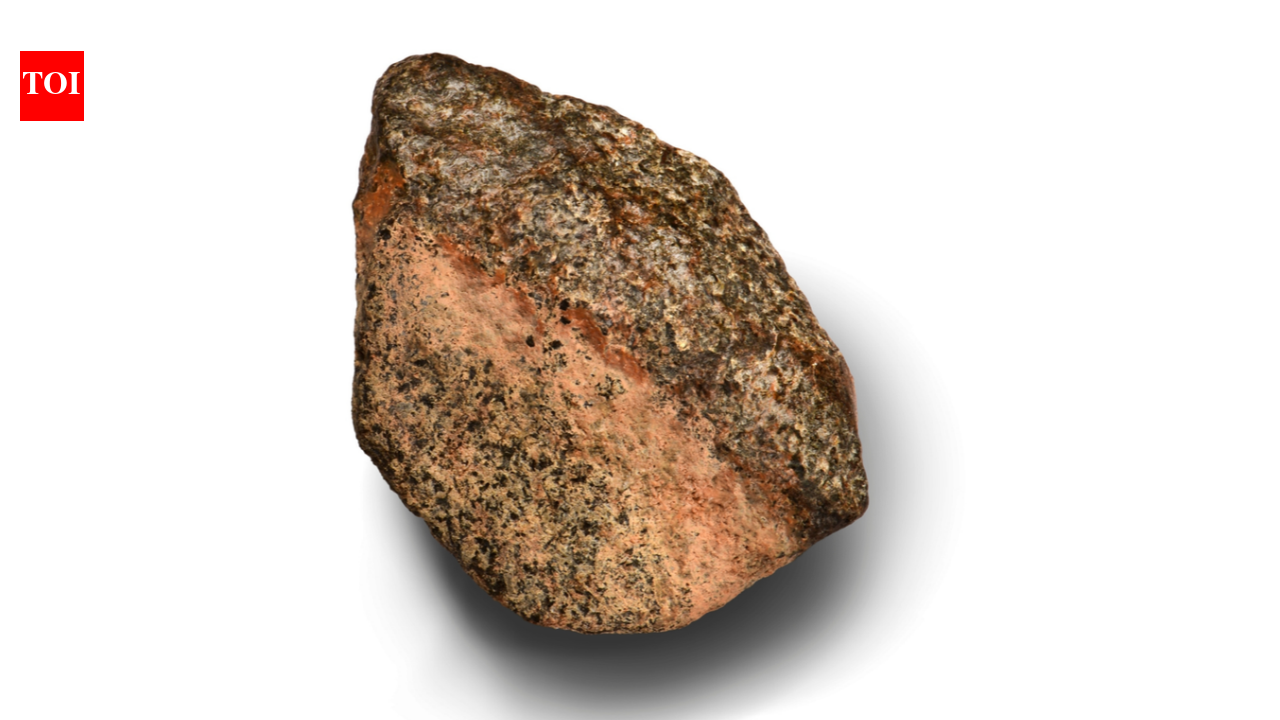
A NASA-funded study reveals a 4.1 billion-year-old history of a pink Martian rock found in the Sahara (Image credit: Darryl Pitt/Maine Mineral & Gem Museum via NASA) A rock that spent more than four billion years preserving clues to the early history of Mars was found in the Sahara Desert, looking like an ordinary pink rock. Discovered in 2022, the 800-gram rock turned out to be one of the oldest Martian meteorites ever identified on Earth. Its mineral composition contains evidence of ancient volcanic activity and interactions between water and rock, offering scientists a unique opportunity to study what Mars was like billions of years before it became the cold, dry planet we know today. In a NASA report published on October 29, 2026, the agency detailed the findings of a NASA-funded study of the meteorite, named Teghaza 001 after the salt plain in Mali where it was discovered. According to the primary source, NASA-funded researchers, including scientists at the Jet Propulsion Laboratory, determined that the rock formed more than 4.1 billion years ago. The findings, published in the journal Science, provide a new look at the formation of the Martian crust and the role water played in shaping the planet’s early surface. How a pink rock from the Sahara turned out to be Martian When Teghaza 001 was discovered, researchers did not immediately know its age or exact origin. Scientists at the University of New Mexico had already identified it as a Martian meteorite by examining its oxygen isotopes. These isotopes act as geochemical fingerprints, helping researchers distinguish rocks from different planetary bodies. However, the meteorite’s unusual texture and mineral composition caught the attention of Yang Liu, a planetary scientist at NASA’s Jet Propulsion Laboratory in Southern California. Although Martian meteorites had been studied before, this specimen contained minerals and structures that made it particularly interesting. The rock is now considered one of approximately 435 Martian meteorites identified on Earth and one of the three oldest known examples. Its importance lies in the variety of minerals it contains, which provide a more complete record of the planet’s early geological history. What its minerals reveal about ancient Mars Researchers discovered that Teghaza 001 contains a mixture of igneous minerals, which form when molten rock cools and solidifies. These minerals offer clues about how the Martian crust developed from magma. The rock also contains zircon crystals, which are particularly valuable to geologists because they preserve information about the conditions and timing of a rock’s formation. By studying these crystals and other mineral grains, scientists were able to establish the age of the meteorite and identify subsequent changes caused by water. To determine the age of the rock, scientists used a technique called in situ rubidium-strontium dating, developed with contributions from researchers at the California Institute of Technology. Unlike older methods, which involve dissolving an entire sample, this technique allows scientists to study individual mineral grains. The team only needed a small piece of meteorite, smaller than a fingernail, leaving most of the rare rock intact for future research. Their findings showed that water had changed the rock about 4.1 billion years ago. This suggests that the meteorite originally formed even earlier. Evidence for water on the Red Planet One of the most significant aspects of the discovery is what it reveals about water on early Mars. Mineral chemistry, oxygen isotopes and textures suggest that water interacted with the planet’s crust during its early geological history. A separate study published in Science Advances in June 2026 examined the water content of the meteorite, providing more information about how water influenced the Martian surface. Lee Saper, a co-author of the research who conducted the work as a postdoctoral researcher at JPL, said the meteorite offered a rare sample of Martian crust from a region not previously represented in the collection of meteorites studied on Earth. He explained that it records interactions between water and rock and may even preserve traces of the Martian atmosphere from a period when the planet was losing water. These findings point toward a more dynamic water cycle on early Mars than scientists were previously able to reconstruct from many available meteorite samples. Scientists still do not know his exact birthplace. Although researchers have confirmed that Teghaza 001 came from Mars, identifying its precise birthplace remains difficult. The team compared its mineral and chemical composition with observations made by NASA’s Mars Reconnaissance Orbiter and identified 13 possible locations on the planet that could match the meteorite. The rock characteristics are particularly similar to materials observed in the cratered southern highlands of Mars. However, scientists cannot yet determine where specifically it occurred. Like other Martian meteorites, Teghaza 001 was thrown into space by a powerful impact on the planet’s surface before eventually traveling through space and reaching Earth. Researchers believe the meteorite could help answer questions about how the Martian crust formed, how water interacted with rocks, and how the planet’s environment changed over billions of years. With more studies planned, scientists hope the unusual pink rock will provide more clues about Mars’ ancient past. Its preserved minerals could also help researchers better understand whether conditions on early Mars were suitable for life and how the planet evolved into the world spacecraft explore today. By examining this rare fragment, scientists can also better understand the geological processes that shaped other rocky planets and the conditions that existed throughout the early solar system.