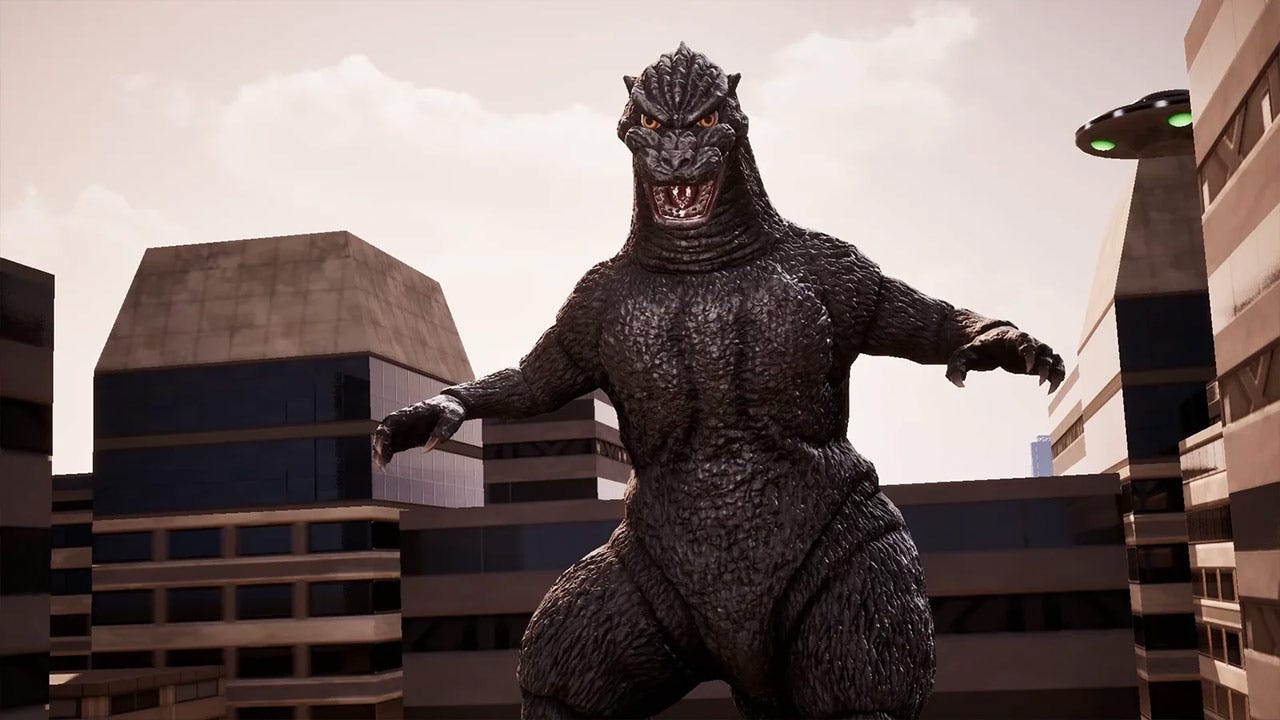
The first time I saw Japan’s most famous kaiju on the big screen was in Godzilla 2000: Millennium. Like any nine-year-old, I was obsessed with Big G. I read Dark Horse comics and made every TV movie I could. Things were different then; Godzilla was a big deal, but theatrical releases of Godzilla films were incredibly rare in the United States. If you watched those movies, they were on TV and were dubbed or edited versions released under different titles like Godzilla: King of the Monsters or Godzilla vs. The Sea Monster. After Godzilla 2000 underperformed, it took another five years for the series to release in US theaters, and into that void came 2002’s Godzilla: Destroy All Monsters Melee. It was the perfect blend of theme (big monsters who loved professional wrestling), genre (3D fighting game), and time period (licensed games were still, like… a thing). It was the kind of game that could dominate a pizza-filled sleepover weekend or become your personality for an entire summer. A friend’s parents bought it for him and that copy became communal: something sacred, carried from one place to another. Perhaps it’s fitting that it returns now in the form of Godzilla: Destroy All Monsters Melee Remastered, 24 years later. The world (and Godzilla) has changed a lot, but original developer Pipeworks is still at the helm. In some ways it feels as relevant now as it did then, just in different ways, and revisiting it was a pleasure even away from the nostalgia. There’s no one-to-one equivalent to what Destroy All Monsters Melee is, but the idea is pretty simple: you choose one of the 12 monsters from Godzilla history (up to Godzilla 2000): Godzilla, Gigan, Megalon, Ghidorah, etc., then you choose an iconic or real-world city. Godzilla location to fight. You’ll fight in classic rubber-suit wrestling style as you dodge environmental hazards, knock down buildings, throw rocks and skyscrapers at each other, and crush pesky military forces that would really rather you make a mess somewhere else. The last kaiju standing wins. Despite the name, this is not a direct remaster. You’re not just looking at upgraded models. It looks fantastic while maintaining the “these are guys in rubber suits kicking each other” vibe that defines the films it’s based on. The audio carries its weight, too: the soundtrack has the booming authority you’d expect from a Godzilla movie, buildings crumble and collapse spectacularly, lightning attacks sound powerful and painful, radio calls from military forces in the area let you know where they’ll focus their fire, and the announcer is having a blast. And the monsters, of course, sound like themselves. And yes, Godzilla does The Noise, just as you remember it, even if it’s your first time here. All of this is held together by a spit-and-duct-tape story that’s there to make you fight: Look, there’s an alien race called the Vortaak. They’re little green men with funky helmets, a fashion sense straight from the ’50s, flying saucers, and more than a little ego. They’re here to take over the Earth, and what better way to do that than to mentally control the frankly absurd amount of kaiju running around, ready to crush a city at a moment’s notice? Unfortunately for them, whichever monster you choose breaks free of their mind control and decides the Earth is worth saving. Driving away the Vortaak means defeating the other monsters. All in a day’s work, really. The soundtrack has the booming authority you’d expect from Godzilla. “That’s Adventure mode, which is one of several single-player options where you can rearrange cities. You also have Destruction for score hunters, where you have to destroy a city in a time limit, an upgraded Adventure mode for monsters that are at a higher level and have better stats (which you get from the experience you gain by playing certain modes), and Survival, which is exactly what it sounds like. Listen, you can count the number of fighting games with good single-player modes on two hands (and several of them have the words “Soul Calibur” in their titles), but what’s on offer here is solid, if not spectacular. You only start with five monsters and a few stages unlocked, but Pipeworks has cleverly reworked this remaster so you can unlock the rest in pretty much any order you want, which you do by playing, following rumors, and unlocking investigations, and you can swap out what you focus on whenever you want. Ghidorah because he’s Ghidorah; as soon as he stops being a silhouette that I can’t select and starts being a gloriously golden three-headed dragon that I can take into battle, part of my lizard brain gets very happy because I can’t wait to fly around and shoot lightning with that bastard. On the other hand, it’s very annoying to see Rodan or Ghidorah or Mecha Godzilla in Adventure mode and make the 12-year-old boy who lives in my head give up his slice of pizza. long enough to say “hell yeah, I want to play that one” and then I realize I can’t, especially in multiplayer. Does it give you more reasons to keep playing? Absolutely, and this was part and parcel of the original experience, but man, sometimes you just want to play with your friends without worrying about unlocks, you know? Melee, and I’m very happy that Pipeworks added online play in addition to the returning local options. It even works very well! Most of the games I played before launch were smooth, although I did suffer from a few disconnections (almost all of them occurred when I was winning or doing well; I’m not saying my boy Lucas is a fraud or anything, but…) It’s here in the multiplayer, Destroy All Monsters Melee really shines. naively, that this is a button masher with no depth. These people are dumb and misguided, and if this were a Godzilla movie, they’d get a dramatic close-up right before a giant monster’s foot turns them into pasta never as challenging as someone else (although, surprisingly, you can’t mix CPU opponents with online friends; let me do a competition stomp, man!) Each kaiju has an energy attack governed by an energy bar that you can. use as a fast projectile or charge a beam. You can also pick up and throw buildings and rocks, or even other kaiju. You can run, jump, fly (if your character has wings), crouch, and block. Did someone shoot you down? If you knock another monster down, it can wake up with an attack, but if you block it or stay out of its range, you can punish it when an opponent is blocking. Each monster also has different stats to take into account. Gigan’s sword arms mean he hits… well, like a kaiju with sword arms, but his projectiles are relatively weak. Anguirus can’t block normally, but his spiked carapace means that anyone who hits him while his back is turned will dance around with a lot of pain, and Godzilla 2000’s extra quickness means he can apply pressure much more easily than his 90s counterpart. Knowing which other city destroyer you’re looking at can be important, and someone who understands the difference between Blunt and Edge attacks or knows when to dodge your threads will kick your colossal ass up and down Tokyo Bay if you’re just grinding away. But smart map play is also important. Once you start destroying a city, there’s less cover to hide behind in future rounds and less stuff to throw at your opponent. power-ups that appear on the map, such as Rage, which buffs your character and provides access to powerful Rage attacks. There are health and energy upgrades, as well as my personal favorite, the Mothra Airstrike, which the announcer proclaims with a delight that makes me think he’s been waiting to see a giant moth dive-bomb another kaiju all his life. If you knock down cliffs on Monster Island, you can throw another monster into the lava. There will be another part of the stage to fight. It’s a good thing. Is it as deep as Street Fighter or Tekken’s Guilty Gear? No. But a lot goes into a game of Destroy All Monsters Melee, and knowing your kaiju helps a lot. There is replay value in completing the gallery and chasing scores in Destruction Mode, but if you vibe with what’s here, it will be because you love it. for a second before crashing to Earth. Admittedly, the deeper stuff isn’t easy to learn because Destroy All Monsters Melee barely teaches you any of it. Aside from the loading screen text and a basic move list, there’s no tutorial whatsoever, so I learned through trial and error, talking to people I played with and finding guides for the original game. scales (or metal). I came out of Destroy All Monsters Melee Remastered with my brain rewired, or perhaps more accurately, it reminded me of what’s important. It’s not about how big the roster is or whether there’s a progression system that will keep you playing forever once the character unlock runs out. It’s not about achievements or daily quests or a battle pass or all that useless Skinner Box nonsense that piles on everything these days. a pure reminder that what makes a game are the moments at 2am when you throw your friend into the lava pit… who happens to have a Fury power-up. It’s the comebacks and the laughs. It’s like stepping back into the shoes of my nine-year-old self, watching a Godzilla movie in theaters before the series was drowning in cultural influence and an interconnected multimedia universe. The joy is in surrendering your expectations and remembering how things can make you feel. You leave. Everything else is noise. And not the cool Godzilla kind.