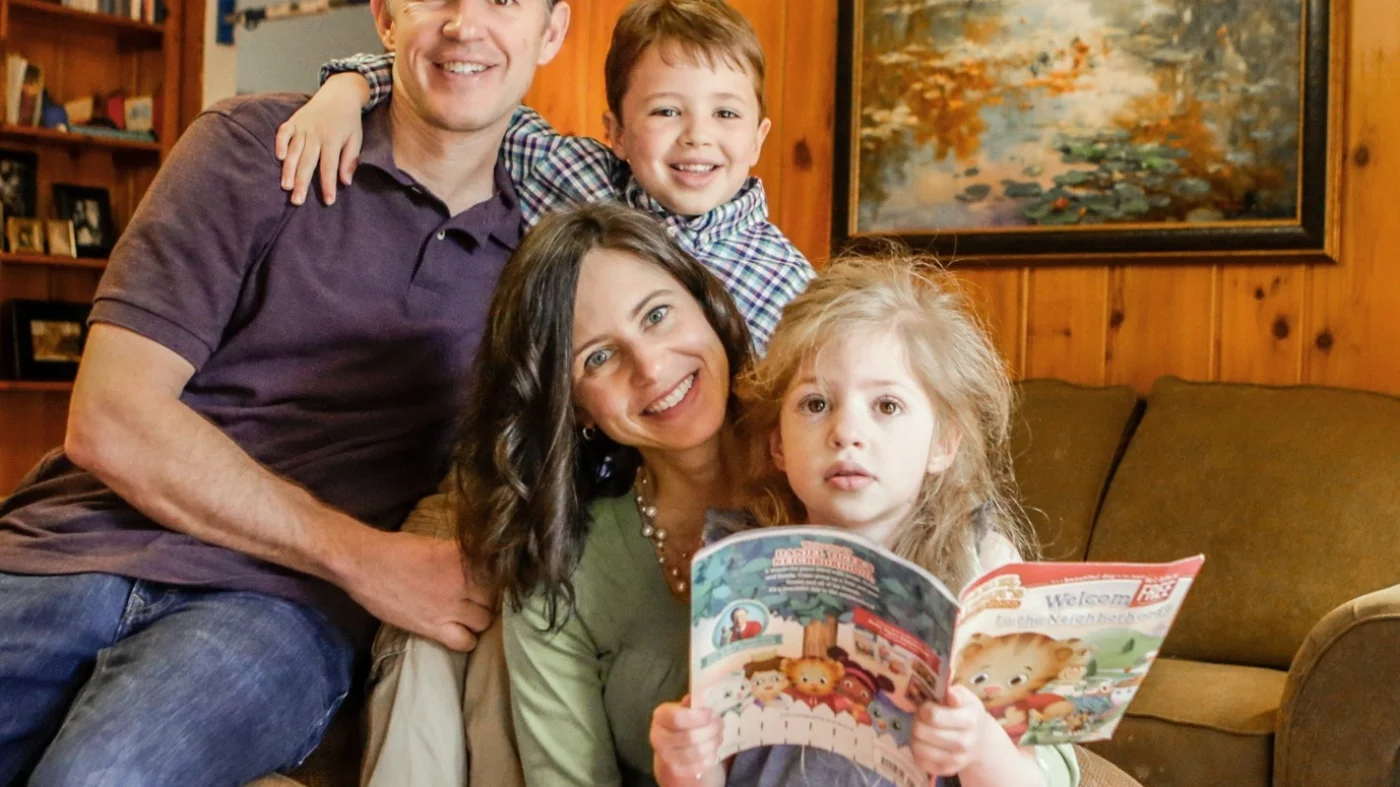
Glenn (from left), Beckham, Cara and Eliza O’Neill pose for a family photo in 2015. Eliza has Sanfilippo syndrome, a rare inherited disease. Robert Clark hide title toggle title i Robert Clark For stories on the science of healthy living, subscribe to NPR’s Health newsletter. When Eliza O’Neill was little, she was one of those girls who always needed to have some accessory, like a hat or scarf. “She would always go get my high heels from the closet and wear them, which scared the hell out of us,” says her mother, Cara O’Neill, a pediatrician in Columbia, South Carolina. But when Eliza turned 3, her parents noticed that she was falling behind in her developmental milestones. He was diagnosed with a pragmatic speech delay, meaning he had learned many words, for example, but was not using them in the usual way in social situations. In 2013, one of Cara’s colleagues suggested testing Eliza for a group of metabolic disorders, just to rule them out. But the test came back positive for something called Sanfilippo syndrome. Cara recalled learning about this rare inherited disease in medical school. “When they said the word, everything came back quickly,” he says. “And it was just this bullet of dread, like, oh my God, this is horrible.” Children with Sanfilippo have a defective gene that prevents them from breaking down heparin sulfate, a molecule essential for normal cell function. As it builds up in the body, it causes serious complications. Children with Sanfilippo lose the ability to talk and walk. They have seizures and typically don’t make it past their teens, according to the Cure Sanfilippo Foundation, which the O’Neills started and continue to run. It took Eliza’s father, Glenn O’Neill, a little time to understand the diagnosis after learning Eliza’s test results. “It actually wasn’t until I got home that I realized how quickly the degeneration occurred,” he says. “And that was really the point where we said, ‘God. Whatever we have to do, we have to do it now.'” Investigating a treatment At Nationwide Children’s Hospital in Columbus, Ohio, researcher Haiyan Fu had been working on a gene therapy in mice for Sanfilippo since the late 1990s. The therapy used a modified virus to deliver a functional copy of the broken gene to patients’ cells. Eliza O’Neill receives a kiss from her father, Glenn, before becoming the first person to receive an experimental gene therapy for her rare disease in 2016. The O’Neill Family hide caption toggle caption i O’Neill Family Fu realized the experimental therapy held promise. “And if we treat it early, it could potentially be a cure,” he says. “So I can’t give up.” However, keeping it running (and funded) was a challenge. He thought he would have to quit in 2009, but the families of the Sanfilippo children prevented him from doing so. “They said, ‘You can’t leave. Can we give you some of the funds to, you know, continue?'” Fu recalls, explaining that these families had helped her from the beginning and didn’t want her work to stop. In total, eight patient foundations, including Ben’s Dream and Cure for Kirby, sustained Fu’s work until the research was ready for the first human trial. Raising the money But a clinical trial would be expensive. Glenn O’Neill had an idea about how to raise the money. “We reached out on a whim to some strangers we found on the Internet to make a viral video,” he says, referring to filmmaker Benjamin Von Wong, who made a video for them over a few days in 2014. It worked. In the spring of 2014, the Saving Eliza video helped the O’Neills break the GoFundMe record at the time, raising $1 million in just a few weeks. It soon reached $2 million. The money raised helped fund the first human trial, which began in May 2016. The experiments were promising enough for the biotech industry to take notice. Ultimately, a biotech company called Ultragenyx acquired the rights to the gene therapy in 2022 and continued studying it. A few years later, the company submitted data to the Food and Drug Administration for review. The FDA approved the gene therapy in September. The unique infusion is called Fayuvi. “The treatment will work better the younger the child because more of the brain is left,” says Emil Kakkis, CEO of Ultragenyx. “By the time they’re 2, 3, 4 years old, diagnosed and discovered, they’ve lost a lot of ground. And we’ve treated some kids who were 6 months old and they’ve done very well. And our view is that when you treat them very young, you actually get better results from gene therapy.” Ultragenyx priced the treatment at nearly $4 million, making it the second most expensive gene therapy in history, according to 46brooklyn, a drug pricing research firm. Kakkis says Ultragenyx is committed to ensuring that all patients receive treatment, regardless of price. “There should be no location, site, logistical status or any other type of rule that prevents us from treating the patient. We understand what [we’ve] It had to be done.” Moments after the FDA approval was announced, Fu received a call from Cara O’Neill and messages from other families who funded her research. Some had lost a child along the way. Fu says Fayuvi’s approval is good news, but it gives her mixed emotions: “It shouldn’t take that long.” As for Eliza, she is now almost 17 years old. She was the first patient to receive the gene therapy as part of a clinical trial in 2016. Because When she received treatment with gene therapy, he was 6 years old and he couldn’t talk anymore. He never came back, but he can communicate with picture cards and devices. And this summer he swam and learned to float on a float, you know?” says Glenn O’Neill. “I’m proud of her. It’s been a difficult road for her, but we also know she’s very lucky.”