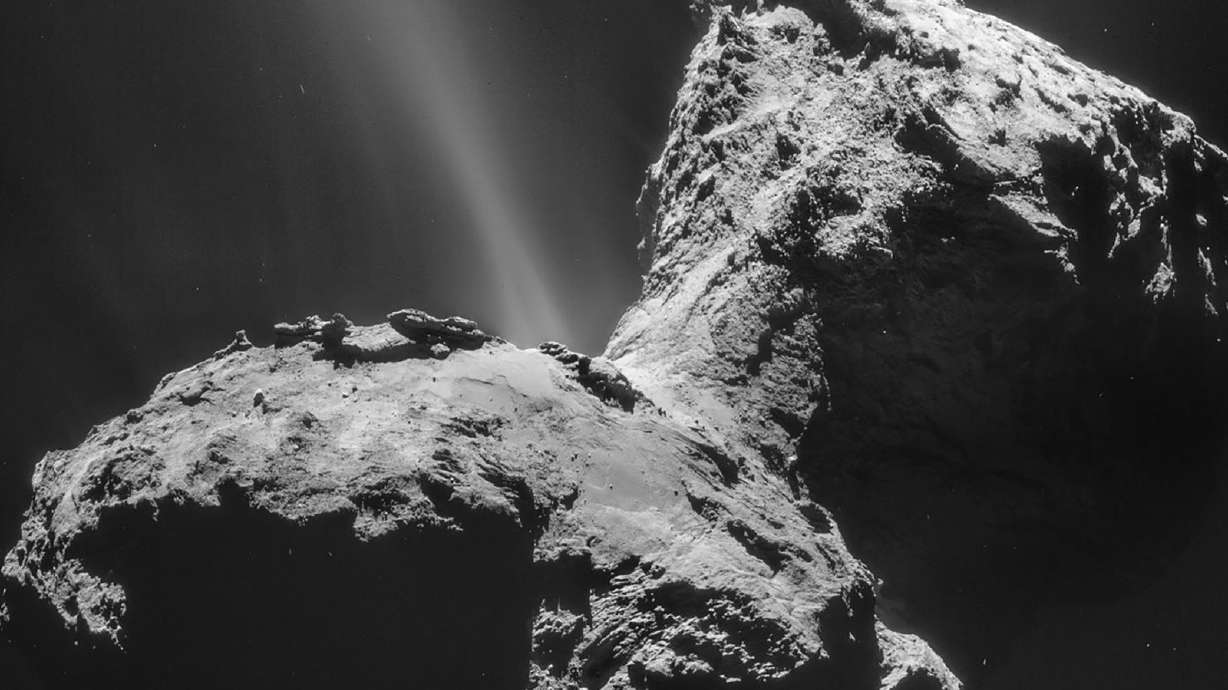
ATLANTA — The popular theory that comets were crucial to the start of life on Earth billions of years ago may not hold up, according to new computer simulations that contradict decades of scientific thinking. The finding suggests that fragile organic molecules supposedly carried by the icy objects would have been destroyed on impact, upending an established theory of the origin of life that dates back to at least 1961. The broader idea that the ingredients for life arrived from space, known as panspermia, is even older and was scientifically postulated in 1908. Life on Earth requires complex organic molecules, but it is unclear whether our early planet had enough of the raw materials needed for chemistry. prebiotic: the chemical reactions that produce the building blocks of life. Comets are made of dust and ice, but are also known to contain organic material. This composition, which has earned celestial bodies the nickname “dirty snowballs,” led scientists to suggest that comets could have deposited water and organic molecules on the Earth’s surface. Early in its history, more than 4 billion years ago, Earth may have experienced a period of intense bombardment by more than 100,000 comets longer than 100 meters (328 feet), according to the new study, published Wednesday in the journal Scientific Reports. However, those impacts were mostly too strong for the molecules that started life to withstand them. The team used the latest models of comet formation and evolution to simulate this early planetary period 100,000 times. “Given what we know about early Earth’s surface environments, on average, our simulations found that there were no successful impacts,” said the study’s lead author, Richard Anslow, who conducted the research while completing his PhD at the Institute of Astronomy at the University of Cambridge in the United Kingdom. The comets contained large concentrations of key molecules necessary for life, but the simulation found that the objects were moving too fast to successfully deposit them. “The typical velocities of these comets when they hit Earth meant that in reality very few, if any, would have been able to release intact organic molecules, so comets don’t actually appear to be as useful for prebiotic chemistry as previously thought,” Anslow said. More precisely, 54% of the simulations showed no impact, while the remaining 46% had at least one and a “small minority” returned up to three collisions, Anslow said. “We can’t rule out with certainty that there was never a successful impact; there could have been one of these chance impacts.” However, such flukes had to occur in a “perfect location” that already met several important conditions, including the presence of liquid water and other chemicals necessary to support life. That combination makes the overall process unlikely, he added. Alternative Explanations The study focuses on a naturally occurring chemical called hydrogen cyanide or HCN, an important precursor in prebiotic chemistry that has been detected in dozens of comets, including the notable comets Halley and Hale-Bopp. Composed of hydrogen, carbon and nitrogen, HCN can lead to the formation of amino acids (molecules that make up proteins) when combined with water; Other studies have previously identified HCN as a potential key ingredient for the origin of life on Earth. “When comets collide with Earth, they are impacted by high temperatures and pressures, and recent studies have found that many of these precursor molecules can be destroyed by this high pressure and temperature, as well as by subsequent impacts,” Anslow said. The study’s authors argue that even if a successful impact had occurred, it is unlikely that it would have released the chemical in a useful concentration, and in the case of an ocean impact, it would have dissolved quickly. To lay the groundwork for prebiotic chemistry to occur, many other precursor molecules are also needed, such as phosphorus- and sulfur-containing compounds, but these are not commonly found in comets, Anslow said. “Comets are really good at releasing hydrogen cyanide, but since where a comet hits Earth is random, we won’t be guaranteed to have everything we need for this chemistry right there.” If comets did not provide the building blocks of life on Earth, Anslow said there are other promising avenues to explore. Another long-held rival theory is the possibility that Earth’s primordial soup could have synthesized the molecules necessary for life on its own. An alternative cosmic source of organic material could have been asteroids, which typically collide with Earth more slowly and in greater numbers. Anslow pointed to recent findings in samples from the asteroids Bennu and Ryugu, which contain the most protein-forming amino acids. The recent study also raises another intriguing possibility: While Earth may not have had ideal conditions to foster HCN from comet impacts, ancient Mars might have been more suitable. “Because Mars is much smaller than Earth and farther from the Sun, the typical impact speed of comets is much slower, so while these impacts on Earth destroyed most of the HCN, this was not the case for Mars,” Anslow said. This idea could add another dimension to the age-old question of whether the Red Planet ever hosted life. “It’s just another perspective we need to keep in the back of our minds as we try to understand the early evolution of Mars in more detail.” Anslow said. The comet theory might still hold. While the authors looked closely at how HCN could have survived the comet impact, the chemical may have undergone reactions before the icy bodies entered Earth’s atmosphere, said Queenie Chan, an associate professor of Earth sciences at Royal Holloway University of London, who was not involved in the study. This process could have created biologically important compounds, such as the building blocks of proteins, that are less volatile and more likely to survive. “Therefore, the inefficiency of delivering HCN intact does not completely rule out a potential role for comets in supplying other important organic compounds that may have contributed to Earth’s prebiotic organic inventory before the emergence of life,” Chan wrote in an email. Nicolle Zellner, a physics professor at Albion College in Michigan, said in an email that she was not surprised by the findings. While she is also reluctant to eliminate comets as possible contributors to the emergence of life, she acknowledged that “the authors have definitely set some good parameters around probability.” Key findings in this article were generated with the help of large language models and reviewed by our editorial team. The article itself is written solely by humans.