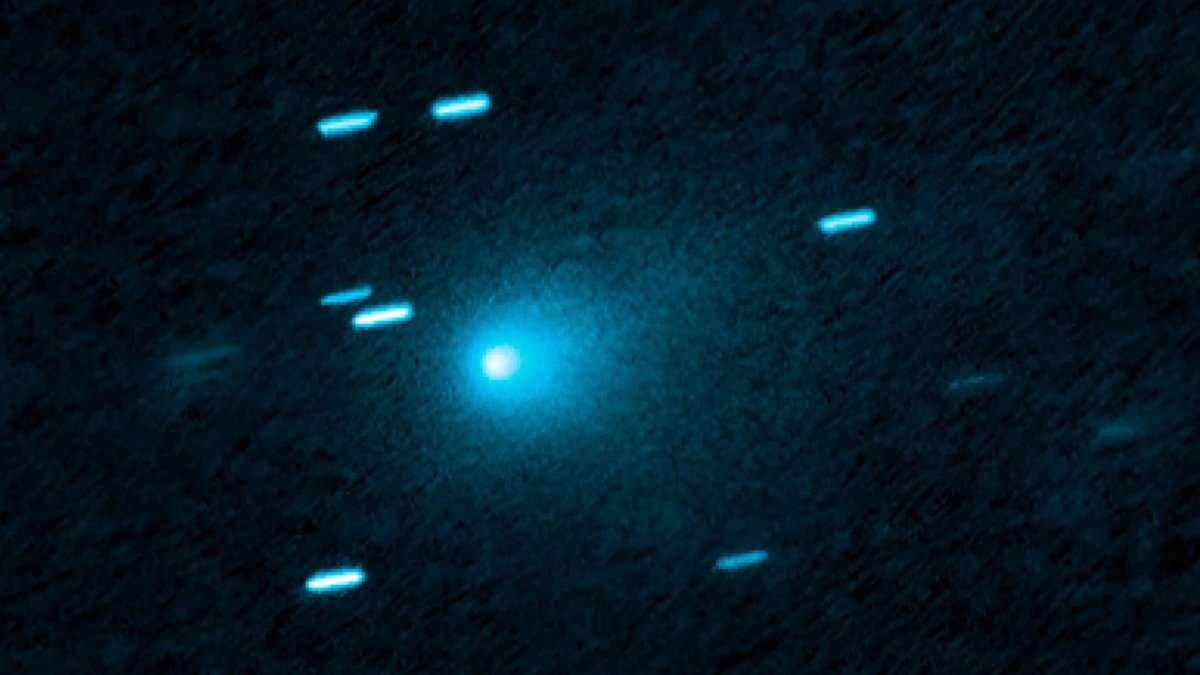
Exiled interstellar visitors like comet 3I/ATLAS are time capsules of the cosmos at large, torn from their exosolar homes by an unknown cataclysm and forced to travel through lonely space for billions of years, perhaps. If they’re lucky, they may cross paths with another star, like the Sun, and warm up in our solar home for a short time before quickly returning to darkness. This is also fortunate for us, as we have an unprecedented view of a piece of an extraterrestrial Solar System, which may have formed long before ours with a chemistry unlike anything seen before. In fact, the exosolar system that formed 3I/ATLAS may have been assembled more than 7 billion years before our Sun came to life, possibly even before 3I/ATLAS’s own star erupted. In a new study published in the journal Nature Astronomy, a research team led by scientists from NASA’s Solar System Exploration Division analyzed the chemical cocktail emanating from the excited atmosphere of the interstellar comet. They used the unrivaled infrared capabilities of the James Webb Space Telescope to observe the comet in late December 2025, when it was about 2.5 times farther from the Sun than we are, passing through the asteroid belt between Mars and Jupiter. A cosmic emissary crosses our cosmic path, as discovered on July 1, 2025. The inherent chaos seen here may suggest the sophistication needed to find similar bodies. (ATLAS/University of Hawaii/NASA) At this distance, its atmosphere, or coma, begins to swell substantially as solar radiation sublimes its icy volatile chemicals. Think of it as the comet that sneezes when it sees the Sun, in an astrophysical version of the possibly false photic sneeze reflex that causes people to sneeze in response to bright lights. The researchers focused on its deuterium to hydrogen (D/H) ratio, which is very revealing because it shows how much deuterium (a heavier version of hydrogen) an object has in proportion to regular, lighter hydrogen. In this case, they tested this ratio on another molecule, methane, to see how much heavy methane 3I/ATLAS retained since its frozen dust grains formed. They found that it contained significantly more than any body in the Solar System, and 13 times more than comet 67P/Churyumov-Gerasimenko, the only other local comet to show a “safe” signature, requiring in situ measurements by the Rosetta spacecraft. D/H ratios in the Solar System and exosolar sources. (Roth et al., Nat. Astron., 2026) “The high D/H ratio of methane in 3I/ATLAS is consistent with the hypothesis that its ices formed in a cold, low-metallicity interstellar or protostellar environment under a high rate of cosmic ray irradiation,” the researchers explain. One possible origin is within the pancake-shaped disk of dust and gas that forms planets around a very young or forming star. These astroenvironments are difficult to study because they are very opaque and hide the cold chemical actions occurring within them, so researchers can often rely on astrochemical models. And that’s why 3I/ATLAS is so precious: it’s a pristine specimen ejected from the hidden depths of an ancient cosmic nursery, possibly around one of the oldest stars in the Milky Way, and delivered directly to our doorstep by the whims of gravity. Seeing its molecular emission, similar to losing your lunch due to cosmic motion sickness as you hurtle towards the Sun, allowed astronomers to solve several pertinent puzzles. Its isotopic ratios suggest that it may have been exposed to a lot of radiation. And perhaps it is born in a prestellar core: a dense region of supercold gas (since its interior is protected from starlight) and the early stages of star formation, so frigid that it acts as a cryopreservative. At temperatures of around -263 degrees Celsius (-440 degrees Fahrenheit), the gases freeze into dust grains, favoring deuterium, since it is heavier than hydrogen, and producing distinctive D/H ratios in molecules such as methane. Furthermore, the low carbon-13 content of 3I/ATLAS suggests its incredible age, originating in an ancient Universe that had not yet been enriched by generations of stars that fused heavier elements and released them into space during their explosive supernova deaths. So overall, this work highlights the mind-blowing scope of cosmic timelines. This comet from who knows where could have traveled for 7 billion years before our Solar System existed. It may have formed before many of the atoms that make up our Sun and planets were forged in the hearts of massive stars, which died (and left remains, of course) to seed our existence. The research has been published in Nature Astronomy. This article was fact-checked by Fiona MacDonald and edited by Fiona MacDonald. While we take pride in our process, we are human. If you spot an error, please let us know.