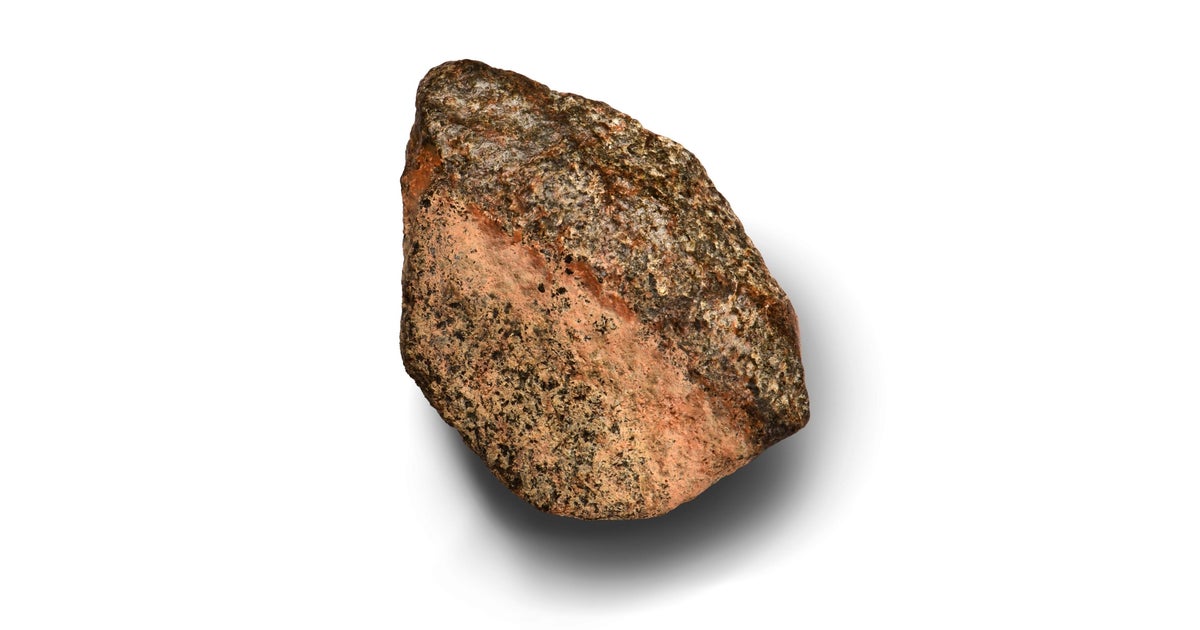
A pink meteorite found in the Sahara Desert in 2022 has been identified as a 4.1 billion-year-old piece of the Red Planet, a NASA study determined. The nearly two-pound meteorite was found in Mali. It was named Teghaza 001, after the salt plain where it was discovered, NASA said in a news release. Studying the meteorite allowed NASA scientists to determine that it was one of approximately 435 on Mars. It can be verified that meteorites were part of Mars by comparing their chemical and mineral composition with samples and data collected by NASA’s Martian missions. Dating the meteorite led researchers to conclude that it was about 4.1 billion years old, making it one of the three oldest Martian meteorites found on Earth, NASA said. This provides “a rare snapshot” of the planet’s crust and formation, the agency said. A NASA image of Teghaza 001. Darryl Pitt/Maine Mineral & Gem Museum “It was only after we started looking closely that we realized this meteorite is truly unique,” said Yang Liu, lead author of a paper detailing the age-dating process and related discoveries. Liu is with NASA’s Jet Propulsion Laboratory in Southern California. “One of the reviewers of the paper called it the Rosetta Stone for Mars.” Previous ancient Martian meteorites provided closer glimpses into the planet’s history. But Teghaza 001 shows how Mars’ crust formed from cooled magma and was then changed by water on the planet’s surface. The meteorite is made from a unique mix of volcanic minerals, including zircon crystals, NASA said, matching samples observed by the agency’s Mars Reconnaissance Orbiter in the planet’s southern highlands. Francis Tissot, a professor of geochemistry at Caltech, helped researchers use a pioneering dating method that studied a piece of meteorite smaller than a fingernail. The precise method allowed scientists to analyze individual grains of minerals. A piece of Martian meteorite Teghaza 001. The piece was used to study its mineralogy and chemistry. NASA/JPL-Caltech That analysis showed that the rock had been altered by Martian water about 4.1 billion years ago. The rock itself may have formed even earlier, NASA said. The data also showed that early Mars may have had a more dynamic water cycle than scientists previously believed. The paper’s author, Lee Saper, said the meteorite “records interactions between water and rock and perhaps even an imprint of the Martian atmosphere as it lost water.” Another study of the meteorite, published in June, focused on the water content of the rock and considered how water might have shaped the early topography of Mars. “This is really our first piece of Martian crust from a part of Mars that we’ve never had a sample of before,” added Lee, a scientist at NASA Ames Research Center. Liu said more research on the meteorite is likely. “We’ve only scratched the surface,” Liu said. Go deeper with The Free Press on: