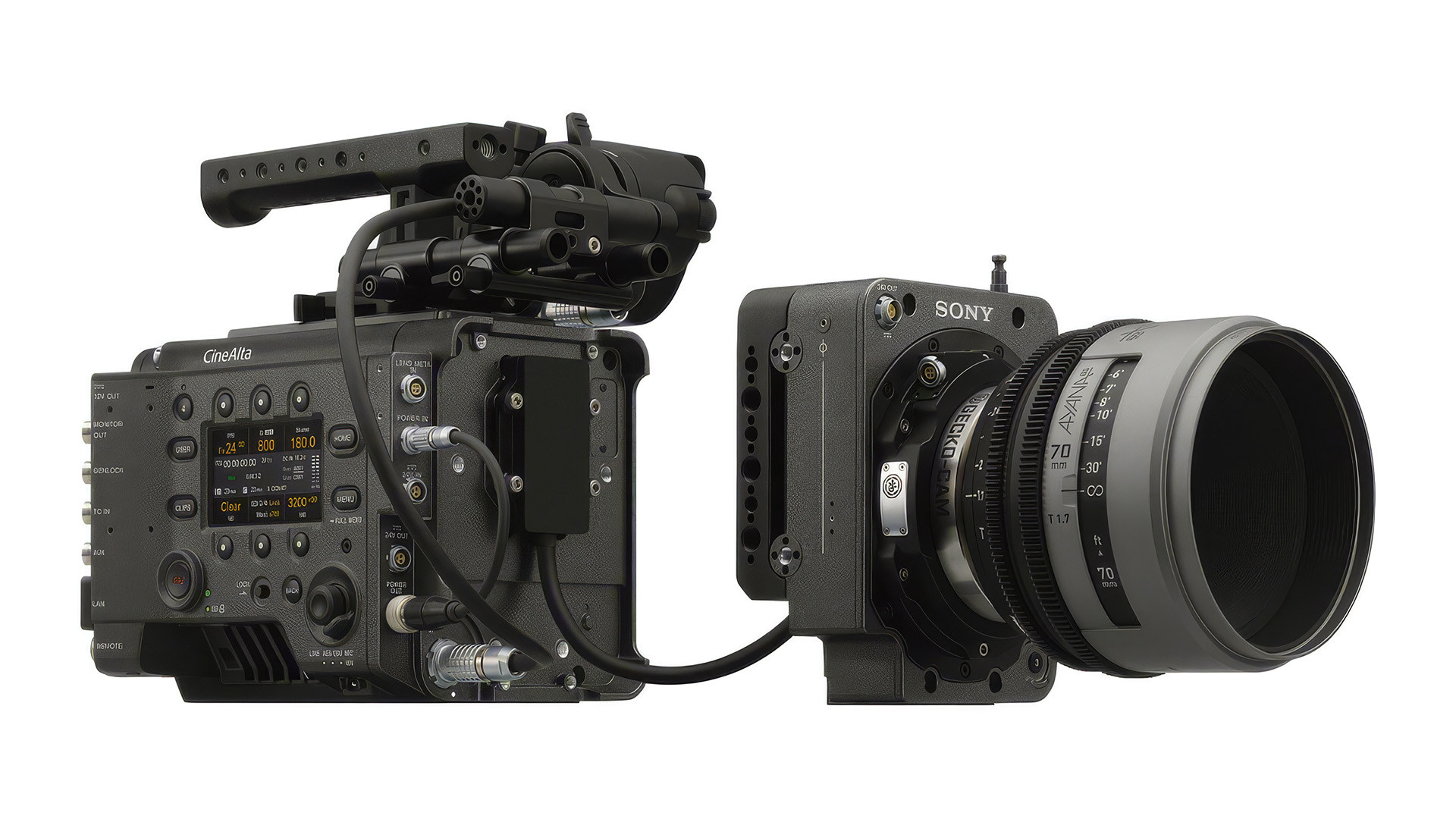
Sony’s RIALTO 65 is now official, placing a 65mm format sensor in a compact head that connects to an existing VENICE 2 body, via cable or directly. It reads 9.6K Open Gate, records 16-bit X-OCN internally, and arrives in the first half of 2027. Today I’m at Sony’s event at Pinewood Studios, where Sony is showing us the system. When Sony announced the RIALTO 65 as a development project in June, we covered it with a long list of open questions about resolution, recording, and lens mounts. Today Sony responds to most of them. The RIALTO 65 (model CBK-6510XS) uses a 53.75 x 35.83 mm sensor with an aspect ratio of 1.5:1, approximately 2.2 times the full frame area. According to Sony, it is among the largest sensors of any cinema camera available on the market. The head weighs around 1.5kg/3.3lb and offers dual base ISO 2500 and 10000, with over 15 stops of latitude at ISO 2500. This article is based on Sony press material. I’ll be checking out the system at Pinewood today and we’ll be posting a video interview of the event in the next few days. So for my own impressions, stay tuned. Sony RIALTO 65 connected to a VENICE 2. Image credit: Sony A taller 65mm sensor For me, the most interesting part is not the size but the shape. ARRI’s ALEXA 65 and new ALEXA 265 have had the 65mm digital market almost to themselves for years. Its sensor has a similar width, but a much wider aspect ratio, close to 2.1:1. Sony goes further, up to 1.5:1, which gives the ratios of a still photography frame. That extra height is useful for anamorphic capture, for framing different deliverables, and for reframing in post. At launch, there are two readout modes: 9.6K 1.5:1 Open Gate, which uses the full sensor, and 9.6K 2.20:1, with a diagonal of approximately 59mm, which accommodates more lenses. Sony says more reading modes will come with future VENICE 2 software updates. In my opinion, the 2.20:1 mode is the one many productions will use first. Many of the large format lenses announced this year, such as the ZEISS Panoptes 65 prime and Angénieux EZ 65 zooms, cover an image circle of approximately 60mm. That fits 2.20:1 mode, but full Open Gate needs glass made for true 65mm coverage. Sony RIALTO 65 connected to a VENICE 2 in “Extension Mode” with the cable and in “Studio Mode”. Image credit: Sony Why the cable is important The name RIALTO tells you how it works. As with the Rialto Extension System 2 and the VENICE 2 Extension System Mini, the head can be separated from the body. In extension mode, one cable connects the two. It disconnects at both ends and Sony includes a 4.5m/14.8ft cable, with a 12m/39.4ft cable as an option. In Studio mode, the head attaches directly to the body as a single camera. This is where I think Sony has a strong argument. Until now, the 65mm digital camera meant a big camera. A 1.5kg head with a cable can be placed on a gimbal, inside a car or on a portable rig, while the body, media and power remain elsewhere. The head also records tilt and sway as metadata for the pole. The 12m cable option for the RIALTO 65 system. Image credit: SonySame channel as VENICE 2. The VENICE 2 body does the recording. So the RIALTO 65 writes to the same AXS cards, to the same 16-bit X-OCN, with S-Log3 and S-Gamut3 and the CineAlta color science that VENICE users know. For rental houses with VENICE 2 packages, this is the real selling point: the media, accessories and subsequent workflows remain the same. My feeling is that this is Sony’s main strategy here. You don’t need to sell a new camera body, just a new front for existing bodies. That’s my assumption, of course. What we don’t know yet is how the sensor works. Our VENICE 2 lab test provides a benchmark for the 8.6K full-frame version. A rolling shutter on a 9.6K sensor of this size is the first thing I want to see in our lab (Sony, if you’re reading this, we’ll be ready when you are). All parts of the RIALTO 65 kit. Image credit: SonyLens, anamorphic and NDThe RIALTO 65 does not have its own lens mount. Sony designed it for third-party lens mount adapters, so each production selects the mount for its lenses, including 65mm optics. With a lens and adapter that communicate with the camera, it records focal length, focus position and aperture as metadata for editing, VFX and virtual production. This is a change from the Extension System Mini, which ships with an E-mount and an ARRI PL adapter. It gives more freedom, but it also adds one more cost and one more decision for the camera crew. Sony hasn’t named any adapter manufacturers yet, and I’m hoping to get more information from Pinewood (but we can see a Gecko Cam adapter in some of the press photos they provided). ND filters for the RIALTO 65. Image credit: Sony For anamorphic work, there’s a compression-free display in multiple aspect ratios and a Zoom to Fit function to check framing. The head also supports 11 insertable ND filters with electronic contacts, so VENICE 2 reads the density of each filter automatically. A replacement CBK-NDK6510 ND filter kit will be available, but Sony says individual filters cannot be purchased separately. Sony’s various RIALTO options: the VENICE Extension System Mini, the original RIALTO and the new RIALTO 65. Image credit: Sony Price and availability The RIALTO 65 (CBK-6510XS), the CBK-NDK6510 ND filter kit and the CBK-12C6510 12m cables will arrive in the first half of 2027. Sony has not announced prices, and B&H and CVP do not yet include the system. For context, the full-frame Mini VENICE 2 extension system launched for $25,000 at B&H. Sony has not said what the price of the RIALTO 65 will be in relation to it. For more information, visit the Sony website. Sony now has a 65mm option that connects to the VENICE 2 system and works with a cable, and I’m curious to see it in person today. Would a 1.5:1 sensor change the way you frame or would you primarily use the 2.20:1 mode? Let me know what you think in the comments below!